Identification of an Unidentified Flying Object Northwest of Latakia, Syria — P-8A Mission Report, November 2016
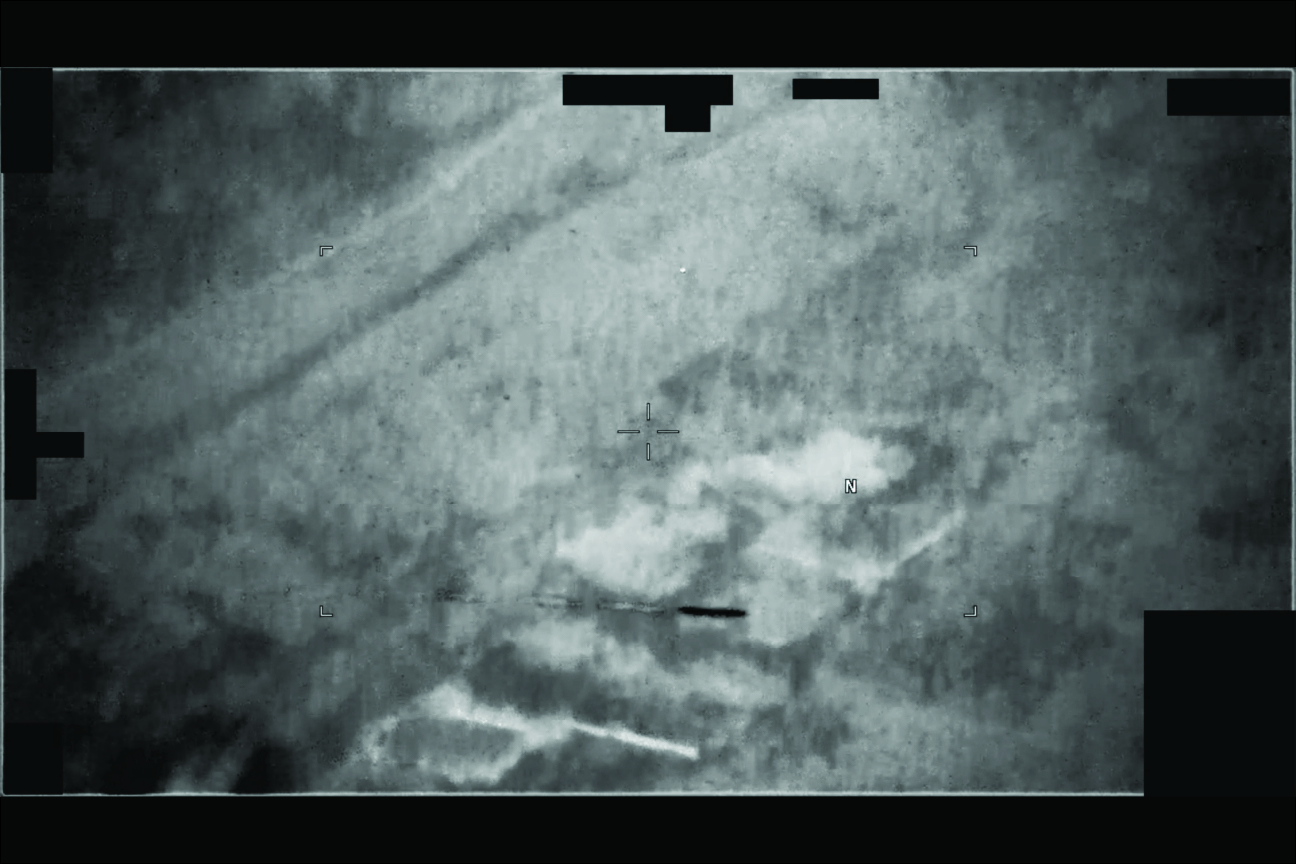
Source file: dow-uap-d55-mission-report-syria-november-2016.pdf Originating agency: Department of Defense / DoD Modern UAP — USCENTCOM Date range: November 18, 2016 Page count: 1 (read in full) High-significance pages: page 1 (the entire document)
Official Blurb (from war.gov)
This document is a mission briefing summarizing an observation of Unidentified Anomalous Phenomena (UAP) by a U.S. military platform near Latakia, Syria. A U.S. military pilot flying a P-8A aircraft reported observing an object via the aircraft's EO/IR sensor, which they characterized as appearing to be in "sea skim mode," traveling at approximately 500 knots (575 mph) on a southeasterly heading. The P-8A lost visual contact with the object after two minutes. All descriptive and estimative language contained in this report reflects the reporter's subjective interpretation at the time of the event. Such characterizations should not be interpreted as a conclusive indication of the presence or absence of any intrinsic object features or performance characteristics.
Summary
On November 18, 2016, a U.S. Navy P-8A Poseidon maritime patrol aircraft assigned to Task Group 67.1 (CTG 67.1) was conducting routine surveillance of Russian naval activity in the eastern Mediterranean when the crew detected an unidentified low-flying object of unknown origin. The object was observed traveling southeast at approximately 500 knots from the vicinity of the Russian Carrier Task Group (KCTG). This document — originally classified SECRET and released to AARO on March 27, 2026 — constitutes the first documented P-8 report of such activity in the eastern Mediterranean.
Research Article
Introduction
During the Syrian conflict, the eastern Mediterranean served as a theater of extensive Russian and American military activity. On November 18, 2016, at the height of a Russian operational push in Syria, a U.S. Navy P-8A Poseidon — on a routine mission monitoring Russian vessels and equipment — encountered something that did not fit the profile of any recognized military activity. The document, originally classified SECRET//REL TO USA, NATO and later released at AARO's request, presents a concise but substantive account of a UAP encounter in an active military operational context.
Operational Background: Monitoring the KCTG
Task Group 67.1 (CTG 67.1) was conducting routine surveillance of the Russian Carrier Task Group (KCTG) operating in the area. This monitoring was part of a standard intelligence-collection effort to track Russian vessels and weapons systems supporting the military campaign across Syria. The P-8A Poseidon, a dedicated maritime patrol aircraft, is capable of deploying EO/IR (electro-optical and infrared) sensors for stand-off surveillance.
Incident Description
Phase one — 13:10 Zulu: The P-8A, positioned at 16,121 feet altitude and approximately 26 nautical miles south of the detection point, identified a possible missile-like object in launch phase. The object was detected through the aircraft's EO/IR sensor. It appeared to originate from an unknown source and was operating in "sea skim mode" — flying extremely low above the water's surface, a technique associated with anti-ship missiles designed to fly under radar coverage — at approximately 500 knots on a southeasterly heading out from the KCTG area.
Phase two — 13:12 Zulu: Approximately two minutes after initial detection, the P-8A lost visual contact with the object at approximately 40 nautical miles northwest of Latakia. Before disappearing, the object was observed passing between the Russian auxiliary vessel INGUL ARS and another unidentified vessel.
UAP Characteristics
The notable characteristics of the object as documented in the report are:
Speed: Approximately 500 knots (~926 km/h). This speed is consistent with certain cruise missiles, but the unknown origin raises questions.
Altitude: Extremely low-level flight ("sea skim mode") — a technique typical of anti-ship missiles designed to evade radar by flying below coverage thresholds.
Visibility: Clear visual conditions with no limiting factors, as described by the P-8A crew. The optimal conditions ensured that the detection was not the result of a visual error.
Duration: Approximately 2 minutes of visual tracking, sufficient for the crew to collect observational data.
Heading: Southeasterly, departing from the direction of the Russian KCTG.
Origin: Unknown. While the initial working hypothesis was that the object may have been fired from one of the Russian vessels, this was not confirmed.
Command Assessment
The P-8 mission commander characterized the interaction as "safe." CTG 67.1's assessment concluded that it was "standard activity consistent with the assessed activity of the KCTG." Despite this, the reporting officers emphasized that this was "the first observed occurrence of possible missile activity by P-8 aircraft in the Eastern Mediterranean."
The decision to classify the incident as UAP — while also noting proximity to KCTG activity without definitively identifying the source — indicates that in real time there was no complete certainty about the object's origin or nature.
Significance
Security dimension: The incident occurred during a period in which Russia was conducting cruise missile strikes from naval vessels and submarines against targets across Syria. The P-8A was monitoring the KCTG while intense military activity was ongoing in the theater. Detecting an object traveling at 500 knots at very low altitude, from an unknown source, prompted immediate concern.
UAP dimension: Given AARO's decision to release this document as part of the UAP corpus, it is worth asking why activity assessed as "standard" was classified and later released within this framework. It is likely the "unknown origin" characteristic that drove the UAP classification — even if the most plausible interpretation remains a Russian launch.
Historical documentation: The document's historical value lies in being a first of its kind: a P-8 reporting an unidentified object flying in sea-skim mode in the eastern Mediterranean during the Syrian war.
Key People
- MG Richard A. Harrison — USCENTCOM Chief of Staff; authorized the document's declassification on March 20, 2026.
- P-8 mission commander — not identified by name; characterized the interaction as safe.
Locations
- Latakia, Syria — central geographic reference point; the initial detection occurred 55 nautical miles northwest of the city.
- Eastern Mediterranean — the overall area of operations.
- KCTG — location of the Russian task group from which the object apparently originated.
Incidents
| Incident | Date | Location | Pages |
|---|---|---|---|
| Unidentified flying object detected by P-8A | November 18, 2016, 13:10Z | 55 nm NW of Latakia, 26 nm south of detection point | 1 |
| Visual contact lost with object | November 18, 2016, 13:12Z | 40 nm NW of Latakia, between INGUL ARS and unidentified vessel | 1 |
Notable Quotes
"P-8A observed an unidentified low-flying object 55 nm northwest of Latakia from an unknown origin, traveling at approx 500KTS on a southeasterly heading outbound from KCTG, for ~2 minutes."
"The mission commander for P-8 characterized the interaction as safe. While this was the first observed occurrence of possible missile activity by P-8 aircraft in the Eastern Mediterranean it is assessed to be standard activity consistent with the assessed activity of the KCTG."
Images
1 image - click any image to enlarge
Related Articles
- DoW/DoD · 2023
Mission Report DOW-UAP-D20: Unidentified Object Observation Over Syria, March 2023
On March 31, 2023 a two-ship of U.S. Air Force F-16CM aircraft launched from Prince Sultan Air Base to fly a Defensive Counter Air mission…
- DoW/DoD · 2023-11-09
Mission Report DOW-UAP-D74: "Bouncy Ball" UAP over Syria, November 2023
Mission Report MISREP 9381202 from USCENTCOM documents a UAP observation over Syria on November 9, 2023, at 2153Z. A U.S. Air Force ISR aircraft operating…
- DoW/DoD · 2022
ISR Mission Report: UAP Observation Over the Eastern Mediterranean, May 2022
A classified Mission Report (MISREP) filed by the 50 ATKS squadron under the 432 AEW, describing a roughly 20-hour, 30-minute ISR sortie over the eastern…
- DoW/DoD · 2022
Mission Report: Unidentified Aerial Phenomenon Over Syria, July 2022
A classified Mission Report (SECRET/NOFORN) describing an armed reconnaissance sortie by the U.S. Air Force over Syria in July 2022, under Operation INHERENT RESOLVE. During…