Mission Report DOW-UAP-D74: "Bouncy Ball" UAP over Syria, November 2023
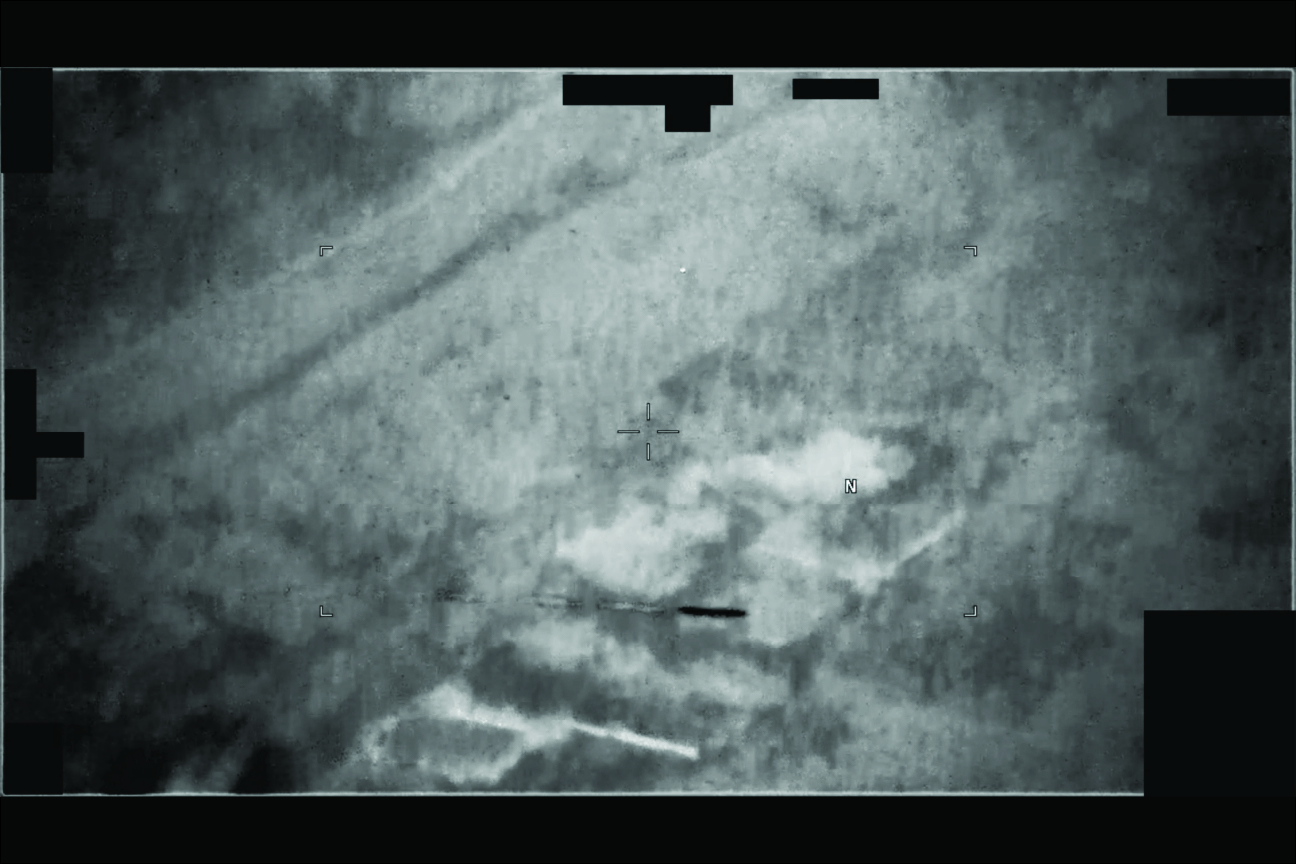
Source file: dow-uap-d74-mission-report-syria-november-2023.pdf Originating agency: Department of War / Department of Defense (USCENTCOM) Incident date: November 9, 2023, 2153Z Page count: 10 (all read) MISREP number: 9381202 UAP event serial number: 092153ZNOV2023-CENTCOM High-significance pages: pages 9–10 (UAP section and GENTEXT/UAP)
Official Blurb (from war.gov)
This document is a Mission Report (MISREP), a standardized reporting form the U.S. Military uses to record the circumstances surrounding its operations. U.S. military services often use MISREPs to report Unidentified Anomalous Phenomena (UAP) to AARO. A U.S. military operator reported observing one UAP "shaped as a bouncy ball." The observer described the UAP as traveling "~424kn (483 mph) consistently for at least 7mins." The reporter described the UAP approaching from the south. The operator assessed the object as "benign."
Summary
On November 9, 2023, at 2153Z (00:53 local time in Syria), a U.S. Air Force ISR aircraft operating under Operation Inherent Resolve in Syrian airspace observed a single UAP "shaped as a bouncy ball." The object approached from the south at nearly the same altitude as the aircraft, descended, passed safely alongside it, and then continued at a consistent speed of approximately 424 knots (~785 km/h, or 483 mph) for at least seven minutes until it moved out of observation range. No emissions were detected from the object. The aircrew assessed the UAP as "benign" — not a threat to the aircraft or to public safety — and with no effects on crew members. The report was filed under Operation Inherent Resolve, U.S. Air Force, USCENTCOM, and originally classified SECRET//NOFORN, with a declassification date of November 9, 2048 — a full 25 years after the event.
Research Article
Introduction
DOW-UAP-D74 belongs to the PURSUE Initiative Release 1 series, published by the Department of War on May 8, 2026. The series spans D1 through D75, providing operational records of UAP observations by U.S. military forces in recent years. D74 is MISREP 9381202 of USCENTCOM, processed under MDR 25-0072 and recommended for release by Brigadier General Brandon R. Tegtmeier, USCENTCOM Chief of Staff, on June 2, 2025.
The document records a single incident at 2153Z on November 9, 2023. The original classification, SECRET//NOFORN (no distribution to foreign nationals), carried an unusually distant declassification horizon — November 9, 2048, a full quarter century after the event — suggesting that someone in USCENTCOM's classification chain initially assessed the information as having sustained long-term intelligence value beyond its immediate operational context.
The reporting aircraft was operating under Operation Inherent Resolve — the U.S. military's central campaign against ISIS (Islamic State) in Iraq and Syria, active since 2014. U.S. forces maintain a limited footprint in Syria, primarily at the al-Tanf Garrison in the country's southeast, near the Iraq-Jordan border junction, and in the northeast in partnership with the Syrian Democratic Forces (SDF). The aircraft was an ISR platform equipped with FMV sensors and SIGINT capability, executing a dynamic target development and surveillance mission against a Violent Extremist Organization (VEO).
Observation Description
The bulk of the report covers a routine collection mission: the aircraft launched at 0217Z and conducted three separate collection sorties at different locations during the day, including an 11-hour-28-minute surveillance of a specific white SUV and a specific individual at a specific building. Then, at 2153Z during the aircraft's return to base (RTB), the central observation occurred.
The GENTEXT of the UAP section (page 10) describes the event with the concise, factual language typical of MISREP reporting:
"WHILE RTB AT 2153Z, [DESIGNATION REDACTED] OBSERVED 1X PROB HC UAP SHAPED AS A BOUNCY BALL COME FROM THE SOUTH AT NEAR CO-ALT. [DESIGNATION REDACTED] OBSERVED THE PROB UAP DROP ALTITUDE AND SAFELY PASS THEIR AIRCRAFT WHILE CONSISTANTLY MAINTAINING ~424KN. AFTER 7MIN OF WATCHING, THE PROB UAP BECAME OUT OF RANGE AND [DESIGNATION REDACTED] CARRIED ON THEIR RTB. NO EMISSIONS CAME FROM THE PROB UAP, UAP WAS NOT CONSIDERED A THREAT TO THE AIRCRAFT OR PUBLIC SAFETY, AND THE UAP HAD NO EFFECTS ON THE AIRCREW."
The structured UAP fields in the report provide additional data: a kinetic altitude of 170 (likely FL170, or 17,000 feet, though the framing is not explicit), airspeed of 424 knots, a southeast track for the friendly aircraft, the UAP classified as physically "solid," no evidence of intelligent control, no RF response, no response to observation or interrogation, and no materials recovered. The UAP's propulsion type was listed as UNK (unknown), but the "Advanced Capabilities And/Or Materials" field is marked YES, with the explanatory note: "TRAVELED ~424KN CONSISTANTLY FOR AT LEAST 7MINS IN THE SHAPE OF A BOUNCY BALL."
Interpreting the Shape: "Bouncy Ball"
The descriptor "shaped as a bouncy ball" is unusual within the USCENTCOM UAP reporting corpus. Most reports employ standard descriptors — spherical, round, cigar, Tic Tac, orb. "Bouncy ball" is not a technical military term; its use suggests the observer had a specific and vivid visual impression that did not translate into standard operational vocabulary.
What distinguishes a "bouncy ball" from simply "a ball"? In everyday terms, a bouncy ball is a small rubber toy — brightly colored, glossy, with a smooth surface that returns light conspicuously. The difference from a plain "spherical" descriptor could reflect several things:
- Scale and apparent size: The descriptor implies the object appeared relatively small, perhaps due to distance or actual physical dimensions.
- Reflective surface: The object may have displayed a shiny or glossy visual signature, characteristic of a rubber-like or polished plastic surface, rather than a matte metallic appearance.
- Motion impression: The word "bouncy" might hint at irregular movement — though the report explicitly states the object moved at consistent speed with no anomalous maneuvers recorded. The descriptor may refer to visual appearance alone, not dynamics.
- Non-threatening impression: The operator may have chosen the analogy to convey that the object appeared almost toy-like — non-martial in appearance — rather than resembling a weapon or military technology.
Crucially, the UAP Maneuverability Observations field is marked NONE, and UAP Anomalous Characteristics/Behaviors is N/A. The object moved in a linear, predictable path. Shape alone is the anomalous element.
Speed Analysis: 424 Knots
A speed of 424 nautical miles per hour equates to 785 km/h or 483 mph. In absolute terms this is not anomalous — it falls within the cruise range of military combat aircraft, intelligence-collection platforms, military transports, and subsonic cruise missiles. However, the speed acquires different significance in combination with the following factors:
Exceptional consistency: The report stresses the word "consistantly" (original spelling, a field misspelling of "consistently"). The object held 424 knots throughout the entire seven-minute observation window, including during its altitude descent. Maintaining a precise airspeed through an altitude change requires accurate throttle or propulsion control — a characteristic of a sophisticated guidance and propulsion system, not of an inertial object or simple drone.
No visible emissions: The report emphasizes "NO EMISSIONS CAME FROM THE PROB UAP." Jet aircraft emit a prominent thermal signature from their engines; piston aircraft leave exhaust trails. Electric drones produce little thermal signature but typically have a maximum speed well below 424 knots. An object traveling at that speed with no detectable emissions is an aerodynamic and propulsive anomaly.
Behavior near the aircraft: The object approached from the south at nearly the same altitude as the observing platform, then descended to "safely pass" — an avoidance maneuver of sorts. This behavior could suggest situational awareness, or at least an automated collision-avoidance system. The report nonetheless explicitly marks "UAP Under Intelligent Control: NO" — the observer did not assess the object as under purposeful external guidance.
Altitude of 170: If the figure refers to FL170 (17,000 feet, ~5,180 meters), the altitude is mid-range, consistent with ISR cruise altitudes. If it refers to 170 feet above ground, the interpretation differs markedly. The report does not frame the value, but the ISR cruise context favors FL170.
The "Benign" Assessment and Its Meaning
The operator's "benign" designation is part of the standard UAP reporting vocabulary — Benign, Suspicious, Hostile, or Unknown. "Benign" indicates that the operator did not feel threatened, that the object performed no attack or interference actions, and that no immediate hostile intent was suspected. It does not indicate the object is uninteresting or explicable — only that it posed no immediate operational threat.
The contrast between "benign" and the "advanced capabilities" acknowledgment is analytically important. The report simultaneously marks YES in the "UAP Advanced Capabilities And/Or Materials" field (citing 424 knots sustained in a bouncy-ball shape for seven minutes) while marking the object as non-threatening. The crew recognized something technologically unconventional while feeling no immediate danger.
The "benign" label may also reflect the operational state of the crew. An aircrew returning to base after a long mission day is unlikely to enter an escalation posture unless there is a clear threat indicator. An object that does not act aggressively, emits no energy, and bypasses the aircraft in what appears to be a courteous arc will naturally receive a calm assessment.
Geo-Operational Context: Syria and Operation Inherent Resolve, November 2023
November 2023 was a tense month in the CENTCOM area. The preceding month (October 2023) had opened a new phase of combat in Gaza following Hamas's October 7 attacks. The United States immediately heightened its regional readiness, deploying two carrier strike groups (USS Gerald R. Ford, USS Dwight D. Eisenhower) to the eastern Mediterranean and intensifying force protection for its positions in Syria and Iraq. Between October and November 2023, Iran-linked militia factions — including Kataib Hezbollah and Harakat Hezbollah al-Nujaba — carried out dozens of drone and rocket attacks against U.S. bases in Syria and Iraq, including al-Tanf.
Against this backdrop, U.S. ISR aircraft were operating in Syrian airspace at an intensive tempo. The reporting aircraft was likely an RC-135, an MQ-9 Reaper, or a similar platform (the 1.4a/1.4g classification conceals its exact identity). Its track — below FL170 and returning to base at night (2153Z corresponds to 00:53 local) — is consistent with a UAS or manned mid-altitude profile.
The MGRS coordinates in the report are marked as 37D ST 69 [censored] 07 [censored] for the initial observation and 37S ET 34 [censored] 09 [censored] for the aircraft's position. Grid zones 37S and 37D in MGRS cover the Middle East, and Syria falls primarily within those zones. The geographic coordinate cited in the document header — 34.8021°N, 38.9968°E — places the incident in central Syria, in the arid country north of Palmyra and the Syrian desert, an area where the coalition operated against ISIS from 2017 onward.
Conclusions
D74 is a significant report for several reasons. First, the "bouncy ball" descriptor is unique. To the best of available knowledge it is one of the very few military reports to use such non-technical, everyday language for a shape description — language that reveals the strength of the operator's visual impression and his inability to map it to standard operational vocabulary. Second, the incident's dynamics — approach from the south, coordinated altitude descent, safe passage alongside the aircraft, and consistent-speed departure — are unusual. An object with no assessed "intelligent control" that nonetheless executes a precise avoidance maneuver while holding exact airspeed is a phenomenon that warrants further technical analysis. Third, the geopolitical context of November 2023 — at the height of U.S.-Iranian tension in Iraq and Syria — raises the question of whether the object was an Iranian or Russian advanced military asset exploiting the operational chaos, or something else entirely external to that context.
Finally, the original SECRET//NOFORN classification with a 2048 declassification horizon is an outlier among UAP records and suggests that someone in USCENTCOM's classification chain judged the information to have sustained long-term intelligence value well beyond any immediate operational window.
Key People
| Role | Name | Note |
|---|---|---|
| Chief of Staff, USCENTCOM | Brigadier General Brandon R. Tegtmeier | Signed release recommendation June 2, 2025 |
| POC, QC, Approver | Withheld under exemptions 3.5c, (b)(3)130b, (b)(6) | All Air Force personnel; POC and Approver from 609 CAOC |
Locations
- Syria — country of observation; approximate coordinate 34.8021°N, 38.9968°E (central Syria)
- al-Tanf Garrison — U.S. base in southeastern Syria, near the Iraq-Jordan border junction
- USCENTCOM AOR — United States Central Command area of responsibility
- 609 CAOC (Combined Air Operations Center) — U.S. joint air operations center at Al Udeid, Qatar; responsible for budgeting and authorizing this report
Incidents
| Incident | Date | Location | Pages |
|---|---|---|---|
| Takeoff of U.S. ISR aircraft | November 9, 2023, 0217Z | Redacted base, Syria/CENTCOM AOR | p. 5 |
| First FMV/SIGINT collection (target development) | November 9, 2023, 0431Z–0554Z (1h 23min) | 37S FU 81 [redacted] 06 [redacted] | p. 6 |
| Second collection (SUV and POI surveillance, 6 stops) | November 9, 2023, 0805Z–1933Z (11h 28min) | 38S MB 48 [redacted] 86 [redacted] | pp. 7–8 |
| Single UAP observation — "bouncy ball" shape | November 9, 2023, 2153Z | 37D ST 69 [redacted] 07 [redacted] (initial); 37S FT 28 [redacted] 3 [redacted] (final) | pp. 9–10 |
| Landing | November 9, 2023, 2319Z | Undisclosed base | pp. 1, 5 |
Notable Quotes
"WHILE RTB AT 2153Z, [DESIGNATION REDACTED] OBSERVED 1X PROB HC UAP SHAPED AS A BOUNCY BALL COME FROM THE SOUTH AT NEAR CO-ALT." — page 10
"[DESIGNATION REDACTED] OBSERVED THE PROB UAP DROP ALTITUDE AND SAFELY PASS THEIR AIRCRAFT WHILE CONSISTANTLY MAINTAINING ~424KN." — page 10
"AFTER 7MIN OF WATCHING, THE PROB UAP BECAME OUT OF RANGE AND [DESIGNATION REDACTED] CARRIED ON THEIR RTB." — page 10
"NO EMISSIONS CAME FROM THE PROB UAP, UAP WAS NOT CONSIDERED A THREAT TO THE AIRCRAFT OR PUBLIC SAFETY, AND THE UAP HAD NO EFFECTS ON THE AIRCREW." — page 10
"UAP Advanced Capabilities And/Or Materials: YES, TRAVELED ~424KN CONSISTANTLY FOR AT LEAST 7MINS IN THE SHAPE OF A BOUNCY BALL." — page 9
Images
1 image - click any image to enlarge
Related Articles
- DoW/DoD · 2016
Identification of an Unidentified Flying Object Northwest of Latakia, Syria — P-8A Mission Report, November 2016
On November 18, 2016, a U.S. Navy P-8A Poseidon maritime patrol aircraft assigned to Task Group 67.1 was monitoring Russian naval activity in the eastern…
- DoW/DoD · 2023
Mission Report DOW-UAP-D20: Unidentified Object Observation Over Syria, March 2023
On March 31, 2023 a two-ship of U.S. Air Force F-16CM aircraft launched from Prince Sultan Air Base to fly a Defensive Counter Air mission…
- DoW/DoD · 2022
ISR Mission Report: UAP Observation Over the Eastern Mediterranean, May 2022
A classified Mission Report (MISREP) filed by the 50 ATKS squadron under the 432 AEW, describing a roughly 20-hour, 30-minute ISR sortie over the eastern…
- DoW/DoD · 2022
Mission Report: Unidentified Aerial Phenomenon Over Syria, July 2022
A classified Mission Report (SECRET/NOFORN) describing an armed reconnaissance sortie by the U.S. Air Force over Syria in July 2022, under Operation INHERENT RESOLVE. During…