Unresolved UAP Report DOW-UAP-PR20: Digitally Annotated Still Image, Kuwait, May 2022
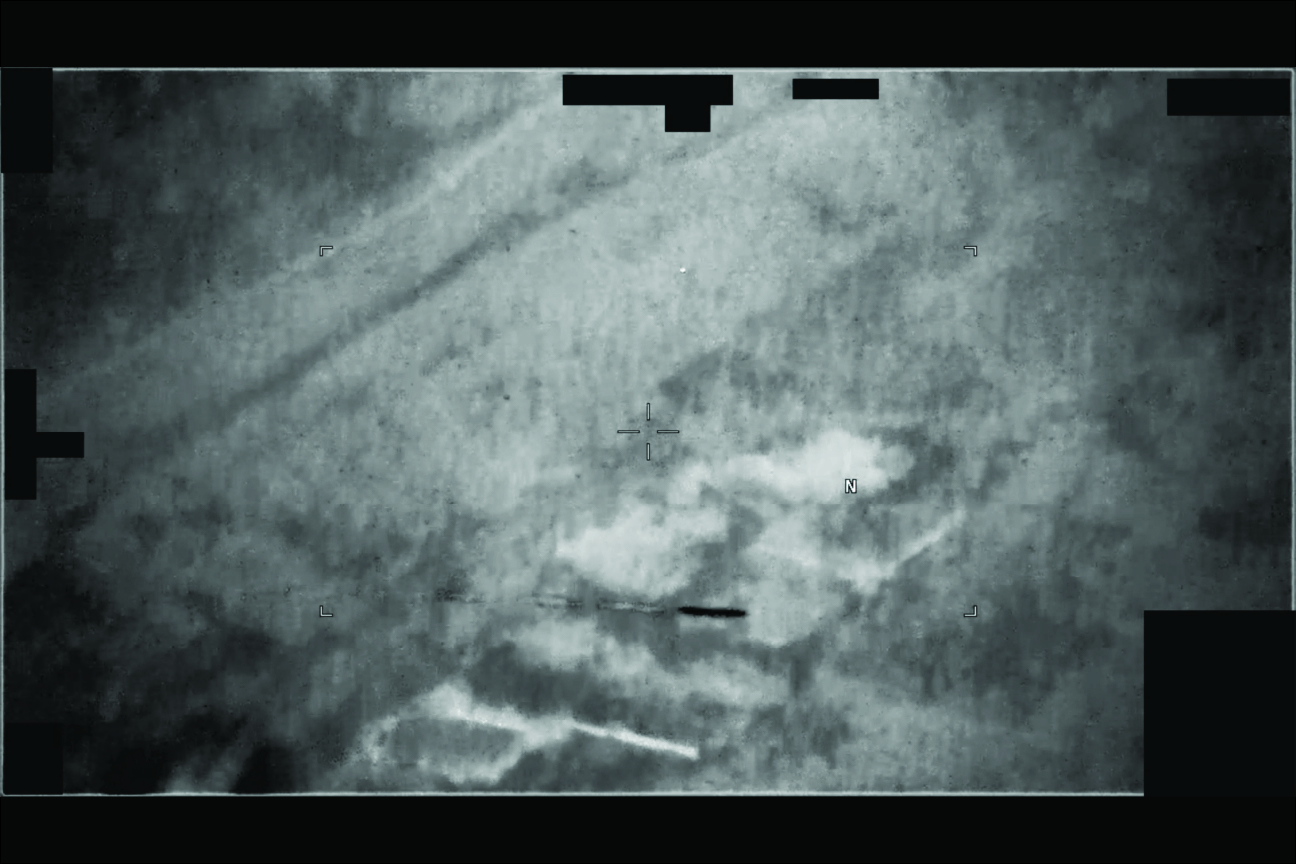
Source file: dow-uap-pr20.pdf Originating agency: Department of War / Department of Defense (USCENTCOM, submitted to AARO) Date range: 2022 (incident); approved for open publication March 10, 2026 Page count: 1 (single still image) Original classification: USCENTCOM MDR 25-0094 thru MDR 25-0099 / JS-250710-TM8S Recommending authority: MG Richard A. Harrison, USCENTCOM Chief of Staff, October 9, 2025 Resolution status: Unresolved by AARO
Official Blurb (from war.gov)
The United States Central Command submitted a report of an unidentified anomalous phenomenon (UAP) to the All-domain Anomaly Resolution Office (AARO) consisting of a still image derived from a U.S. military system in 2022. The original reporter digitally altered the imagery by adding a red line encircling an area of interest before submitting it to AARO. An accompanying mission report, DoW-UAP-D12, described the UAP as moving from north to northeast. The operator reported that they were unable to positively identify the UAP.
Image Description: The image contains an encircled, elongated area of contrast in the top left quarter. The area of contrast increases in intensity along its length from top left to bottom right.
Summary
DOW-UAP-PR20 is an Unresolved UAP Report from the Department of War's PR series — a category distinct from the standard D-series mission reports. The document, comprising a single still frame, was captured during a 2022 incident within the USCENTCOM area of responsibility and subsequently forwarded to AARO for analysis. The original reporter added a freehand red digital annotation — a roughly circular line drawn with a digital tool — around an area of interest in the upper-left quadrant of the frame. Inside that annotation sits a bright, elongated sliver whose intensity grows along its length, apparently capturing a moving object. The accompanying D-series report, DOW-UAP-D12 (an ISR mission flown in Iraq, May 2022), states that the UAP moved from north to northeast and that the aircraft's screener could not achieve a positive identification. AARO, whose mandate is to resolve UAP reports by identifying the source of the phenomenon, completed its analysis but reached a conclusion of "unable to resolve." That status is rare and analytically significant within the broader population of UAP reports handled by U.S. authorities.
Research Article
Introduction
DOW-UAP-PR20 belongs to a distinctive subset of Department of War documents known as the PR series — Unresolved UAP Reports. These differ fundamentally from the D-series Mission Reports (MISREPs). D-series records are standardized operational filings that document the circumstances surrounding a UAP observation; many are closed with a conventional explanation or remain uninvestigated. The PR series, by contrast, is reserved for cases in which USCENTCOM concluded that the evidence warranted submission to AARO for in-depth examination, and in which AARO — after conducting that examination — was still unable to identify the source of the phenomenon.
The significance of PR20 is amplified by its pairing with D12, a separate document in the same archive. D12 is a U.S. Air Force MISREP produced by the 196 ATKS during Operation INHERENT RESOLVE over Iraq, dated May 20, 2022. At 2043Z, an ISR platform observed an unidentified object traveling north to northeast. The crew tracked it for as long as possible using FMV sensors and SIGINT equipment, but the screener could not obtain a positive identification. PR20 is the visual artifact of that same incident — the still image that was singled out, annotated, and forwarded to document the anomalous nature of what was seen.
What Is a PR Report? The Unresolved Series
The distinction between the D series and the PR series is central to understanding the DoW archive. The D series spans D1 through D75 and consists of standard MISREPs in which UAP were observed. A number of those cases are ultimately attributed to known phenomena or closed without further action. The PR series is categorically different: these are the instances in which USCENTCOM saw fit to request AARO analysis because the observation contained elements that could not be resolved within the reporting unit. AARO completed its assessment but returned a finding of "unresolved."
The "Unresolved" designation is a formal analytical conclusion, not merely an administrative placeholder indicating that inquiry is still pending. It means that AARO's analysts — with access to commercial aviation databases, military flight records, satellite tracks, meteorological data, radar archives, and multi-source intelligence — examined the evidence and could not match it to any known object or phenomenon. Within the full population of UAP reports reaching AARO, this outcome applies to a small fraction. PR20's inclusion in that category places it in a higher tier of analytical interest. As the twentieth file in the series, and linked directly to D12, it represents one of the observations that escaped the standard reporting framework and was judged to merit separate evidentiary documentation.
Image Description and the Contrast Phenomenon
The image itself is a single monochrome frame that appears to have been produced by a military sensor system, most likely an infrared or EO/IR targeting pod. Several features stand out on close examination.
The red annotation: Near the center-left of the frame sits a hand-drawn oval in red, applied with a digital drawing tool. This marking is not part of the sensor output; it was added by the original reporter before the image was submitted to AARO. It functions as a manual callout, directing the viewer's attention to the area of interest.
The elongated area of contrast: Inside the red oval appears a bright, narrow streak. Its brightness increases along its length, from the upper-left end (dim) toward the lower-right end (bright). AARO's official description deliberately uses minimal language — "an elongated area of contrast" — to avoid inferring shape, mass, speed, or phenomenology without supporting evidence. This graduated brightness pattern is consistent with several scenarios: an object in motion that left a streak across the sensor's integration window; a heat source growing stronger in the direction of travel (as from a propulsion exhaust); an atmospheric refraction or optical artifact; or sensor noise. The image alone cannot discriminate among these possibilities.
Background characteristics: The frame background shows non-uniform texture with diagonal banding, typical of IR imagery or possibly synthetic aperture radar (SAR) processing. A small teal crosshair reticle is visible at roughly the center of the frame, and a capital "N" at the bottom indicates north. Teal corner brackets at the image edges are standard for military sensor interface displays.
Authorization markings: The upper-left corner carries the stamp "CLEARED For Open Publication, Mar 10, 2026, Department of Defense, OFFICE OF PREPUBLICATION AND SECURITY REVIEW." The upper-right corner reads "Recommendable by MG Richard A. Harrison, USCENTCOM Chief of Staff, Recommendation on 9 Oct 25." At the bottom: "USCENTCOM MDR 25-0094 thru MDR 25-0099 / JS-250710-TM8S, USCENTCOM Recommendation to AARO, 10/17/25 001."
The Connection to DOW-UAP-D12
The pairing of PR20 with D12 is essential to any full understanding of the incident. D12 documents a U.S. Air Force MQ-9 Reaper sortie flown by the 196th Attack Squadron under Operation INHERENT RESOLVE on May 20, 2022. The aircraft launched from OKAS (a Gulf-state base with identity still censored, likely in Kuwait) and operated over Iraqi airspace. At 2043Z the crew observed an unidentified object moving north to northeast; they tracked it as long as possible using the AIRHANDLER Version 2 SIGINT system and the ANDAS4 FMV pod, but the screener returned no positive identification. PR20 is the still image extracted from that engagement.
The geographic coordinates cited for the incident — 29.3759 N, 47.9774 E — correspond to Kuwait City, reflecting the platform's likely launch origin rather than the precise observation location. The UAP itself was observed in Iraqi airspace, as D12 specifies. Together the two records present the same event from complementary perspectives: D12 supplies the operational narrative and context; PR20 supplies the visual evidence. The characteristics D12 documents but the image alone cannot show include the object's direction of travel (north to northeast), a count of one object, and the absence of positive RF signatures.
AARO's "Unresolved" Determination and Its Weight
AARO was established by Congressional mandate in 2022 with a staff of professional analysts, access to classified and unclassified multi-domain intelligence, cross-reference tools, and an operational budget. When AARO classifies an incident as "unresolved," one of three analytical conclusions has been reached: the available data are insufficient for resolution; the evidence is inconsistent with conventional explanations; or the phenomenon's characteristics cannot be matched to any known platform. In any of those outcomes, the case enters a category requiring further investigation.
AARO's 2024 annual report noted that the proportion of incidents remaining unresolved is small relative to the total reporting volume. Most cases close as balloons, drones, birds, meteorological objects, or misidentifications. That PR20 and D12 survived that filtering process places them in a genuinely anomalous subset.
Operational Environment: Operation INHERENT RESOLVE
The geopolitical context matters for interpreting the phenomenon. Operation INHERENT RESOLVE is the sustained U.S. military campaign against ISIS in Iraq and Syria. In May 2022, Iraqi airspace contained a dense mix of platforms: U.S. aircraft (F-15, F-16, F-22, A-10, UAS), coalition aircraft from the United Kingdom, France, and Turkey, Iraqi Air Force jets, commercial airliners on international routes, and Iranian-backed militia drones (PMF-affiliated UAS). Within that environment, an object that sophisticated intelligence tools — AH Version 2 and ANDAS4 — could not classify represents a departure from the statistical baseline. The 609 CAOC, which coordinated the mission, is among the world's most capable airspace management centers; its failure to identify the object strengthens the reporting unit's credibility.
Significance
PR20 carries weight on several dimensions. First, it belongs to the small and rare subset of UAP incidents that AARO has formally sealed with an "unresolved" finding, distinguishing it from the bulk of reporting that ends in a conventional attribution. Second, its pairing with D12 provides two-tier documentation — narrative and visual — that enables cross-source analysis. Third, the incident occurred in an active military operational environment with advanced sensors and experienced operators, reducing the probability of a mundane misidentification. Fourth, the original reporter's decision to add a digital annotation before submitting the image to AARO demonstrates that a trained military operator recognized the phenomenon as warranting separate documentation — an act of real-time human interpretation signaling a genuine anomaly assessment. Fifth, the public release of this image in March 2026, authorized by MG Richard A. Harrison, is a rare act of transparency and reflects a measured willingness to open the UAP discussion to public scrutiny.
The document leaves core questions unanswered: what was the observed object, why could it not be identified, and did its physical characteristics exceed what is known? AARO does not hold those answers, and the "unresolved" status is itself an honest acknowledgment of that analytical limit. For independent researchers, PR20 represents a well-documented starting point for further inquiry, comparative study against similar incidents in the archive, and the broader effort to understand the pattern of UAP activity within the USCENTCOM area of responsibility.
Key People
- Major General Richard A. Harrison (MG Richard A. Harrison) — USCENTCOM Chief of Staff; signed the recommendation to AARO on October 9, 2025.
- Original Reporter — Unidentified USCENTCOM operator who observed the phenomenon and added the red digital annotation to the image before forwarding it.
- Screener — The aircraft's ground-based image analyst during the D12 mission, who could not achieve a positive identification. Name and unit redacted.
Locations
- Kuwait — The Gulf-state from which the ISR platform most likely launched; country coordinates 29.3759 N, 47.9774 E.
- Iraq — Airspace where the UAP was observed, per D12.
- USCENTCOM AOR (Area of Responsibility) — The Central Command's area of responsibility, encompassing the Middle East and Central Asia.
- OKAS — Launch base (ICAO code; base identity classified; believed to be in a Gulf-state).
Incidents
| Incident | Date | Location | Document |
|---|---|---|---|
| UAP observation during 196 ATKS ISR mission | May 20, 2022, 2043Z | Iraqi airspace (38S MC 79XX 70XX) | D12 |
| Extraction of still image from military sensor | May 20, 2022, ~2043Z | Same airspace | PR20 |
| Red digital annotation added by original reporter | Shortly after incident | USCENTCOM | PR20 |
| Forwarded to AARO for examination | 2022–2025 | USCENTCOM, AARO | PR20 |
| USCENTCOM recommendation to AARO for publication | October 9, 2025 | USCENTCOM (MG Harrison signature) | PR20 |
| Classified as "Unresolved" by AARO | 2025 | AARO | PR20 |
| Approved for public release by DoD | March 10, 2026 | Office of Prepublication and Security Review | PR20 |
Notable Quotes
"The United States Central Command submitted a report of an unidentified anomalous phenomenon (UAP) to the All-domain Anomaly Resolution Office (AARO) consisting of a still image derived from a U.S. military system in 2022." — official blurb
"The original reporter digitally altered the imagery by adding a red line encircling an area of interest before submitting it to AARO." — official blurb
"An accompanying mission report, DoW-UAP-D12, described the UAP as moving from north to northeast. The operator reported that they were unable to positively identify the UAP." — official blurb
"The image contains an encircled, elongated area of contrast in the top left quarter. The area of contrast increases in intensity along its length from top left to bottom right." — AARO official image description
"AT 2043Z, [CALLSIGN REDACTED] OBSERVED A UAP FLY NORTH TO NORTH EAST AND FOLLOWED AS LONG AS POSSIBLE. SCREENER COULD NOT GET A POSITIVE ID ON THE UAP." — D12, GENTEXT/UAP, May 20, 2022
Images
1 image - click any image to enlarge
Related Articles
- DoW/DoD · 2024
Mission Report DOW-UAP-D28: Unidentified Anomalous Phenomenon Over Al Asad Air Base, Iraq, September 2024
On September 20, 2024, during an Armed Overwatch mission as part of Operation INHERENT RESOLVE over Al Asad Air Base in Iraq, a U.S. special-operations…
- DoW/DoD · 2020-10-01
Mission Report DOW-UAP-D63: UAP Observation in the Strait of Hormuz, October 2020
Mission Report MISREP 4871281 from the 482 ATKS / 432 AEW under USCENTCOM documents a 21-hour ISR sortie from OKAS (Ali Al Salem, Kuwait) over…
- DoW/DoD · 2022
Mission Report: UAP Observation in the Middle East, May 2022
A declassified Mission Report (MISREP) under number undefined-7473483, submitted within the U.S. Air Force's Operation INHERENT RESOLVE. A single aircraft from the 432 AEW conducted…
- DoW/DoD · 2023
Mission Report DOW-UAP-D20: Unidentified Object Observation Over Syria, March 2023
On March 31, 2023 a two-ship of U.S. Air Force F-16CM aircraft launched from Prince Sultan Air Base to fly a Defensive Counter Air mission…