NASA-UAP-D5: Apollo 17 Science Crew Debriefing — Anomalous Ultraviolet Spectrum, 1973
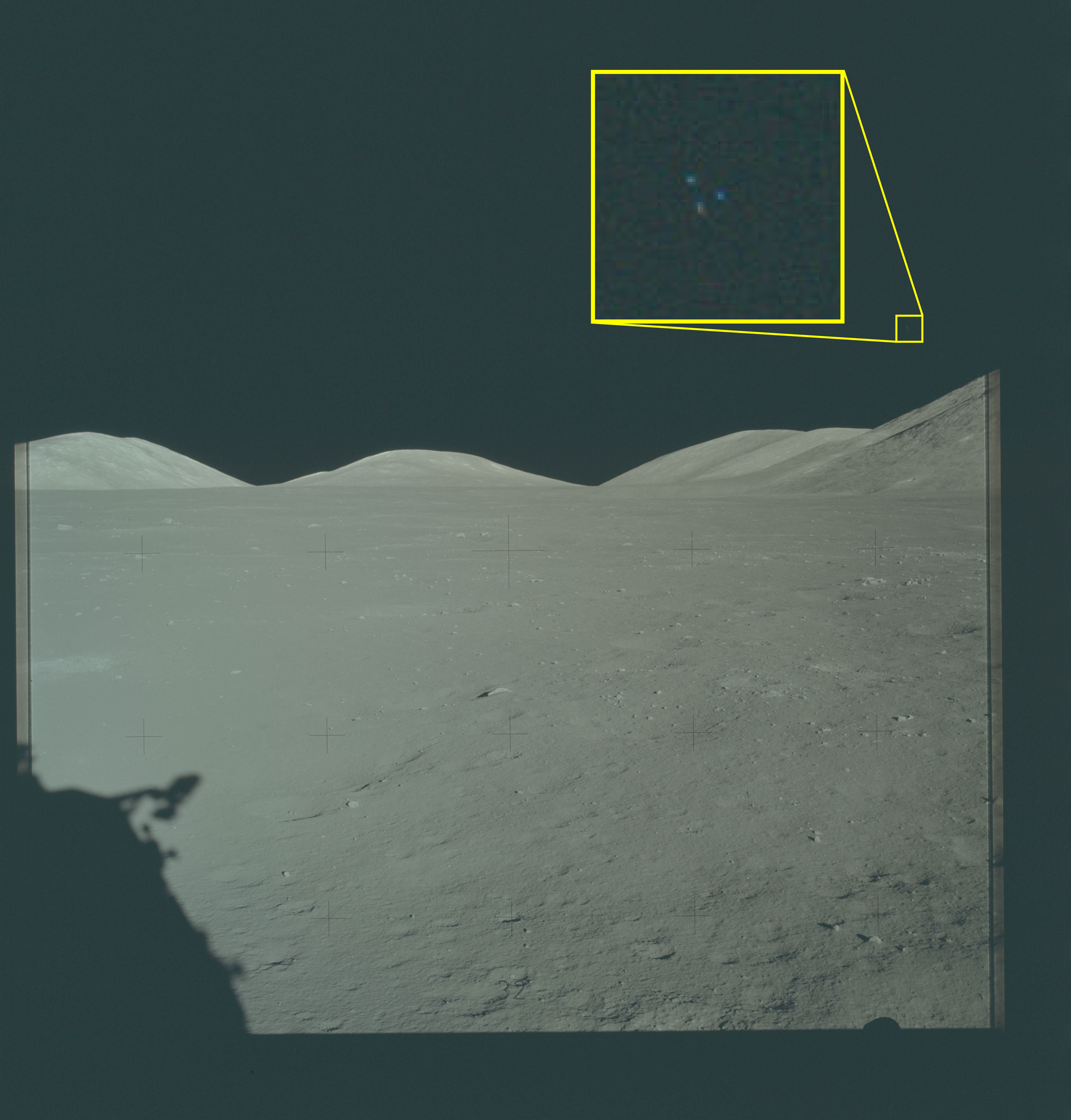
Source file: nasa-uap-d5-apollo-17-crew-debriefing-for-science-1973.pdf Originating agency: NASA / Manned Spacecraft Center, Houston Debriefing date: January 8, 1973 Date of actual observations: December 1972 (Apollo 17 mission) Page count: 3 (excerpt from the full report; central quotation on pages 119–120) Source document: MSC-07632, Science Requirements Branch, Planetary and Earth Sciences Division
Official Blurb (from NASA)
Apollo 17 was the ninth crewed U.S. mission to the Moon, and the sixth to land Astronauts on the lunar surface. This document is an excerpt from the Apollo 17 Crew Debriefing for Science on January 8, 1973, in which Dick Henry (Dick Henry), co-investigator on the ultraviolet experiment on Apollo 17, discusses seeing results that were unexpected.
Summary
This document records a chapter from the formal post-mission debriefing of the Apollo 17 crew, held approximately one month after the mission's return to Earth. The section documented here was presented by Dick Henry, co-investigator on the ultraviolet photometer/spectrometer experiment installed on Apollo 17's command module. Henry presents a series of scientific findings, among them a fourth point concerning an anomalous phenomenon: when the instrument's sensors were directed toward high galactic latitudes — both north and south — a spectrum was observed bearing the characteristics of a hot star, even though no known hot stars were present in the instrument's field of view. Henry proposes a conservative interpretation involving reflection of starlight from interstellar dust, but acknowledges that some spectral features do not fit that theory, leaving open the possibility that the signal is extragalactic radiation. This finding constitutes a scientific anomaly of unidentified origin.
Research Article
Introduction: The Apollo 17 Ultraviolet Experiment
Apollo 17 launched on December 7, 1972, and was the last mission in the Apollo program — and, to date, the last to carry human beings beyond low Earth orbit. The crew comprised Eugene Cernan, commander; Ronald Evans, command-module pilot; and Harrison Schmitt, lunar-module pilot and trained geologist. Schmitt was the first scientist-astronaut, and remains the only professional scientist to have walked on the Moon.
Beyond surface activities, Apollo 17 carried a suite of orbital experiments operating from the command module as it circled the Moon. Among these was the ultraviolet spectrometer, designed to measure light emissions at wavelengths below the visible spectrum. The experiment was uniquely suited to its location: operating from lunar orbit allowed observation of deep space without interference from Earth's atmosphere and without the distraction of daylight scattered through that atmosphere.
The excerpt before us was given at the formal scientific debriefing of the crew and investigators, held January 8, 1973, at the Manned Spacecraft Center in Houston, Texas. During the debriefing each co-investigator presented preliminary findings. On pages 119 and 120 of the transcript, Dick Henry, co-investigator on the ultraviolet experiment, spoke to several findings, including what he called the "fourth point" — relating to an anomalous phenomenon.
Henry's Findings: The High-Galactic-Latitude Sky
Henry explained the scientific rationale of the observation. When looking toward the plane of the Milky Way galaxy, the ultraviolet sky is bright with radiation emitted by the hot, densely packed stars concentrated there. The open question was: what does one see when pointing instead toward the galactic poles — toward the north or south galactic pole, regions not populated by prominent stars?
The motivation for this search came from a neighboring discipline, X-ray astronomy. Henry noted that one of the most exciting results in that field had been the discovery of an X-ray background spread across the entire sky, which nobody had anticipated. That discovery had subsequently led to the identification of a diffuse gamma-ray background, which Dr. Trombka, principal investigator on the Apollo gamma experiment, had presented at the same debriefing a short time earlier. In the ultraviolet it was not clear in advance whether an equivalent background existed. As Henry put it: "In the UV, nobody knows, but you never know until you look."
The Anomaly: A Hot-Star Spectrum from a Direction Without Hot Stars
The team selected a number of observation points at high galactic latitudes, both north and south, and directed the ultraviolet spectrometer at each. Henry reported two significant findings.
First, the spectrum measured was substantially above the instrument's "dark count" — that is, above the detector's internal noise. An earlier experiment had shown that the instrument displayed a higher-than-expected dark current, but Henry clarified that this anomalous current did not in fact interfere with the ultraviolet experiment itself, because the signal measured was strong enough to stand clearly above the noise floor.
Second — and here the anomaly lies — the measured spectrum appeared to carry the signature of a hot star. In Henry's own words: "The spectrum that we see looks like the spectrum of the hot star." The problem: the team knew that no hot stars were within the instrument's field of view. The source of this "hot-star" spectrum was therefore not any hot star in the observed direction.
The Interpretations: Interstellar Dust versus Extragalactic Radiation
Henry presented two possible interpretations.
Conservative interpretation — interstellar dust: The spectrum may represent light from hot stars located in the galactic plane, which scatters upward out of the plane and is reflected by interstellar dust clouds. In other words, the apparently "empty" region at high galactic latitude is not truly empty; dust clouds within it act as reflecting surfaces for starlight originating below. This interpretation rests on solid physical ground, as interstellar dust in the galaxy is well studied.
Alternative interpretation — extragalactic radiation: Henry noted that certain features of the spectrum do not fit the dust-reflection theory. In his words: "There are certain characteristics of the spectrum, though, that don't fit that theory, and it's at least possible that this is extragalactic radiation." If this interpretation were confirmed, it would represent a cosmic ultraviolet background analogous to the X-ray background and the gamma-ray background — radiation originating from sources outside the Milky Way, possibly corresponding to broad astrophysical processes on an intergalactic scale.
Henry concluded the passage by noting that he anticipated a detailed computer analysis to resolve between the two, but that this process would take considerable time.
Scientific Significance
The uniqueness of the finding stems from the fact that the source of the "hot-star" spectral signature was unidentified. Each of the two interpretations Henry offered leads to a significant conclusion.
If the explanation is reflection from interstellar dust, then the distribution of interstellar dust at high galactic latitudes is more extensive and developed than the theoretical models of the era assumed — requiring an update to models of galactic structure.
If the explanation is extragalactic radiation, this would represent a first-order astrophysical discovery: a cosmic ultraviolet background testifying to emission processes on an extragalactic scale. In that case, Apollo 17 would have yielded early evidence of an ultraviolet background later investigated in subsequent decades by more advanced satellites.
It is important to understand that this document is not a UAP report in the classical sense of an unidentified aerial phenomenon. There is no visible object here, no structure, no maneuver. What is present is a scientific anomaly in the electromagnetic spectrum, discovered during a systematic orbital research program. Its classification within a UAP archive follows from the broad definition that the source of the phenomenon is unknown. Both central characteristics of a UAP file — the anomalous nature of the phenomenon and the unclear origin of the signal — apply here, but in an astrophysical rather than a military-aerial domain.
From a historical vantage point, Henry and his team identified a genuine anomaly. In the decades following Apollo, satellite missions — principally IUE, GALEX, and the Hubble Space Telescope — confirmed the existence of a diffuse ultraviolet background across the sky, comprising both dust-reflection components ("Diffuse Galactic Light") and an extragalactic contribution. Henry thus touched on one of the important open questions of ultraviolet astrophysics only three years after the field had begun to take shape.
Key People
- Dick Henry — Co-investigator on the Apollo 17 ultraviolet spectrometer experiment. Presented the anomalous high-galactic-latitude findings at the debriefing.
- Dr. Trombka — Principal investigator on the Apollo gamma-ray experiment, who presented cosmic gamma-ray background results at the same debriefing; referenced by Henry as context for a parallel background phenomenon.
- Gary Thomas — University of Colorado; researcher on hydrogen Lyman-alpha radiation, mentioned in the passage concerning Henry's fifth point.
- Eugene Cernan — Apollo 17 commander, the last person to walk on the Moon as of this writing.
- Ronald Evans — Apollo 17 command-module pilot, who operated the orbital experiments including the ultraviolet spectrometer.
- Harrison Schmitt — Lunar-module pilot, geologist, the first scientist-astronaut on the Moon.
Locations
- Lunar orbit / Cislunar space — Location of the experiment; the Apollo 17 command module as it orbited the Moon.
- Manned Spacecraft Center — Houston, Texas; site of the debriefing.
- Planetary and Earth Sciences Division — The body that produced the debriefing report.
Incidents
| Incident | Date | Location | Pages |
|---|---|---|---|
| Ultraviolet spectrum measured at high galactic latitudes; spectrum identical to that of a hot star in a direction without hot stars in the field of view | Observations December 1972; reported January 8, 1973 | Lunar orbit, Apollo 17 UV experiment | 119–120 |
Notable Quotes
"One of the most exciting results of X-ray astronomy was the fact that an X-ray background was observed over the sky that nobody had expected, and part of this is the gamma-ray background that Dr. Trombka talked about. In the UV, nobody knows, but you never know until you look. You do have to deal with this background of stars that we know is there. So, we did look at a large number of different points at high galactic latitudes, both north and south. The spectrum that we see is above this dark count. In other words, this abnormally high dark current did not, in fact, interfere with that experiment. The spectrum that we see looks like the spectrum of the hot star; however, we know that there were no hot stars within our field of view. Therefore, the most conservative interpretation, I think, is that what we're seeing is light from hot stars in the galactic plane going up out of the plane and reflecting off interstellar dust. There are certain characteristics of the spectrum, though, that don't fit that theory, and it's at least possible that this is extragalactic radiation." — Dick Henry, pages 119–120
Images
1 image - click any image to enlarge
Related Articles
- NASA · 1972-12-07
NASA-UAP-D2: Apollo 17 Air-to-Ground Voice Transcript, December 1972
Apollo 17 was the ninth crewed U.S. mission to the Moon and the last to land astronauts on the lunar surface. This document is an…
- NASA · 1972-12-07
Apollo 17 Technical Crew Debriefing: Light Flashes and a Lunar Surface Observation, 1973
An excerpt from the Apollo 17 Technical Crew Debriefing conducted January 4, 1973, two and a half weeks after the crew returned from the Moon…
- NASA · 1969-07-16
Apollo 11 Technical Crew Debriefing: Three Anomalous Observations Outbound and Return, 1969
Excerpts from the Apollo 11 Technical Crew Debriefing (Volumes I and II), dated July 31, 1969, documenting three anomalous observations recorded by Neil Armstrong, Michael…
- NASA · 1973-05-14
Skylab Technical Crew Debriefings, 1973–1974: Light Flashes, a 'Reddish Satellite,' and Maneuvering Lights Around the Space Station
Technical crew debriefings from all three Skylab missions (1973–1974) document anomalous visual phenomena observed in low Earth orbit. Skylab 2 crew reported internal eye flashes…