NASA-UAP-D2: Apollo 17 Air-to-Ground Voice Transcript, December 1972
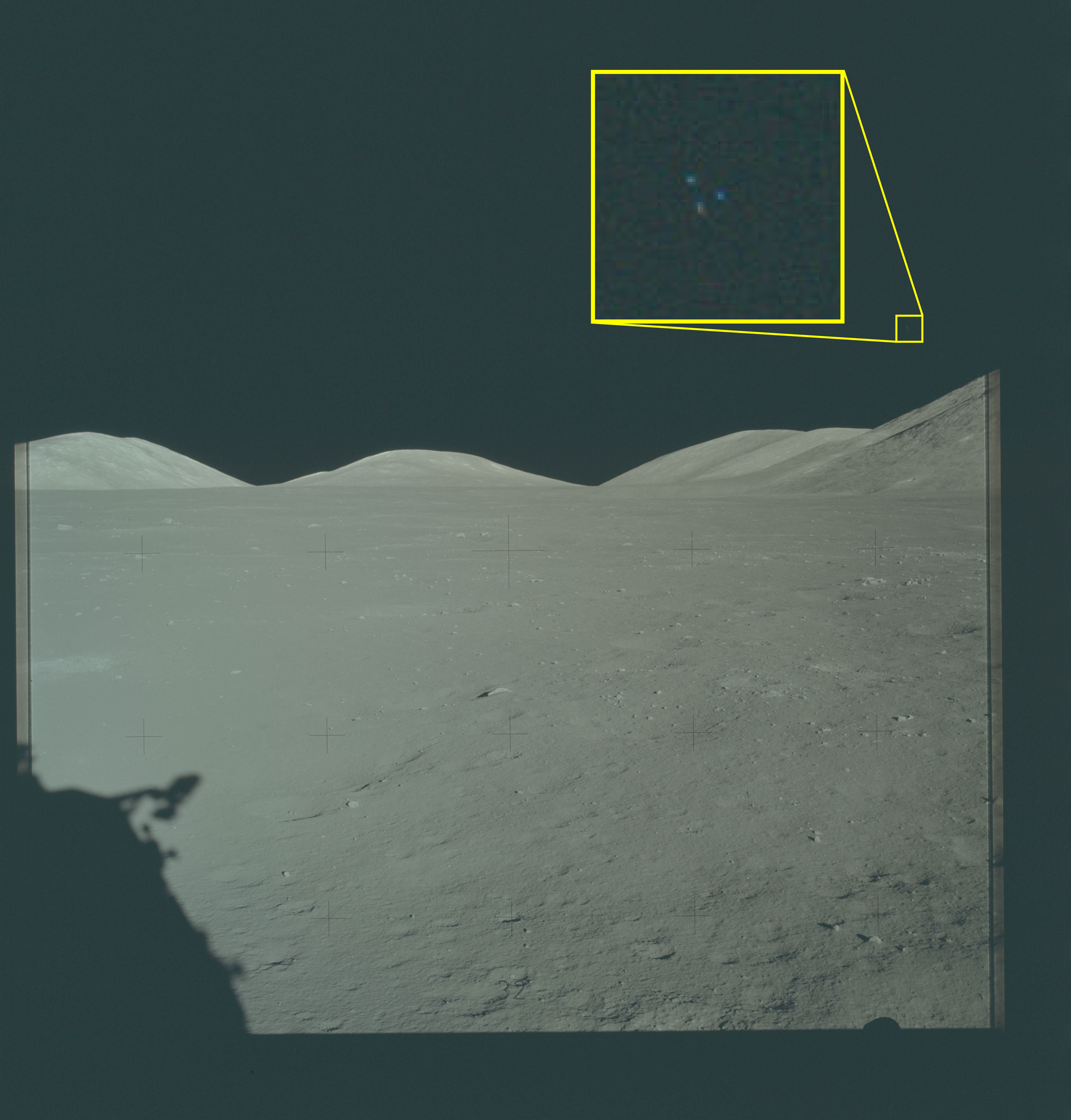
Source file: nasa-uap-d2-apollo-17-transcript-1972.pdf Originating agency: National Aeronautics and Space Administration (NASA) Date range: December 7–19, 1972 (Apollo 17 mission) Page count: 16 High-significance pages: Tape 5/2 to 5/5 (first incident), Tape 46/4 to 47/14 (second incident), Tape 60/2 (third incident — Grimaldi flash)
Official Blurb (from NASA)
Apollo 17 was the ninth crewed U.S. mission to the Moon and the sixth to land astronauts on the lunar surface. This document is an excerpt from the Apollo 17 Technical Air-to-Ground Voice Transcription, December 1972, highlighting three periods in which astronauts reported observing unidentified phenomenon.
Summary
This document is an official excerpt from the Apollo 17 Technical Air-to-Ground Voice Transcription — the last crewed American lunar mission to date. At three separate points during the mission, the three crew members — Commander Eugene "Gene" A. Cernan, Command Module Pilot Ronald Evans, and Lunar Module Pilot Harrison "Jack" Schmitt — reported encountering unidentified phenomena. In the first incident, roughly one hour after trans-lunar injection, a cloud of particles and bright fragments appeared around the spacecraft; Evans described them as "jagged, angular fragments that are tumbling," and Schmitt compared the scene to "the Fourth of July." In the second incident, on flight day three, Cernan reported difficulty sleeping due to pulsing light phenomena and subsequently identified a physically distinct object at a distance, flashing in a rhythmic pattern. In the third incident, on flight day four, Schmitt exclaimed that he had just seen a flash on the lunar surface north of Grimaldi crater. The document provides direct first-person testimony of phenomena observed in cislunar space and on the lunar surface — some of which receive technical explanations, while others, notably the Grimaldi flash, retain an anomalous character that continues to interest researchers.
Research Article
Introduction: Apollo 17 and Historical Context
Apollo 17 launched on December 7, 1972, from Kennedy Space Center in Florida, and returned to Earth on December 19, 1972. It was the final mission of the Apollo program and remains the last time humans traveled to another celestial body. The crew, divided between the Command Module "America" and the Lunar Module "Challenger," included Commander Eugene Cernan, Command Module Pilot Ronald Evans, and Lunar Module Pilot Harrison Schmitt — a geologist by training and the only scientist-astronaut ever to walk on the Moon.
The mission holds additional records: the longest lunar surface stay, the largest geological sample collection, and the longest time in lunar orbit of any Apollo mission. Cernan was the last of the two astronauts to leave the lunar surface; his words — "We leave as we came, and, God willing, as we shall return" — made him the last human to stand on the Moon. That mission acquires new dimensions in light of the air-to-ground radio transcript, which documents three periods in which the crew reported unidentified phenomena.
The specific document is an official excerpt of the Apollo 17 Technical Air-to-Ground Voice Transcription, an internal NASA record that transcribes all radio communication between the crew and Mission Control in Houston. The three excerpts were selected specifically because they document observations that fall under the UAP category. The document was released in response to FOIA requests and as part of NASA's contemporary transparency effort regarding anomalous phenomena.
First Incident: "Like the Fourth of July" (Day 00, Hour 03)
The first incident occurred on the first flight day, approximately 3 hours and 34 minutes after launch. At that point the spacecraft had already completed its trans-lunar injection (TLI) burn, pushing it from Earth orbit toward the Moon. The crew was conducting the Transposition, Docking, and Extraction maneuver — in which the Command Module detaches from the Saturn V's third stage (S-IVB), rotates 180 degrees, and docks with the Lunar Module still attached to the S-IVB.
At 00:03:34:10, Evans reported: "Now we've got a few very bright particles or fragments or something that go drifting by as we maneuver." He identified two categories: particles moving with the spacecraft and single fast-moving flashes passing at relatively high speed.
Schmitt added: "There's a whole bunch of big ones on my window down there — just bright. It looks like the Fourth of July out of Ron's window." The comparison to Fourth of July fireworks — dense, sparkling bursts — is evocative. Evans elaborated: "Yes. Now you can see some of them in shape. They're very jagged, angular fragments that are tumbling."
Evans's visual assessment — jagged, angular, tumbling — argues against the initial interpretation of fluid droplets. Evans: "Not to me. They look like pieces of something." Commander Cernan joined in: "My impression is that they are — flat, flakelike particles. Some may be 6 inches across."
Evans's working hypothesis was cautious: "If you had some kind of a — I got the impression maybe they were curved a little bit, as if they might be off the side of the S-IVB. And that's a wild guess — ice chunks, possibly. Or maybe there's paint coming off of it." The phrase "wild guess" is telling — Evans knew he had no firm explanation. Mission Control offered a memory from an elevator trip to the launch vehicle the previous week: "I noticed on one trip up the elevator last week near one of the flags. I thought it was on the S-II, but it might have been on the S-IVB. Looked like it was peeling. Maybe that's what you've got." Peeling paint from the S-IVB third stage or frozen propellant pellets ejected during the maneuver is a plausible explanation, though not a confirmed one.
Second Incident: Cernan and the Pulsing Lights (Day 02, Hours 18–21)
The second incident — arguably the most physically complex — occurred on the third flight day, more than two days and eighteen hours after launch. On Tape 46/4, Cernan reported to Mission Control that he had difficulty falling asleep the previous night, attributing it partly to a powerful optical phenomenon.
He described: "I definitely saw some of these — because I had a hard time going to bed, to start with — I saw some of the same peripheral horizon-type things you said were not the type of data you were looking for; but I also saw a — some sets of the streaks. And probably the one most imposing thing I remember is — and the last one I remember before falling asleep — was the fact that there was a very bright spot that flashed right between my eyes like a very bright headlight — like a train coming at you, only with a flash."
Cernan's train-headlight analogy carries specific meaning. It implies not simply high optical intensity but also a sensation of directional origin — as if the flash came from a particular point, not diffuse illumination. He was emphatic: "It's something physical in the distance. (Laughter) Oh, yes." At 02:18:49:02 he added: "I just want to emphasize that it's definitely not — not one of these particles that tends to look like a star out there. It's something physical in the distance."
Cernan applied three-dimensional reasoning. He could compare the nearby particles floating around the spacecraft with the more distant object and determine it was not among them: "It is a — it is a bright object, and it's obviously rotating because it's flashing. It's way out in the distance, as I say, because there are particles that are close by and it's obviously not one of those. It's apparently rotating in a very rhythmic fashion because the flashes come around almost — almost on time."
The rhythmic character of the flashes is analytically important. Cernan identified two alternating flash types: "Let's call it the XZ plane of the spacecraft. One unique thing about it, Bob, is that it's got two flashes. As it comes around in — in rhythmic fashion, you get a very bright flash; and then you get a dull flash. And then it'll come around with a bright flash, and then a dull flash."
Schmitt, drawing on roughly 24 hours of observation, offered a hypothesis: "Bob, couple of revolutions ago when I was looking at it, I had a much brighter view and I believe I was looking at it broadside. It looks to me it may be flashing more or less end-on now... we've been noticing that, I think, for about 24 hours or so. I just — hadn't put it together as maybe being the S-IVB. I thought it was just some other particle out there." At 02:20:55:22, Cernan reported two flashing objects: "Hey, Bob. We got two of those flashers out there. They could be SLA panels. I don't know. They're alike in intensity and pretty regular in the — in the intensity, bright and dim flashes they come out with, and they're widely separated." SLA panels (Spacecraft Lunar Module Adapter panels) are the four metal segments that enclosed the Lunar Module during launch and separated after TLI. This is technically plausible.
Third Incident: Flash on the Lunar Surface, North of Grimaldi (Day 03, Hour 15)
The third incident — perhaps the most scientifically significant — occurred on the fourth flight day while the crew was in lunar orbit. At 03:15:33:25, Schmitt was describing the spacecraft's passage over Oceanus Procellarum and the Grimaldi crater complex beginning to come into view from the northwest. He was explaining the lunar geology, the contrast between the dark basaltic mare and the bright highlands, when at 03:15:38:09 he abruptly called out:
"Hey, I just saw a flash on the lunar surface!"
Mission Control responded with interest: "Oh, yes?" Schmitt continued: "It was just out there north of Grimaldi. Just north of Grimaldi. You might see if you got anything on your seismometers, although a small impact probably would give a fair amount of visible light."
His description was geographically precise: "It was a bright little flash right out there near that crater. See the crater right at the edge of Grimaldi. Then there is another one north of it. Fairly sharp one north of it is where there was just a thin streak of light." Mission Control asked him to mark the location on his map. Schmitt agreed: "I keep looking occasionally for — yes, we will. I — I was planning on looking for those kind of things."
Analysis: Cosmic-Ray Visual Phenomena or Transient Lunar Phenomena?
The second incident — Cernan and Schmitt's distant flashing object — is an early and detailed documentation of what later research identified as Cosmic Ray Visual Phenomena (CRVP). Apollo astronauts beginning with Apollo 11 had reported light flashes appearing even with eyes closed. Subsequent research demonstrated that high-energy heavy atomic nuclei (HZE particles) from galactic cosmic radiation penetrate the helmet and skull, reach the retina or visual cortex, and produce an optical sensation of a flash. The ALFMED experiment on Apollo 16 and 17 — which Schmitt mentions on Tape 46/5 — was designed specifically to measure this effect. However, an important distinction applies: Cernan's "train headlight" that flashed "right between my eyes" may describe a CRVP event, while the rhythmically pulsing distant object is a fundamentally different phenomenon.
Schmitt's flash north of Grimaldi cannot be explained as CRVP. It was an external observation on the lunar surface — not an internal visual sensation. It falls under the category of Transient Lunar Phenomena (TLP): brief flashes of light, color changes, or patches of haze observed on the lunar surface, documented by observers for centuries, primarily through ground-based telescopes. The scientific community has long debated their origin.
The most widely accepted current explanation is meteorite impact. When a meteoroid strikes the lunar surface at tens of kilometers per second, the kinetic energy is converted to heat and light, producing a brief visible flash. Modern automated optical systems (such as ESA's NELIOTA project) now routinely document such flashes. Schmitt himself, as a professional geologist, immediately suggested this: "A small impact probably would give a fair amount of visible light — you might see if you got anything on your seismometers." Seismometers placed by earlier Apollo missions (12, 14, 15, 16) were operational at the time and could have detected an impact.
The area north of Grimaldi holds special significance. Grimaldi is a large impact basin approximately 220 km in diameter on the limb of the near side of the Moon, and it is known as one of the highest-concentration areas for historical TLP reports. Researcher Winifred Cameron's systematic TLP catalog (NASA TR R-277) records dozens of historical sightings of flashes, hazes, and color changes in the Grimaldi region. Some attribute this concentration to lunar outgassing from fractures; others, to meteorite impacts; others, to unusual reflective properties of surface materials. Schmitt's observation is one of the first TLP reports from lunar orbit — close-range direct testimony from a scientifically trained witness — and carries high evidentiary value.
Significance
The Apollo 17 air-to-ground transcript presents three distinct categories of unidentified phenomena. The first — particles surrounding the spacecraft — receives a plausible technical explanation but was not definitively resolved by the crew. The second — pulsing lights — is partially consistent with known phenomena (CRVP and tumbling S-IVB debris), but Cernan's "train headlight" description is exceptionally vivid and may not fit neatly into the standard category. The third — the Grimaldi flash — is the clearest visual evidence of a TLP event from close-range lunar observation, documented by a professional geologist in real time.
The scientific value of this record is substantial. It confirms that phenomena observed by astronomers from Earth's surface for centuries do occur physically on the lunar surface. It offers the testimony of a lunar science expert with rigorous geological training. It identifies the Grimaldi region as a focus of recurring activity. And it exemplifies careful, professionally disciplined documentation of UAP-type observations — in which the astronauts immediately offer possible explanations while leaving the evidence open for later analysis.
The document is now recognized as a source to revisit in contemporary UAP research. With the establishment of AARO in 2022 and NASA's renewed transparency and UAP research mandate, Apollo source documents are presented as early evidence that professionally trained American astronauts were documenting unexplained phenomena as far back as 1972.
Key People
-
Eugene "Gene" A. Cernan, Mission Commander — U.S. Navy officer and test pilot. Previously flew Gemini 9A and served on Apollo 10. The last human to walk on the Moon. His reports of the "train headlight" and the distant rhythmically flashing object are the central elements of the second incident.
-
Ronald "Ron" Evans, Command Module Pilot of "America" — U.S. Navy officer and test pilot. Remained in lunar orbit for 75 hours while Cernan and Schmitt walked on the surface. He was the primary observer in the first particle incident and a key observer in the second.
-
Harrison "Jack" Schmitt, Lunar Module Pilot — geologist (Ph.D., Harvard). The only scientist-astronaut to walk on the Moon. His geological training gives particular weight to his report of the Grimaldi flash, as he was able to identify the precise geographic features of the area being observed. Schmitt later served as a U.S. Senator from New Mexico.
Locations
- The Moon — mission target. Apollo 17 landed in the Taurus-Littrow valley.
- Cislunar Space — the region between Earth and the Moon, where the first and second incidents occurred.
- Grimaldi Crater — a large impact basin (~220 km in diameter) on the lunar limb, known as one of the highest-concentration areas for historical TLP reports. The Schmitt flash was observed just north of this feature.
- Oceanus Procellarum — the largest lunar mare, a dark basaltic plain over which the crew was passing at the time of the third incident.
Incidents
| Incident | Date | Location | Pages |
|---|---|---|---|
| Bright angular tumbling particles surrounding the spacecraft — "like the Fourth of July" | Day 00, 03:34:10 to 03:42:29 (December 7, 1972) | Cislunar space, post-TLI during T&D maneuver | Tape 5/2 – 5/5 |
| High-intensity pulsing lights; "train headlight" flash in Cernan's eyes; distant rhythmically flashing physical object with bright and dim flash alternation | Day 02, 18:42:34 to 21:07:05 (December 9–10, 1972) | Cislunar space, during crew rest period | Tape 46/4 – 47/14 |
| Bright flash on the lunar surface north of Grimaldi crater | Day 03, 15:38:09 (December 10, 1972) | Lunar orbit, over Oceanus Procellarum near Grimaldi | Tape 60/2 |
Notable Quotes
"There's a whole bunch of big ones on my window down there — just bright. It looks like the Fourth of July out of Ron's window." — Harrison "Jack" Schmitt, 00:03:34:10
"Yes. Now you can see some of them in shape. They're very jagged, angular fragments that are tumbling." — Ronald Evans, 00:03:34:10
"If you had some kind of a — I got the impression maybe they were curved a little bit, as if they might be off the side of the S-IVB. And that's a wild guess — ice chunks, possibly. Or maybe there's paint coming off of it." — Ronald Evans, ~00:03:36
"I saw some of the same peripheral horizon-type things you said were not the type of data you were looking for; but I also saw a — some sets of the streaks. And probably the one most imposing thing I remember is — and the last one I remember before falling asleep — was the fact that there was a very bright spot that flashed right between my eyes like a very bright headlight — like a train coming at you, only with a flash." — Eugene "Gene" Cernan, 02:18:42:34
"It is a — it is a bright object, and it's obviously rotating because it's flashing. It's way out in the distance, as I say, because there are particles that are close by and it's obviously not one of those. It's apparently rotating in a very rhythmic fashion because the flashes come around almost — almost on time." — Eugene Cernan, 02:18:47:51
"I just want to emphasize that it's definitely not — not one of these particles that tends to look like a star out there. It's something physical in the distance." — Eugene Cernan, 02:18:49:02
"Hey, I just saw a flash on the lunar surface!" — Harrison "Jack" Schmitt, 03:15:38:09
"It was just out there north of Grimaldi. Just north of Grimaldi. You might see if you got anything on your seismometers, although a small impact probably would give a fair amount of visible light." — Harrison Schmitt, 03:15:38:09
"It was a bright little flash right out there near that crater. See the crater right at the edge of Grimaldi. Then there is another one north of it. Fairly sharp one north of it is where there was just a thin streak of light." — Harrison Schmitt, 03:15:38:09
Images
1 image - click any image to enlarge
Related Articles
- NASA · 1972-12-07
Apollo 17 Technical Crew Debriefing: Light Flashes and a Lunar Surface Observation, 1973
An excerpt from the Apollo 17 Technical Crew Debriefing conducted January 4, 1973, two and a half weeks after the crew returned from the Moon…
- NASA · 1972-12
NASA-UAP-D5: Apollo 17 Science Crew Debriefing — Anomalous Ultraviolet Spectrum, 1973
An excerpt from the Apollo 17 Science Crew Debriefing of January 8, 1973, in which Dick Henry, co-investigator on the ultraviolet experiment, reports unexpected findings…
- NASA · 1969-11-19
NASA-UAP-D1: Apollo 12 Technical Air-to-Ground Voice Transcript, November 1969
An excerpt from the Apollo 12 Technical Air-to-Ground Voice Transcription, November 1969, highlighting two periods in which astronauts reported observing unidentified phenomena: a one-hour period…
- NASA · 1969-07-16
Apollo 11 Technical Crew Debriefing: Three Anomalous Observations Outbound and Return, 1969
Excerpts from the Apollo 11 Technical Crew Debriefing (Volumes I and II), dated July 31, 1969, documenting three anomalous observations recorded by Neil Armstrong, Michael…