Apollo 17 Technical Crew Debriefing: Light Flashes and a Lunar Surface Observation, 1973
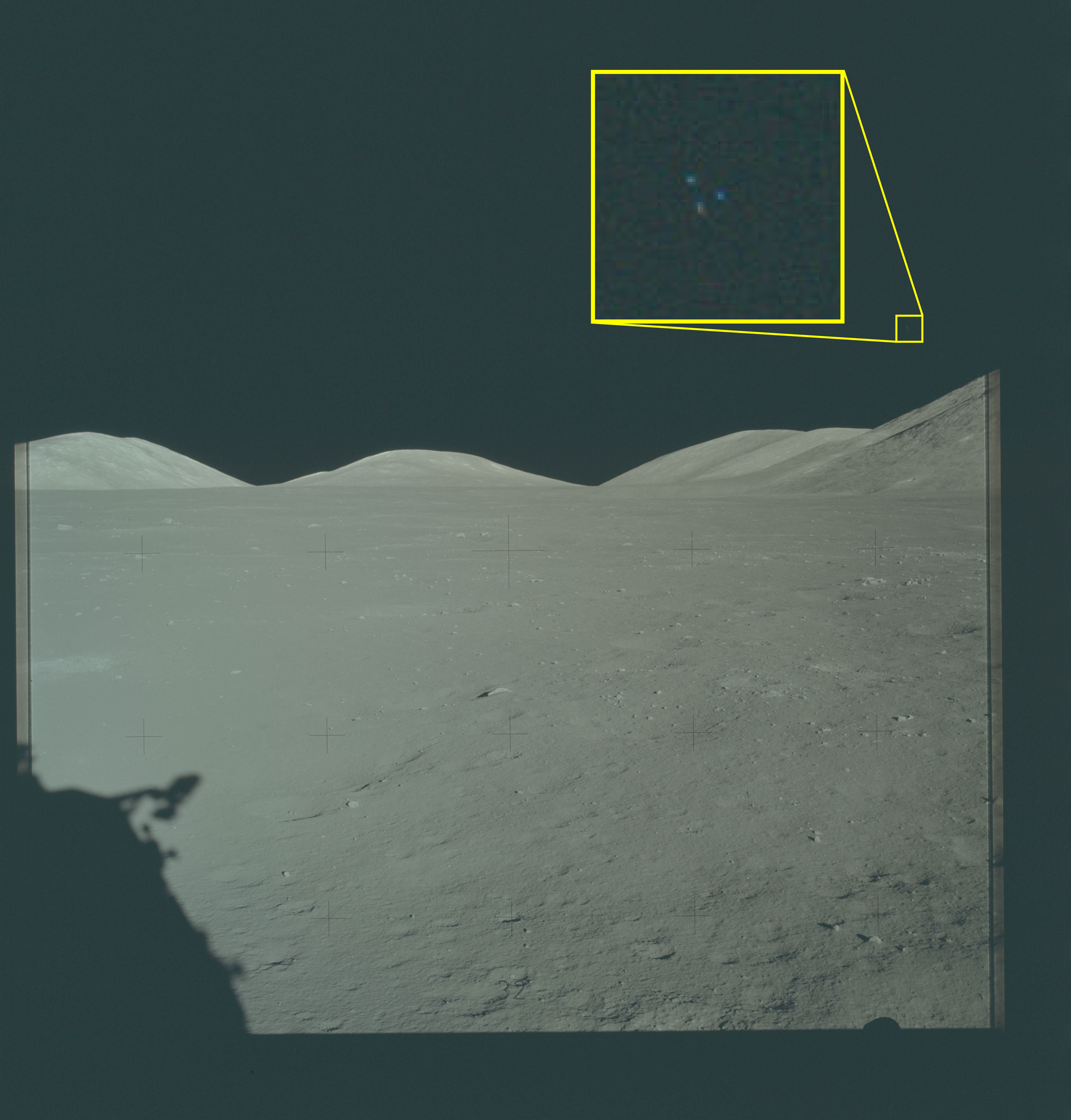
Source file: nasa-uap-d6-apollo-17-technical-crew-debriefing-1973.pdf Originating agency: NASA (Manned Spacecraft Center, Houston / MSC-07631) Date range: Mission December 7–19, 1972; debriefing January 4, 1973 Page count: 2 in excerpt (relevant page: 24-4) High-significance pages: page 24-4 (Schmitt's testimony on light flashes and the lunar surface observation)
Official Blurb (from NASA)
Apollo 17 was the ninth crewed U.S. mission to the Moon, and the sixth to land Astronauts on the lunar surface. This document is an excerpt from the Apollo 17 Technical Crew Debriefing on January 4, 1973, in which astronaut Harrison Schmitt reported seeing light flashes.
Summary
This document is an excerpt from the Technical Crew Debriefing of Apollo 17, conducted at NASA's Manned Spacecraft Center in Houston on January 4, 1973 — two and a half weeks after the crew returned from the Moon. Page 24-4 contains the testimony of Harrison "Jack" Schmitt, Lunar Module Pilot and the only scientist-astronaut ever to walk on the Moon. Schmitt describes a phenomenon documented across all Apollo missions: internally perceived light flashes seen when the astronauts were dark-adapted. He confirms these occurred "just about continuously during the whole flight" whenever the crew had adapted to darkness. Beyond those recurring flashes, he reports a single observation he describes as "a flash on the lunar surface" — a characterization that differs fundamentally from the internal ocular flash phenomenon and connects to a known but still poorly understood area of astronomy: Transient Lunar Phenomena (TLP). The excerpt also documents the ALFMED experiment (Apollo Light Flash Moving Emulsion Detector), designed specifically to test the cosmic-ray hypothesis for the flashes.
Research Article
Introduction: The Apollo 17 Debriefing
Apollo 17 was the last mission of the Apollo program and the only one to carry a professional scientist-astronaut to the lunar surface — geologist Harrison "Jack" Schmitt. The crew also included Commander Eugene Cernan and Command Module Pilot Ronald Evans. The mission launched on December 7, 1972, landed in the Taurus-Littrow Valley on December 11, and returned to Earth on December 19, 1972.
The Technical Crew Debriefing was conducted on January 4, 1973, two and a half weeks after the mission's successful conclusion. It is an internal NASA protocol, originally classified Confidential, designed to capture in detail the astronauts' impressions of every operational and technical aspect of the flight, including anomalous observations. Section 24 of the debriefing covers visual sightings, and page 24-4 contains the reports on light flashes.
Schmitt's Findings: Continuous Flashes
Light flashes reported by astronauts are not unique to Apollo 17. They were first documented during Apollo 11 in the summer of 1969, when Neil Armstrong and Buzz Aldrin reported flashes in darkness. Nearly every astronaut who traveled beyond Earth's magnetosphere subsequently reported the same phenomenon. Schmitt confirmed the experience in unambiguous terms:
"We had light flashes just about continuously during the whole flight when we were dark adapted."
The phrase "dark adapted" is physiological terminology: the eye's adjustment to complete darkness, a process requiring approximately twenty to thirty minutes. The flashes are only visible after that adaptation — which means astronauts could observe them primarily when their eyes had adjusted to the darkness inside the capsule.
Astronauts have described the phenomenon in various ways: a point flash, a luminous streak, a branching pattern, or a brief "star." It occurs inside the eye itself rather than in external reality, and therefore appears even with the eyes closed.
The ALFMED Experiment: Scientific Testing of the Hypothesis
The prevailing hypothesis well before Apollo 17 was that the flashes originated from cosmic rays — extremely high-energy particles (primarily protons and helium nuclei) arriving from the Sun and from beyond the solar system. When such a particle penetrates the retina or the visual cortex, it produces ionization along its track, which the brain interprets as a flash of light. Inside Earth's magnetosphere most cosmic rays are filtered out; beyond it, astronaut exposure is significantly higher.
To test this hypothesis, the ALFMED experiment was designed for Apollo 16 and 17. The device consisted of nuclear emulsion plates in multiple layers worn as a helmet around the astronaut's eyes. When a cosmic ray particle crossed the helmet and reached the eye, its track was recorded in the emulsion. The astronaut simultaneously wore eye covers in complete darkness and reported each flash as it occurred. Comparing the astronauts' flash reports with the particle tracks in the emulsion was intended to confirm or refute the cosmic-ray hypothesis.
Schmitt described the experiment:
"That one period of time when we had the blindfolds on for the ALFMED experiment there were just no visible flashes, although that evening, that night, before I went to sleep, I noticed that I was seeing the light flashes again."
This observation is notable. The astronaut wearing the ALFMED helmet saw no flashes while wearing it, but resumed seeing them the same night after removing it. Schmitt explicitly notes this was "that one interval either side of it where the light flash was not visible to myself or to the other two crewmen."
Subsequent ALFMED analyses published after the mission did confirm a correlation between cosmic-ray particle tracks and astronaut flash reports, supporting the cosmic-ray hypothesis as the primary explanation. However, the full phenomenon is not entirely explained by cosmic rays alone, and later studies continued to examine additional mechanisms.
The Flash on the Lunar Surface: The Anomalous Observation
The most interesting passage for UAP research is not the recurring internal flashes but a single sentence Schmitt states:
"I had one which I thought was a flash on the lunar surface."
This is a claim that goes beyond the definition of the cosmic-ray phenomenon. An internal ocular flash is not linked to any location in external reality — it appears in the center of the visual field regardless of where the astronaut is looking. Schmitt, a professional geologist trained in precise terrain observation, himself distinguishes that this particular flash appeared to him as if located on the lunar surface. He does not assert certainty but describes a perception: "I thought was." His hedging is scientifically precise.
This observation connects to a known but still poorly understood astronomical phenomenon: Transient Lunar Phenomena (TLP, or sometimes TLE — Transient Lunar Events). TLP is an umbrella term for reports, some dating back over a century, of brief flashes, color changes, or patches of haze on the lunar surface. Reports come from amateur and professional astronomers and are numerous enough that the phenomenon is considered real, though a comprehensive physical explanation remains elusive.
Proposed explanations for TLP include:
- Meteorite impact — a small celestial body striking the airless lunar surface at tens of kilometers per second releases kinetic energy as heat and light in a brief visible flash. Modern automated systems (such as ESA's NELIOTA project) now routinely document such flashes.
- Outgassing — release of gas from within the lunar interior through fractures may create transient hazes that alter light reflection.
- Electrostatic effects — lunar dust acquiring electrical charge during sunrise and sunset at the terminator may produce luminous haloes.
- External reflections — Earth atmospheric or optical effects in ground-based observation.
- Observational errors — optical illusions or the internal eye flashes themselves, in the case of ground-based observers.
Was Schmitt witnessing a meteorite impact in real time? That would be the most plausible interpretation if his account is accurate. The Moon has no protective atmosphere, and small bodies strike it constantly. Their impact flashes are detectable in real time by ground-based observation (in 2019 a European astronomical mission recorded over 100 impact flashes through automated telescopes). An astronaut in lunar orbit, or on the trans-Earth trajectory, was in an ideal position to observe such an event directly.
Analysis: Cosmic Rays vs. TLP
Schmitt's testimony must be read with care. He clearly distinguishes two categories of experience:
- Most of the flashes — seen nearly continuously under dark-adapted conditions, regardless of where he is looking. These match the known cosmic-ray internal visual phenomenon.
- One specific flash — perceived as localized on the lunar surface. This does not match the internal phenomenon and represents a fundamentally different observation.
The ALFMED experiment was designed to validate the cosmic-ray explanation alone. The anomalous flash Schmitt identifies is outside the scope of that experiment. The debriefing contains no specific follow-up treatment of that single flash as a scientific finding requiring investigation, and Schmitt himself draws no firm conclusion from it. It is an incidental remark by a geologist with trained observational eyes — about something he could not explain.
Significance
Schmitt's report is significant for three reasons.
First, it comes from a scientist-astronaut — a person specifically trained in precise observation of geological surfaces, and who later served as a U.S. Senator. Schmitt is not an incidental witness. His distinction between an internal ocular flash and a flash "on the lunar surface" is a professional judgment.
Second, the report was given in a technical academic and operational context — an internal NASA debriefing, not a public interview. Schmitt's reasoning in this testimony is not aimed at publicity; it is directed at NASA's technical planning team as potentially relevant information for future missions.
Third, the report directly connects two separately active research areas: cosmic-ray visual phenomena (whose biological and cognitive effects in long-duration spaceflight continue to be studied) and TLP (whose physical cause science has not yet fully explained).
Apollo 17 was humanity's last close-range view of the Moon for decades. Schmitt's testimony from that final approach carries particular historical weight.
Key People
- Harrison "Jack" Schmitt — Lunar Module Pilot (LMP), Apollo 17; geologist (Ph.D., Harvard); the only scientist-astronaut to walk on the Moon. Born 1935. U.S. Senator from New Mexico 1977–1983. In this document he is the primary witness to both the continuous flashes and the anomalous lunar surface observation.
- Eugene "Gene" Cernan — Mission Commander (CDR) and "the last man on the Moon." Naval aviator by training. In this document he reports an unusual observation of a carrier vessel during the descent.
- Ronald "Ron" Evans — Command Module Pilot (CMP). Remained in lunar orbit while Cernan and Schmitt walked on the surface. In this document he describes the fireball of re-entry as "a tunnel with a bright spot at the center."
Locations
- The Moon — lunar surface, observed from Apollo 17's orbit.
- Taurus-Littrow Valley — Apollo 17's landing site.
- Cislunar Space — the region between Earth and the Moon, where most of the flash phenomena were documented.
- Manned Spacecraft Center, Houston, Texas — now Johnson Space Center; site of the debriefing.
Incidents
| Incident | Date | Location | Page |
|---|---|---|---|
| Near-continuous internal light flashes throughout the mission when dark-adapted | December 7–19, 1972 | Apollo 17, cislunar and lunar | 24-4 |
| Single flash perceived as located on the lunar surface | During mission (exact date not specified) | Lunar surface, from LMP vantage point | 24-4 |
| Absence of flashes during ALFMED experiment with blindfolds | During ALFMED test period | Apollo 17 module | 24-4 |
| Flashes resume same evening after ALFMED blindfolds removed | Same night as ALFMED test | Apollo 17 module | 24-4 |
Notable Quotes
"We had light flashes just about continuously during the whole flight when we were dark adapted. I had one which I thought was a flash on the lunar surface. That one period of time when we had the blindfolds on for the ALFMED experiment there were just no visible flashes, although that evening, that night, before I went to sleep, I noticed that I was seeing the light flashes again." — Harrison "Jack" Schmitt, Lunar Module Pilot, page 24-4
"So, it just seemed to be that one interval either side of it where the light flash was not visible to myself or to the other two crewmen." — Harrison Schmitt, page 24-4
Images
1 image - click any image to enlarge
Related Articles
- NASA · 1972-12-07
NASA-UAP-D2: Apollo 17 Air-to-Ground Voice Transcript, December 1972
Apollo 17 was the ninth crewed U.S. mission to the Moon and the last to land astronauts on the lunar surface. This document is an…
- NASA · 1972-12
NASA-UAP-D5: Apollo 17 Science Crew Debriefing — Anomalous Ultraviolet Spectrum, 1973
An excerpt from the Apollo 17 Science Crew Debriefing of January 8, 1973, in which Dick Henry, co-investigator on the ultraviolet experiment, reports unexpected findings…
- NASA · 1969-11-19
NASA-UAP-D1: Apollo 12 Technical Air-to-Ground Voice Transcript, November 1969
An excerpt from the Apollo 12 Technical Air-to-Ground Voice Transcription, November 1969, highlighting two periods in which astronauts reported observing unidentified phenomena: a one-hour period…
- NASA · 1969-07-16
Apollo 11 Technical Crew Debriefing: Three Anomalous Observations Outbound and Return, 1969
Excerpts from the Apollo 11 Technical Crew Debriefing (Volumes I and II), dated July 31, 1969, documenting three anomalous observations recorded by Neil Armstrong, Michael…