Military Mission Report: Triangular Metallic UAP Observed over the Mediterranean Sea
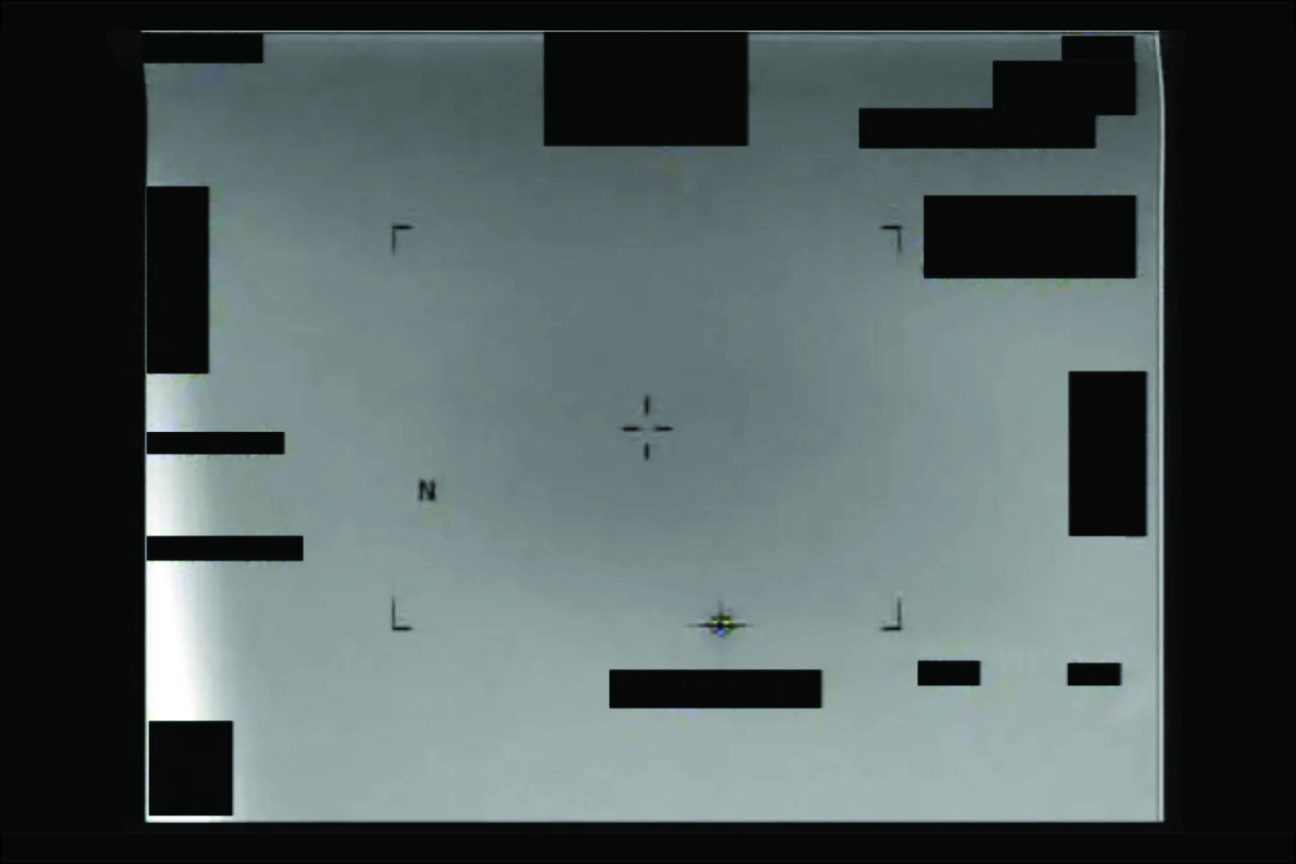
Source file: dow-uap-d54-mission-report-mediterranean-sea-na.pdf Originating agency: Department of Defense / DoD Modern UAP Date range: Unknown (redacted) Page count: 7 (all read) High-significance pages: page 7
Official Blurb (from war.gov)
This document is a Mission Report (MISREP), a standardized reporting form the U.S. Military uses to record the circumstances surrounding its operations. U.S. military services often use MISREPs to report Unidentified Anomalous Phenomena (UAP) to AARO. The GENTEXT, or "general text" section of these reports often contains important qualitative, contextual information, distinguishing it from the more quantitative, or numerical, data found elsewhere in the report. A U.S. military operator reported observing one UAP. The report describes the UAP as a "triangular and metallic UAP." The reporter estimated the UAP's altitude as 24,989 feet and speed as 168 knots (193mph). All descriptive and estimative language contained in this report reflects the reporter's subjective interpretation at the time of the event. Such characterizations should not be interpreted as a conclusive indication of the presence or absence of any intrinsic object features or performance characteristics.
Summary
This is a classified military Mission Report documenting a UAP encounter over the Mediterranean Sea in which a U.S. military pilot observed a single unidentified anomalous phenomenon with a triangular shape and metallic appearance. The object was observed during a return-to-base (RTB) leg at 1319Z while the aircraft transited over coordinates 36°34'53"N, 02°55'94"E, flying at 24,989 feet MSL at 168 knots. Six of the document's seven pages are withheld entirely under FOIA exemption 1.4(a), which protects national security information and intelligence sources and methods.
Research Article
Introduction
This document is a military Mission Report subject to FOIA classification exemption 1.4(a), which protects information bearing on national security, intelligence sources, and operational methods. The report, assigned internal identifier DoW-UAP-D54, was created on April 29, 2026, and publicly released in heavily redacted form. Six of its seven pages are entirely blacked out, each page displaying only the classification marker "1.4(a)" in the upper corner.
Page 7 — the sole page with readable content — provides brief but substantive details about a UAP encounter observed over the Mediterranean Sea. The document is marked SECRET/NOFORN, meaning it is classified at the Secret level and not releasable to foreign nationals.
Object description
According to the GENTEXT/UAP section, the only readable portion of the document, the unidentified aerial object has the following characteristics:
Shape: Triangular Appearance: Metallic Quantity: Single object (1X UAP)
The description itself is classified SECRET/NOFORN, indicating that additional detail — precise dimensions, movement profile, further physical characteristics — remains withheld.
Circumstances of the observation
The encounter occurred during a return-to-base (RTB) leg at 1319Z. The pilot, whose identity is redacted under exemption 1.4(a), observed the object while transiting over coordinates 36°34'53"N, 02°55'94"E — a position in the Mediterranean Sea, most likely in the waters off the northern coast of Algeria.
Technical parameters associated with the reporting aircraft at the time of the observation:
- Altitude: 24,989 feet above mean sea level (MSL)
- Speed: 168 knots
These figures are consistent with a fast military aircraft operating at medium-high altitude, most likely a reconnaissance or combat platform. The pilot's name and precise flight path are fully redacted.
Classification scope and withheld material
The six withheld pages almost certainly contained information of the following types, based on standard MISREP structure and the breadth of exemption 1.4(a):
- Pilot identity and unit designation
- Aircraft tail number and configuration
- Precise sortie routing and tasking instructions
- Sensor equipment carried and detection methodology
- Intelligence analysis of the observed object's behavior and characteristics
- Operational context and supporting classification rationale
Exemption 1.4(a) is among the broadest FOIA withholding authorities available, covering material whose disclosure could reasonably be expected to damage national security. Its application to virtually the entire document reflects the sensitivity of the collection platform or mission context involved.
Significance
This document carries research value on several grounds.
First, it confirms that U.S. forces conduct patrols and missions over the Mediterranean — a theater often associated with Sixth Fleet operations and NATO maritime activity — during which unidentified objects are encountered and formally documented.
Second, the description of the object as "triangular and metallic" is notable. Triangular UAP have been reported repeatedly in the history of military encounter documentation, from the 1990 Belgian wave to more recent U.S. Navy and Air Force observations. A triangular, metallic shape appearing at altitude near a military aircraft operating at 168 knots is not easily reconciled with conventional explanations such as balloons or consumer drones.
Third, the degree of redaction — six of seven pages withheld — implies that the intelligence derived from this observation was assessed as genuinely sensitive, and that the collection platform or methods involved are of continuing operational value.
The coordinates noted in the readable page (36°34'53"N, 02°55'94"E) point to the southern Mediterranean, close to the North African coastline, an area of high strategic importance to NATO and the U.S. Sixth Fleet. This geographic context adds weight to the significance of the observation.
Key People
- Unidentified pilot ([REDACTED] 1.4(a)) — aircrew who reported the encounter during a return-to-base transit
Locations
- Mediterranean Sea — general area of the encounter
- 36°34'53"N, 02°55'94"E — precise observation point, near the northern coast of Algeria
Incidents
| Incident | Date | Location | Pages |
|---|---|---|---|
| Observation of triangular, metallic UAP | Unknown (redacted); time 1319Z | 36°34'53"N, 02°55'94"E; Mediterranean Sea | 7 |
Notable Quotes
"1X UAP DETECTED WITH DESCRIPTIVE INFORMATION SUCH AS BEING A TRIANGLUAR AND METALLIC UAP." — page 7
"DURING RTB AT 1319Z, [1.4(a)] OBSERVED 1X UAP WHILE TRANSITING OVER 363453N 0255943E FLYING AT AN ALTITUDE OF 24,989FT MSL AND SPEED OF 168KTS." — page 7
Images
1 image - click any image to enlarge
Related Articles
- DoW/DoD · 2024
UAP Mission Report: Greece, January 2024 — The Diamond-Mass Incident at FL200
A classified MISREP mission report, released on October 24, 2025 by Major General Richard A. Harrison, USCENTCOM Chief of Staff, documents a UAP observed on…
- DoW/DoD · 2020
Mission Report DOW-UAP-D5: UAP Observations in the Arabian Gulf, 2020
A classified U.S. Department of Defense Mission Report (DOW-UAP-D5) recording UAP observations during 2020 operations in the Arabian Gulf. Five of six pages are heavily…
- DoW/DoD · 2023
AARO Unresolved Case Analysis Update: The Western U.S. "Orbs Launching Orbs" Event, 2023
A signed All-domain Anomaly Resolution Office (AARO) Memorandum for Record, dated 05 June 2026 and signed by Director Jon T. Kosloski, summarizing the agency's ongoing…
- DoW/DoD · 2022
Unresolved UAP Report DOW-UAP-PR20: Digitally Annotated Still Image, Kuwait, May 2022
An Unresolved UAP Report (PR series) submitted by USCENTCOM to AARO, consisting of a single still image captured by a U.S. military sensor system in…