Arabian Gulf UAP Mission Report, 2020 — Document DOW-UAP-D3
Source file: dow-uap-d3-mission-report-arabian-gulf-2020.pdf Originating agency: Department of Defense / DoD Modern UAP Date range: 2020 (exact date redacted; UAP event at 1736 UTC) Page count: 7 (all read) High-significance pages: 6, 7
Official Blurb (from war.gov)
This document is a Mission Report (MISREP), a standardized reporting form the U.S. Military uses to record the circumstances surrounding its operations. U.S. military services often use MISREPs to report Unidentified Anomalous Phenomena (UAP) to AARO. The GENTEXT, or "general text" section of these reports often contains important qualitative, contextual information, distinguishing it from the more quantitative, or numerical, data found elsewhere in the report. A U.S. military operator reported observing a "line of dots followed by a trailing dot." All descriptive and estimative language contained in this report reflects the reporter's subjective interpretation at the time of the event. Such characterizations should not be interpreted as a conclusive indication of the presence or absence of any intrinsic object features or performance characteristics.
Summary
This document is a SECRET-classified U.S. military Mission Report (MISREP No. 8799515) concerning the observation of four unidentified anomalous phenomena (UAP) seen during a U.S. Air Force intelligence, surveillance, and reconnaissance (ISR) mission over the Arabian Gulf region in 2020. The report was filed by an Air Force unit under AFCENT (U.S. Air Forces Central Command). Most operational details are redacted under exemption (b)(1)1.4a, including the mission name, the unit, the aircraft type, and the flight particulars. The description of the UAP incident itself, however, is partially preserved and supplies specific and meaningful data.
Research Article
Introduction
In 2020, while U.S. Air Force forces were conducting a classified ISR mission over the Arabian Gulf region under AFCENT command, four unidentified objects were observed in the area's skies. The report, designated Misrep 8799515, is an example of the UAP documentation format the U.S. Department of Defense has adopted in recent years as part of a structured effort to collect and catalog incidents of this kind in a standardized form. The document was released as part of the 2026 wave of disclosures and represents a first-order record of a genuine operational UAP incident.
Report structure and the data set
The report is organized according to the standard MISREP format, which comprises several principal sections:
Admin: The document is classified SECRET with a declassification date of June 3, 2048. The major command (MAJCOM) is AFCENT, and the military service involved is the U.S. Air Force. The combatant command (COCOM) is redacted.
Aircraft equipment (ACEQUIP): All aircraft particulars are redacted, including the callsign, aircraft type, tail number, armament, radar, radar warning receiver (RWR), missile warning system (MWS), and chaff and flares. The form records that the aircraft carried a targeting pod (TGT Pod) and additional avionics, but those details are redacted.
Timeline: All takeoff, landing, and mission-duration details are redacted. It is known that this was an ISR mission, that at least one aircraft flew it, and that weather was not a limiting factor — although cloud cover obscured the field of view at certain points.
The UAP section: The UAP section is the core of the report and contains the most significant unredacted data.
The UAP incident: analysis of the available data
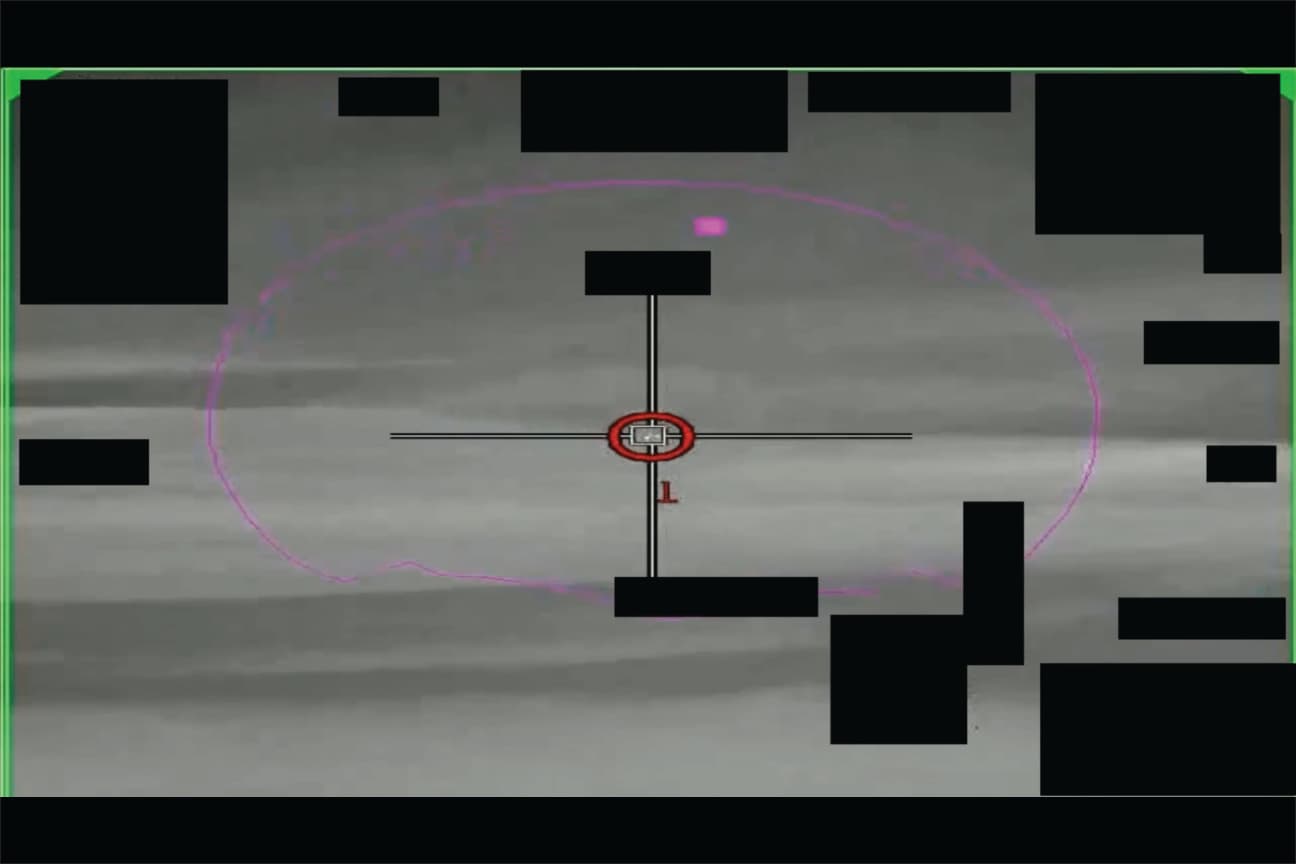
At an approximate time of 1736 UTC, four UAP were observed. The sighting occurred while the aircraft was conducting an ISR mission, and a sensor camera — most likely an EO/IR (electro-optical / infrared) system — captured the events in real time.
The recorded sequence of events is as follows:
- 17:36:22 — one UAP observed beneath a (redacted) level
- 17:36:30 — two UAP observed side by side
- 17:36:49 — one additional UAP observed
The four UAP were observed flying within the sensor's field of view (FOV), but cloud cover interfered with tracking and with obtaining a clear visual. The report references "ISR 1," presumably an accompanying video or imagery file.
Technical data on the UAP
What can be extracted from the fields that were defined on the form but left unfilled, together with the few entries that were preserved:
- UAP Advanced Capabilities And/Or Materials: NO — this is a notable detail that survived unredacted. The UAP were not assessed as displaying anomalous advanced capabilities or unknown materials.
- Number of UAP: a partial annotation indicates four objects.
- First/last UAP position: both redacted.
- UAP altitude, depth, speed, and track: redacted.
- Propulsion, payload, signatures: all redacted.
- UAP Under Intelligent Control: redacted.
- UAP Effects on Persons/Equipment: not filled (presumably no effects).
- UAP Objects/Material Recovered: not filled (presumably none).
Organizational significance of the report
The report represents a substantive shift in how the U.S. military addresses the UAP phenomenon. Whereas reports of this kind previously had no formal format at all, the structured form presented here — with dedicated UAP fields such as event type, maneuverability, response to observer actions, propulsion, advanced capabilities, and more — attests to a systematic institutional policy for collecting such data.
The fact that the report was submitted through a SECRET channel and attributed to AFCENT command indicates that the incident was considered serious enough to enter the formal military reporting chain. The document was released to the public with a defined declassification date (2048), which suggests that limited discretion was exercised in publishing it, and that the bulk of the classification requires a decades-long wait.
Limitations of the analysis
Most of the operational information — aircraft type, exact location, flight altitude, speed, specific sensor details, and the page 1 narrative content — is redacted under FOIA exemptions (b)(1)1.4a and (b)(1)1.4c. This redaction materially limits the capacity for analysis and leaves open questions regarding the nature of the UAP, the distance, the size, and the speed.
Key People
All personnel names are redacted under exemptions (b)(6) and (b)(3) 10 U.S.C. §130b, which protect the privacy of military personnel. It is known that the following were involved:
| Role | Service | Status |
|---|---|---|
| POC (primary point of contact) | U.S. Air Force | Name redacted |
| QC (quality control) | U.S. Air Force | Name redacted |
| APPROVER | U.S. Air Force | Name redacted |
Locations
- Arabian Gulf — general area of the mission
- AFCENT — U.S. Air Forces Central Command (area of responsibility: the Middle East)
- Takeoff, landing, and UAP positions: redacted
Incidents
| Incident | Date | Location | Pages |
|---|---|---|---|
| Observation of 4 UAP during an ISR mission | 2020, ~1736Z | Arabian Gulf (exact location redacted) | 6–7 |
| First single UAP observed | 17:36:22Z | Beneath a redacted level | 7 |
| Two UAP observed side by side | 17:36:30Z | Sensor field of view | 7 |
| Fourth UAP observed | 17:36:49Z | Sensor field of view | 7 |
Notable Quotes
"4X UAP OBSERVED FLYING IN [REDACTED] FOV. CLOUD COVERAGE OBSTRUCTED [REDACTED] FROM FOLLOWING AND GETTING A CLEAR VISUAL. (SEE ISR 1)."
"AT APPROX 1736Z 4 UAP WERE OBSERVED BENEATH [REDACTED] 1X UAP OBSERVED AT 17:36:22, 2X UAP OBSERVED SIDE BY SIDE AT 17:36:30, AND 1X UAP OBSERVED AT 17:36:49."
UAP Advanced Capabilities And/Or Materials: NO
Gentext/Additional Details (Takeoff): (SECRET//REL TO USA, FVEY) WEATHER WAS (NOT) A FACTOR
Images
1 image - click any image to enlarge
Related Articles
- DoW/DoD · 2020-07-16
Mission Report DOW-UAP-D65: Three UAP Observations in the Persian Gulf, July 16, 2020
USCENTCOM Mission Report Misrep 4472514 documents three separate observations of an unidentified aerial phenomenon during a single ISR sortie over the Persian Gulf, the Strait…
- DoW/DoD · 2020-09-15
Mission Report DOW-UAP-D62: UAP Observation, Link-Loss Events, and Iranian Air-Defense Intercepts over the Strait of Hormuz, September 2020
Mission Report MISREP 4782130 from the U.S. Air Force 482 ATKS / 432 AEW documents an intense 21-hour ISR sortie over the Strait of Hormuz…
- DoW/DoD · 2020
Range Fouler Debrief Form — Middle East Theater, May 2020
This document is a Range Fouler Debrief Form re-reviewed for release by Brigadier General Richard A. Harrison, USCENTCOM Chief of Staff. It records a UAP…
- DoW/DoD · 2020
Mission Report: Formation of Unknown Flying Objects over the Persian Gulf, August 2020
MISREP number 4685903, filed by the 482 ATKS unit of the 432 AEW under USCENTCOM, documents a 21-hour ISR/SIGINT sortie over the Arabian Gulf, Strait…