Mission Report: Formation of Unknown Flying Objects over the Persian Gulf, August 2020
Source file: dow-uap-d61-mission-report-persian-gulf-august-2020.pdf Originating agency: Department of Defense / DoD Modern UAP — USCENTCOM MDR 26-0019 Date range: August 26–27, 2020 Page count: 7 (all read) High-significance pages: 1, 5, 6, 7
Official Blurb (from war.gov)
This document is a Mission Report (MISREP), a standardized reporting form the U.S. Military uses to record the circumstances surrounding its operations. U.S. military services often use MISREPs to report Unidentified Anomalous Phenomena (UAP) to AARO. The GENTEXT, or "general text" section of these reports often contains important qualitative, contextual information, distinguishing it from the more quantitative, or numerical, data found elsewhere in the report. A U.S. military operator reported observing a "formation of unknown flying objects" traveling northeast to northwest along the coast for approximately two minutes. The report notes that light cloud coverage "prevented the continuous tracking of the formation." All descriptive and estimative language contained in this report reflects the reporter's subjective interpretation at the time of the event. Such characterizations should not be interpreted as a conclusive indication of the presence or absence of any intrinsic object features or performance characteristics.
Summary
MISREP number 4685903 was filed by the 482 ATKS unit of the 432 AEW under USCENTCOM command. The mission, which lasted approximately 21 hours and 5 minutes, encompassed ISR/SIGINT operations over the Arabian Gulf, Strait of Hormuz, and Gulf of Oman. At 1527Z on August 27, 2020, a formation of unidentified flying objects was observed. The aircraft tracked the formation for roughly two minutes before losing contact in cloud cover. The crew was unable to reacquire the formation. Weather conditions prevented continuous tracking.
Research Article
Introduction
On August 26, 2020, at 2307Z, a U.S. Air Force aircraft departed base OKAS on an extended reconnaissance sortie over the Persian Gulf region. The mission was classified as type AREC and was designed to support NAVCENT under the USCENTCOM umbrella, with operations directed from the 609th Combined Air Operations Center (609th CAOC). The aircraft was equipped with an ANDAS4 sensor and an AH_GMESH system for intelligence collection.
Mission details and progression
The aircraft arrived on station at 0041Z on August 27, 2020, having coordinated with NAVCENT 24 hours before takeoff. Mission objectives included characterizing Iranian naval vessels and unmanned aerial system (UAS) activity, monitoring activity outside ports, and establishing a pattern of life across the area of operations.
The sequence of main events unfolded as follows:
- At 0532Z, the aircraft was hailed on the Guard frequency by Iranian air defense. The call was professional in tone and had no impact on the mission.
- At 0611Z, a single small vessel was observed anchored at the large naval port of Greater Tunb Island, in the vicinity of grid 40RCQ30.
- At 0702Z, an aircraft assessed as a "possible IL-76 Candid" was observed over Abu Musa Island airfield, in the vicinity of grid 40RCP02.
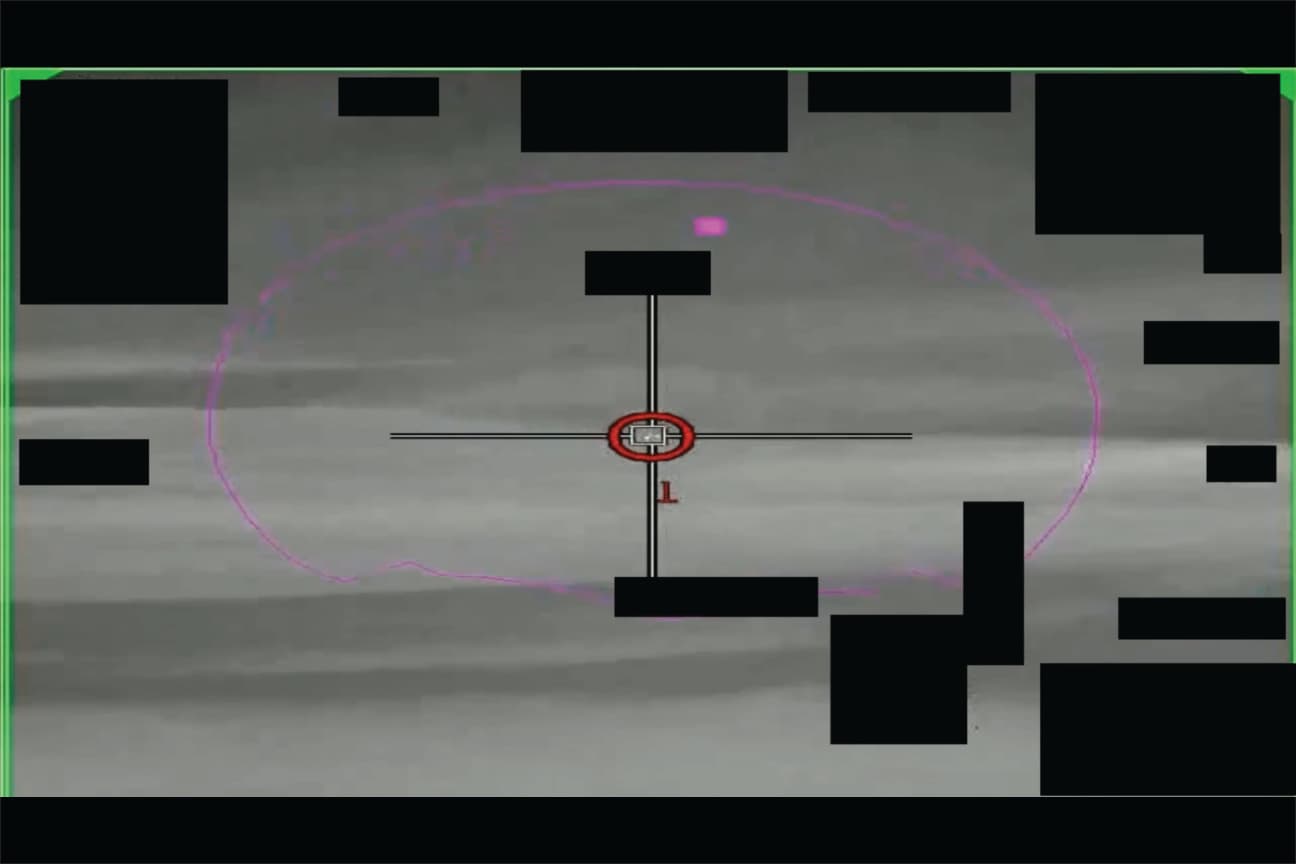
- At 1527Z, a formation of unidentified flying objects was observed — the central finding of this report.
- At 1742Z, a vessel assessed as a "Naser WAP" was observed alongside an M/V craft, both dead in the water (DIW) in the vicinity of 39RUN49. Two adult males were visible on the deck of the Naser WAP.
- At 1840Z, the aircraft was released from its tasking and returned to base.
The UAP incident: formation of unknown flying objects
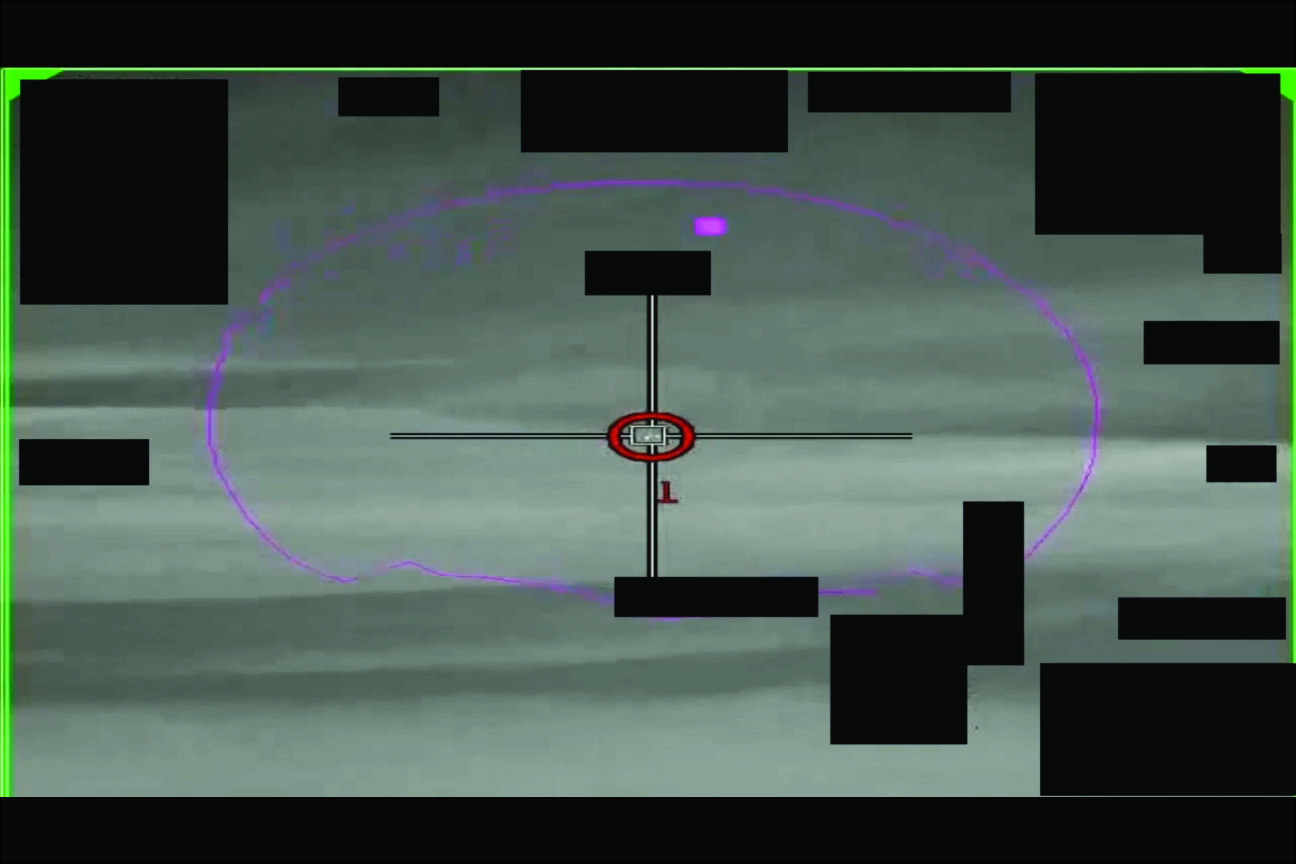
This is the most significant finding in the report. Between 1527Z and 1529Z on August 27, 2020, the aircraft observed a formation of unknown flying objects traveling northeast to northwest (NE-NW) along the coastline in the vicinity of grid 39RVM8. The crew tracked the formation for approximately two minutes using a sensor whose identity is redacted under classification exemption 1.4(a), before losing positive identification (PID) in cloud cover.
Official details of the formation as documented in the report:
- Observed activity description: FORMATION OF UNK FLYING OBJECTS
- Method of observation: sensor (classified — 1.4a)
- Location of observed activity: 39RVM8 (partial grid coordinates, partially redacted)
- Direction of travel: NE–NW along the coast
- Duration of tracking: approximately two minutes
- End of tracking: loss of PID in cloud cover; crew unable to reacquire
The weather note in the report states explicitly: "LIGHT CLOUD COVERAGE PREVENTED CONTINUOUS TRACKING OF UAP EVENT" — light cloud cover prevented continuous tracking of the UAP event. This phrasing is significant: the official report used the term "UAP" in describing the incident.
Analysis of technical data
Several technical details in the report reinforce both the credibility of the observation and the seriousness with which the military system treated the event.
ANDAS4 sensor. This is an advanced sensor suite installed on Air Force surveillance aircraft for reconnaissance and intelligence collection. Its use indicates the observation was not purely visual.
AH_GMESH system. A secondary sensor listed as available during the mission, likely associated with a data network.
21-hour sortie. The mission lasted 21 hours and 5 minutes, of which 17.9 hours were IMINT (imagery intelligence) hours and 19.2 hours were SIGINT (signals intelligence) hours. This level of coverage reflects the operational intensity of the tasking.
Weather factors. The report's explicit statement that weather prevented continued tracking — while also noting that the coverage was only "light" — raises a question worth examining: why did light cloud coverage succeed in causing a loss of identification on a formation of objects described as "flying." This incongruity between the modest weather description and the outcome warrants attention.
Significance
This report was declassified and released by Major General Richard A. Harrison, USCENTCOM Chief of Staff, on January 22, 2026, as part of the Department of Defense's broader institutional disclosure of UAP-related materials.
Several points highlight its significance.
Institutional recognition. The use of the term "UAP" in an official Air Force report — embedded in the weather section, no less — confirms that the crew understood they were tracking an unexplained phenomenon and recorded it as such through formal channels.
Intelligence gap not filled. The report explicitly records "Intel Gap Filled: No," meaning the mission failed to fully characterize the observed phenomenon. This is a formal acknowledgment that the objects were not identified.
Regional context. The event occurred in one of the most geopolitically sensitive waterways in the world — the Persian Gulf, where Iranian air defense operates, U.S. naval forces conduct continuous patrols, and maritime traffic from multiple nations converges. This environment adds considerable complexity to any interpretation of the incident.
Formal documentation. A MISREP is an operational document submitted by the crew and approved by officers. Incorporating a UAP event into such a document is not a trivial act; it reflects a deliberate choice to record the observation through the standard military reporting chain.
Key People
- MG Richard A. Harrison — USCENTCOM Chief of Staff; authorized release of this document on January 22, 2026
- POC (point of contact): 1st Lt (name redacted — 3.5c, b(3), 130b, b(6)), 482 ATKS, 432 AEW, 609 CAOC
- QC (quality control): Ctr (name redacted — 3.5c, b(6)), 12AF Det 3, PAROC
- Approver: 1st Lt (name redacted — 3.5c, b(3), 130b, b(6)), 609th AOC, 609 CAOC
Locations
- OKAS — takeoff and landing base (location classified)
- Arabian Gulf — primary area of operations
- Strait of Hormuz — secondary area of operations
- Gulf of Oman — secondary area of operations
- Greater Tunb Naval Port — IVO 40RCQ30 — observation site
- Abu Musa Island — IVO 40RCP02 — observation site
- 39RVM8 — grid location of the UAP event
- 39RUN49 — location of observed naval vessels
- 40RCP78 — aircraft position during Iranian air defense Guard call
Incidents
| Incident | Date | Location | Pages |
|---|---|---|---|
| Takeoff from OKAS | August 26, 2020, 2307Z | OKAS | 1, 4 |
| Arrival on station | August 27, 2020, 0041Z | Arabian Gulf | 4 |
| Iranian air defense Guard call | August 27, 2020, 0532Z | 40RCP78 | 1, 6 |
| Vessel observed at Greater Tunb Port | August 27, 2020, 0611Z | 40RCQ30 | 5 |
| Possible IL-76 observed over Abu Musa Island | August 27, 2020, 0702Z | Abu Musa, 40RCP02 | 5 |
| UAP formation — unknown flying objects | August 27, 2020, 1527–1529Z | 39RVM8 | 1, 6, 7 |
| Naser WAP and M/V observed | August 27, 2020, 1742Z | 39RUN49 | 5 |
| Released from tasking, returned to base | August 27, 2020, 1840Z | — | 1, 4 |
| Landing at OKAS | August 27, 2020, 2012Z | OKAS | 1, 4 |
Notable Quotes
"FROM 1527Z TO 1529Z, [REDACTED] OBSERVED A FORMATION OF FLYING OBJECTS TRAVELING NE-NW ALONG THE COAST IVO 39RVM8[...] WAS TRACKING THIS FORMATION FOR APPROXIMATELY 2 MINUTES BEFORE PID WAS LOST IN CLOUD COVER. AIRCREW WAS UNABLE TO GAIN PID AGAIN ON THIS FORMATION" — pages 6–7, primary finding
"LIGHT CLOUD COVERAGE PREVENTED CONTINUOUS TRACKING OF UAP EVENT" — page 5, ISR weather note
"LIGHT CLOUD COVERAGE PREVENTED THE CONTINOUS TRACKING OF THE FORMATION" — page 7, OBSERVATION weather note
"Observed Activity Description: FORMATION OF UNK FLYING OBJECTS" — page 6, official description of observed activity
"Intel Gap Filled?: No" — page 5, mission effectiveness
Images
1 image - click any image to enlarge
Related Articles
- DoW/DoD · 2020-07-16
Mission Report DOW-UAP-D65: Three UAP Observations in the Persian Gulf, July 16, 2020
USCENTCOM Mission Report Misrep 4472514 documents three separate observations of an unidentified aerial phenomenon during a single ISR sortie over the Persian Gulf, the Strait…
- DoW/DoD · 2020
Mission Report: UAP Observation over the Persian Gulf, August 2020
MISREP number 4592219 documents a U.S. Air Force ISR/AREC sortie over the Persian Gulf, Strait of Hormuz, and Gulf of Oman conducted on August 8-9…
- DoW/DoD · 2020-09-15
Mission Report DOW-UAP-D62: UAP Observation, Link-Loss Events, and Iranian Air-Defense Intercepts over the Strait of Hormuz, September 2020
Mission Report MISREP 4782130 from the U.S. Air Force 482 ATKS / 432 AEW documents an intense 21-hour ISR sortie over the Strait of Hormuz…
- DoW/DoD · 2020
Range Fouler Debrief Form — Middle East Theater, May 2020
This document is a Range Fouler Debrief Form re-reviewed for release by Brigadier General Richard A. Harrison, USCENTCOM Chief of Staff. It records a UAP…