Mission Report DOW-UAP-D65: Three UAP Observations in the Persian Gulf, July 16, 2020
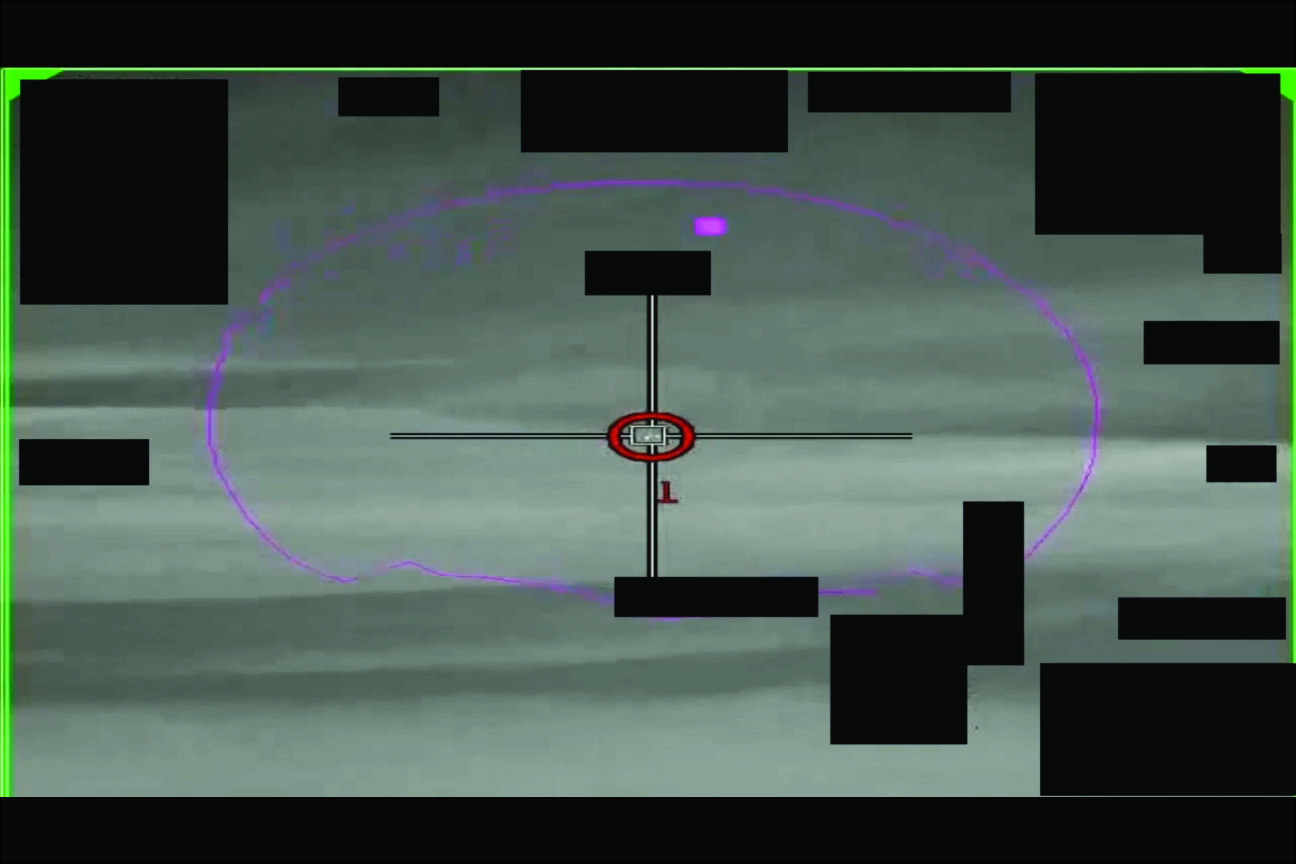
Source file: dow-uap-d65-mission-report-persian-gulf-july-2020.pdf Originating agency: Department of War / Department of Defense, USCENTCOM Report number: Misrep 4472514 Date: July 16, 2020 Page count: 8 High-significance pages: pages 6 and 7 (OBSERVATION and GENTEXT/OBSERVATION sections)
Official Blurb (from war.gov)
This document is a Mission Report (MISREP), a standardized reporting form the U.S. Military uses to record the circumstances surrounding its operations. U.S. military services often use MISREPs to report Unidentified Anomalous Phenomena (UAP) to AARO. A U.S. military operator reported encountering three separate UAP on July 16, 2020, at 1830Z, 1920Z, and 2345Z. The GENTEXT, or "general text" section of these reports often contains important qualitative, contextual information.
Summary
Misrep 4472514, produced by USCENTCOM and released as part of PURSUE Initiative Release 1, documents a particularly rare occurrence: three separate UAP observations made by the same aircraft on the same day, over a window of more than five hours. The aircraft was operated by the 482nd Attack Squadron (482 ATKS) and the 432nd Air Expeditionary Wing (432 AEW) of the U.S. Air Force. It departed OKAS (Ali Al Salem Air Base, Kuwait) at 0443Z and spent more than 21 hours on mission in support of U.S. Naval Forces Central Command (NAVCENT). The platform carried the ANDAS4 targeting pod and the AH_GMESH avionics suite — a profile consistent with a long-endurance unmanned aircraft such as the MQ-9 Reaper. All three observations — at 1830Z, 1920Z, and 2345Z — were made in the vicinity of MGRS grid-square 39R, which encompasses the Persian Gulf. All three were captured through full-motion video (FMV) and returned for exploitation by DGS-1.
Research Article
Introduction
DOW-UAP-D65 is part of the PURSUE Initiative Release 1 series, published by the Department of War on May 8, 2026. Within that series, D65 stands out for one central reason: it records three distinct UAP observations made by the same aircraft in a single day, spanning more than five hours. While many documents in the series capture a single sighting, a cluster of three within one mission, in a geographically compact area, suggests either recurrent activity by a phenomenon in the operating zone or intermittent observation of one or more objects over the course of a long patrol.
The event occurred on July 16, 2020, in the Persian Gulf — an area of paramount strategic sensitivity. In June and July 2020, only months after the assassination of General Qasem Soleimani in January 2020, U.S.-Iran tensions were running high. NAVCENT maintained active surveillance of Iranian naval movements, including Houdong-class, Naser-class, and Safir-class vessels. The report itself notes Iranian naval sightings during the same mission: at 1932Z the crew observed a Safir Kish vessel, and at 2140Z they observed Houdong and Naser vessels anchored at Bushehr.
Mission Profile
The mission was classified as an AREC (Aerial Reconnaissance) sortie in support of NAVCENT, tasked to scan "identified vessels outside of ports, to determine pattern of life, UAS activity, and unusual activity characteristics." In other words, it was a maritime intelligence and pattern-of-life mission focused on Iranian naval movements. The key timeline:
- 0443Z: Takeoff from OKAS (Ali Al Salem, Kuwait)
- 0504Z: Arrival on station
- 0552Z to 0012Z: NAVCENT support; scans per target deck in the Persian Gulf
- 0615Z: Guard call received (standard safety radio); standard response
- 0645Z: Naser WAP vessel observation
- 1830Z: First UAP observation
- 1920Z: Second UAP observation
- 1932Z: Safir Kish vessel observation
- 2140Z: Houdong and Naser vessels observed at Bushehr
- 2345Z: Third UAP observation
- 0012Z (July 17): Mission end; return to base
- 0124Z: Control returned to LRE
- 0200Z: Landing at OKAS
Total mission duration: 21 hours and 17 minutes, of which 20 hours and 20 minutes were spent on station. Total tallied hours: 20.3 mission hours, 18.3 of which were IMINT (imagery intelligence). All FMV product was allocated to DGS-1 (Distributed Ground System 1) for exploitation.
Three UAP Observations
The three observations are documented in separate OBSERVATION sections on pages 6 and 7. Each includes a timestamp (DTG), aircraft position, altitude, airspeed, activity location, and method of observation. In all three cases the observation method was FMV — full-motion video — meaning the phenomenon was recorded by the aircraft's airborne sensor.
First Observation: 1830Z
- DTG: 161830:00ZJUL20
- Aircraft altitude: FL 200 (approximately 20,000 feet)
- Aircraft airspeed: 98 KIAS (knots indicated airspeed)
- Aircraft heading: 152 magnetic (south-southeast)
- Aircraft position: 39RXK (partial grid, partially redacted)
- Activity location: 39RVM (partial grid, partially redacted)
The GENTEXT for this observation reads: "AT 1830Z OBSERVED AN UNIDENTIFIED AERIAL PHENOMENON IVO 9RVM..." (with coordinate elements redacted). Local time at the Persian Gulf (UTC+3 or +4 depending on precise location) places the sighting in the early-to-mid evening hours.
Second Observation: 1920Z
- DTG: 161920:00ZJUL20
- Aircraft altitude: FL 190 (approximately 19,000 feet)
- Aircraft airspeed: 90 KIAS
- Aircraft heading: 34 magnetic (north-northeast)
- Aircraft position: 39RUN (partial grid, partially redacted)
- Activity location: 39RUN (same grid area)
The GENTEXT reads: "AT 1920Z OBSERVED AN UNIDENTIFIED AERIAL PHENOMENON IVO 39RUN..." Only 50 minutes elapsed between the first and second observations. The aircraft changed heading by 118 degrees — from 152 to 34 — and descended 1,000 feet. These changes may indicate the crew was maneuvering to follow the phenomenon.
Third Observation: 2345Z
- DTG: 162345:00ZJUL20
- Aircraft altitude: FL 191 (approximately 19,100 feet)
- Aircraft airspeed: 115 KIAS
- Aircraft heading: 331 magnetic (north-northwest)
- Activity location: 39RUN6234236874 (near-complete coordinate)
The GENTEXT reads: "AT 2345Z OBSERVED AN UNIDENTIFIED AERIAL PHENOMENON IVO 39RUN6234236874." The third observation occurred approximately four and a half hours after the second, in darkness (approximately 02:45 local time). The near-complete MGRS coordinate 39RUN6234236874 places the sighting in the northern sector of the Persian Gulf, near the Iranian coastline.
Technical Analysis: What Can the Details Tell Us?
The Observing Platform
The primary sensor, ANDAS4, combined with the AH_GMESH avionics and the flight profile — relatively low altitudes of FL 190–200, slow airspeeds of 90–115 knots, and a 21-hour endurance — is consistent with an MQ-9 Reaper UAS assigned to the 482nd Attack Squadron, a drone unit. This means the "operator" who reported the observations was not physically aboard the aircraft but was a ground-based sensor operator monitoring the FMV feed remotely.
MGRS Positioning and Location Overlap
MGRS coordinates in the 39R zone cover eastern Iraq, western Iran, the northeastern Arabian Peninsula, and the Persian Gulf. The three grids cited in the report — 39RXK, 39RVM, and 39RUN — fall within a relatively compact sector, each cell spanning roughly 100 kilometers, indicating the mission was concentrated in a specific sector of the gulf. Combined with the Iranian naval observations (Naser WAP, Safir Kish, Houdong) and the reference to Bushehr (Iran's principal naval port on the gulf's eastern shore), the observations most likely occurred in the northern half of the Persian Gulf, within 50–200 km of the Iranian coast.
Timing of Multiple Observations
The interval between the three observations is not random. Observation 1 (1830Z) and Observation 2 (1920Z) are separated by 50 minutes — enough time for transit between adjacent grid cells but little more. Observation 3 (2345Z) comes 4 hours and 25 minutes after the second. This chronology is consistent with two interpretations:
- Recurrent activity in the area — different objects appearing in the operating zone over the course of the day.
- Intermittent tracking of a single object — which was available for observation only at intervals.
Distinguishing between these possibilities is not achievable from the available report data, since the GENTEXT contains no physical description of the objects — no shape, size, color, speed, or flight characteristics of the UAP themselves.
Comparison with Other D-Series Records
D65 is notable for the absence of any physical description of the objects — in contrast to other reports in the series (such as D8, which describes "2 round white hot UAPs"). The report confines itself to "OBSERVED AN UNIDENTIFIED AERIAL PHENOMENON" three times. It is possible that descriptive detail was redacted under FOIA exemption 1.4(a), or that the GENTEXT fields in the original document simply did not contain a physical description. However, all three observations are recorded as having been captured on FMV, meaning video documentation may exist in separate holdings and could support deeper analysis if released.
Strategic Significance
The geographic setting of these observations — the Persian Gulf in summer 2020 — was among the most sensitive operational environments in the world. Only days after the third observation, on July 19, 2020, an explosion occurred at a missile storage facility in Na'in, Iran, one in a series of incidents attributed to cyber operations and sabotage. The months preceding July 2020 had included the Soleimani strike (January 3), strikes on Ain al-Asad Air Base (January 8), and the Iranian shootdown of Ukrainian Airlines Flight 752 (January 8). In that climate, multiple UAP observations by a U.S. ISR aircraft in Persian Gulf airspace are not a peripheral event.
Conclusion
DOW-UAP-D65 is among the most event-dense records in the D series, with three separate UAP observations that clearly meet the military criteria for "unidentified aerial phenomenon." The absence of detailed physical description in the GENTEXT limits its analytical value, but the existence of FMV documentation for all three sightings leaves open the possibility of more substantive investigation if the video records are ever released. The combination of three observations, a high-value strategic location, and an advanced ISR collection platform makes this one of the more significant reports in the series.
Key People
- MG Richard A. Harrison — USCENTCOM Chief of Staff; authorized declassification on March 16, 2026.
- POC: 2d Lt from 482 ATKS, 432 AEW (name redacted).
- QC: Officer from 12 AF PAROC (name redacted).
- APPROVER: Capt from 609 AOC ISRD Unit Support (name redacted).
Locations
- Persian Gulf / Arabian Gulf — central location of all three observations.
- Strait of Hormuz — strategic chokepoint between the Persian Gulf and the Gulf of Oman.
- Gulf of Oman — secondary operating area.
- Bushehr — Iranian port where Iranian naval vessels were observed during the mission.
- OKAS — takeoff and landing base (Ali Al Salem Air Base, Kuwait).
- MGRS 39R — grid zone for all three observation coordinates.
Incidents
| Incident | Date | Location | Pages |
|---|---|---|---|
| First UAP observation (FMV), FL 200, heading 152M, 98 KIAS | 1830Z, July 16, 2020 | MGRS 39RVM (partially redacted) | p. 6 |
| Second UAP observation (FMV), FL 190, heading 34M, 90 KIAS | 1920Z, July 16, 2020 | MGRS 39RUN (partially redacted) | p. 6 |
| Third UAP observation (FMV), FL 191, heading 331M, 115 KIAS | 2345Z, July 16, 2020 | MGRS 39RUN6234236874 | p. 7 |
Notable Quotes
"AT 1830Z OBSERVED AN UNIDENTIFIED AERIAL PHENOMENON IVO 9RVM..." — page 6, GENTEXT/OBSERVATION
"AT 1920Z OBSERVED AN UNIDENTIFIED AERIAL PHENOMENON IVO 39RUN..." — page 6, GENTEXT/OBSERVATION
"AT 2345Z OBSERVED AN UNIDENTIFIED AERIAL PHENOMENON IVO 39RUN6234236874" — page 7, GENTEXT/OBSERVATION
"AT 0443Z TOOK OFF FROM OKAS. AT 0504Z HANDED OVER FROM THE LRE. FROM 0631Z TO 0050Z FROM 0552Z TO 0012Z SUPPORTED NAVCENT TO OPERATION IVO ARABIAN GULF, STRAIT OF HORMUZ AND GULF OF OMAN." — page 1, Narrative
Images
1 image - click any image to enlarge
Related Articles
- DoW/DoD · 2020-09-15
Mission Report DOW-UAP-D62: UAP Observation, Link-Loss Events, and Iranian Air-Defense Intercepts over the Strait of Hormuz, September 2020
Mission Report MISREP 4782130 from the U.S. Air Force 482 ATKS / 432 AEW documents an intense 21-hour ISR sortie over the Strait of Hormuz…
- DoW/DoD · 2020-10-01
Mission Report DOW-UAP-D63: UAP Observation in the Strait of Hormuz, October 2020
Mission Report MISREP 4871281 from the 482 ATKS / 432 AEW under USCENTCOM documents a 21-hour ISR sortie from OKAS (Ali Al Salem, Kuwait) over…
- DoW/DoD · 2020-11-02
Mission Report DOW-UAP-D64: Two UAP over the Arabian Gulf during an IRGCN-Focused ISR Mission, November 2020
Mission Report MISREP 5039166 from the 482 ATKS / 432 AEW documents two UAP observations five minutes apart on November 2, 2020, over the Arabian…
- DoW/DoD · 2020
Mission Report: Formation of Unknown Flying Objects over the Persian Gulf, August 2020
MISREP number 4685903, filed by the 482 ATKS unit of the 432 AEW under USCENTCOM, documents a 21-hour ISR/SIGINT sortie over the Arabian Gulf, Strait…