Mission Report DOW-UAP-D62: UAP Observation, Link-Loss Events, and Iranian Air-Defense Intercepts over the Strait of Hormuz, September 2020
Source file: dow-uap-d62-mission-report-strait-of-hormuz-september-2020.pdf Originating agency: Department of War / Department of Defense (USCENTCOM) Date range: September 15–16, 2020 (152302Z SEP20 to 162008Z SEP20) Page count: 9 (all read) High-significance pages: page 1 (Misrep 4782130 Narrative), page 5 (GENTEXT/ISR operational timeline), page 7 (first EMI event), page 8 (second EMI event; UAP observation), page 4 (timeline and takeoff data) Classification marking: USCENTCOM MDR 26-0019 / Approved for Release to AARO / 01/26/26 Declassification date: January 22, 2026 (by MG Richard A. Harrison, USCENTCOM Chief of Staff)
Official Blurb (from war.gov)
This document is a Mission Report (MISREP), a standardized reporting form the U.S. Military uses to record the circumstances surrounding its operations. U.S. military services often use MISREPs to report Unidentified Anomalous Phenomena (UAP) to AARO. The GENTEXT, or "general text" section of these reports often contains important qualitative, contextual information, distinguishing it from the more quantitative, or numerical, data found elsewhere in the report.
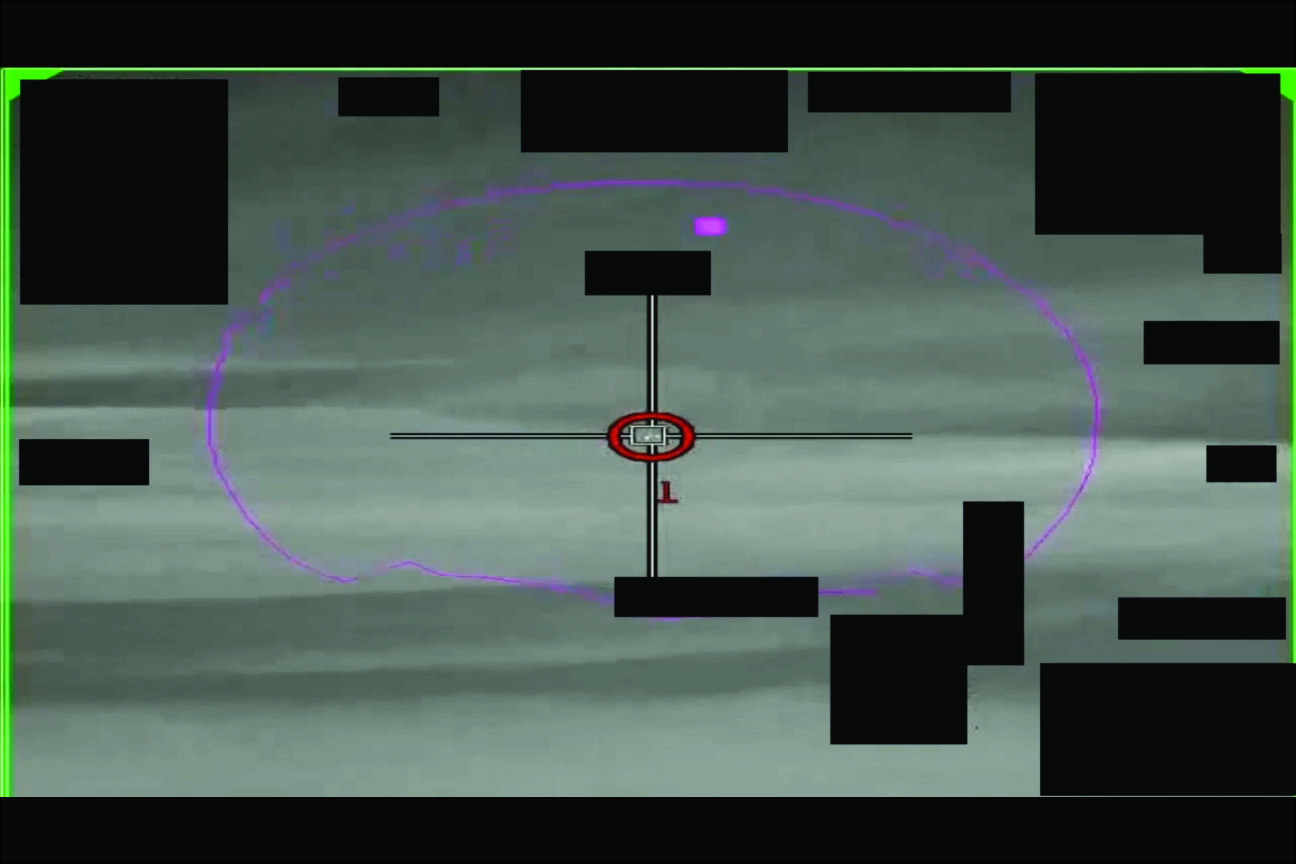
A U.S. military operator reported observing one UAP at an estimated altitude of 1,800 feet.
All descriptive and estimative language contained in this report reflects the reporter's subjective interpretation at the time of the event.
Summary
DOW-UAP-D62 is MISREP number 4782130 of the U.S. Air Force, produced by the 482nd Attack Squadron (482 ATKS) under the 432nd Air Expeditionary Wing (432 AEW) at the 609th Combined Air Operations Center (609 CAOC), under USCENTCOM command. The operational asset — identity redacted under FOIA exemptions 1.4(a) and 1.4(g) — departed OKAS at 152302Z SEP20 (September 15, 2020, 23:02 UTC) and returned after 20 hours and 56 minutes on mission.
The sortie was an AREC (Aerial Reconnaissance) mission in support of NAVCENT (Naval Forces Central Command), tasked to characterize IRIN/IRGCN vessels, unmanned aerial system activity, out-of-port activity, and to establish a pattern of life in the area. During 20 hours and 10 minutes on station, the crew documented a series of events: three guard calls from Iranian air defense on 243.000 MHz and additional redacted frequencies; two link-loss events (Lost Link / EMI) lasting 11 and 27 minutes respectively; an IR-SA-5 launcher sighted on Abu Musa Island; two possible Houdong fast-attack craft anchored pierside at MGRS 39RXL60; and a UAP observation at 161732Z SEP20 in the vicinity of 39RVM51, at FL180, 90 KIAS, captured via FMV and analyzed by DGS1.
Research Article
Introduction
DOW-UAP-D62 belongs to the PURSUE Initiative Release 1 series, published by the Department of War in 2026. The D series spans D1 through D75, consisting of military MISREP reports of UAP encounters from recent decades. D62 records an incident from September 16, 2020, that occurred in the Strait of Hormuz — strategically the most constricted waterway in the Middle East, through which approximately one-third of all seaborne oil shipments transit annually.
The Strait of Hormuz separates the Arabian Peninsula (Oman) from Iran and connects the Arabian Gulf to the Gulf of Oman. Since 2019 the area has been a high-friction zone between the United States and its Gulf partners on one side and Iran and its proxies on the other. In 2020 specifically, the operational backdrop included sustained tension following the January 2020 strike on General Qasem Soleimani, subsequent Iranian ballistic-missile attacks on Ain al-Asad Air Base in Iraq, and a marked uptick in Iranian naval and aerial activity in the region.
The report sheds rare light on the character of U.S. operations in the area: not merely a single UAP sighting, but a broad picture of SIGINT collection via AIRHANDLER, ISR activity, and the crew's management of electromagnetic interference (EMI) events that caused link loss and flight-path deviations.
Mission Framework
The operational asset, fully redacted, was assigned to 482 ATKS — an attack squadron operating primarily with the MQ-9 Reaper, though the exact type is withheld under 1.4(a) and 1.4(g). Number of aircraft: one. Base of operations: OKAS, the ICAO identifier for Ali Al Salem Air Base in Kuwait. The aircraft was under LRE (Launch and Recovery Element) control, handed over to the mission element at 152313Z SEP20 — eleven minutes after takeoff.
Primary sensor: ANDAS4, an electro-optical/infrared (EO/IR) targeting pod standard on the MQ-9, providing day and night imaging (FLIR) with tracking, photography, and target identification capability. Available avionics: AH\GMESH — most likely an AIRHANDLER SIGINT collection system integrated with a supplementary sensor suite. FMV product was exploited by DGS1, the first unit of the Air Force's Distributed Common Ground System.
Mission totals: 20.9 hours of operations; 15.2 hours of IMINT (imagery intelligence); one IMINT tasking executed; 19.3 hours of SIGINT; one SIGINT tasking executed; two total taskings completed. The original planned declassification date was March 1, 2045 (20450301), but the document was released nearly two decades early under the PURSUE Initiative.
Operational Timeline
The main narrative on page 1 provides a precise timeline of events. All times are Zulu (UTC); dates are September 15–16, 2020:
- 2302Z (September 15): Takeoff from OKAS.
- 2313Z: Control transferred from LRE.
- 2346Z to 1902Z (~19.3 hours): SIGINT collection via AIRHANDLER.
- 0318Z to 1829Z (~15.2 hours, September 16): NAVCENT support for a [redacted] operation in the vicinity of the Arabian Gulf, Strait of Hormuz, and Gulf of Oman.
- 0408Z: First guard call from Iranian air defense. Aircraft at 40RCP76 (partially redacted), heading 360T (true north), FL180.
- 0421Z: Second guard call; same sequence. Aircraft at 40RCP76, heading 010M (magnetic), FL180.
- 0930Z: IR-SA-5 launcher observed in the vicinity of 40RCP03 on Abu Musa Island.
- 1141Z: Third guard call, this time specifically on 243.000 MHz. Aircraft at 40RCP28, heading 277T, FL040 (4,000 feet). Tone: PROFESSIONAL (compared to DIRECTIVE in earlier calls).
- 1248Z to 1259Z (11 minutes): First EMI event; link lost. Aircraft at 39RXK06, heading 290T, FL180, 89 KIAS. Mission change: flight-path deviation. System impact: complete. Mission impact: MEDIUM. JSIR ID330412.
- 1321Z: Two possible Houdong-class fast-attack craft observed anchored pierside in the vicinity of 39RXL60.
- 1414Z to 1441Z (27 minutes): Second EMI event; link lost. Aircraft at 39RVM92, heading 264T, FL180, 120 KIAS. Flight-path deviation. Mission impact: MEDIUM. JSIR ID330414.
- 1732Z: UAP observation. Aircraft at 39RVM51, FL180, 90 KIAS. Observation method: FMV. Description: UAP. GENTEXT summary: "AT 1732Z, [REDACTED] OBSERVED A UAP IVO 39RVM51[REDACTED]70."
- 1829Z: Aircraft released from tasking and turned for return to base (RTB).
- 1923Z: Control returned to LRE.
- 161958Z: Landing at OKAS.
- 162008Z: Last engine shutdown.
The UAP Observation
The OBSERVATION section on page 8 documents the core of the report. Numerical data:
- Observation DTG: 161732:00ZSEP20 (September 16, 2020, 17:32 UTC). In Iranian local time (UTC+4 / +3:30), this falls in the late afternoon — approximately 21:02 or 21:32 locally.
- MGRS coordinate: 39RVM51[1.4a]70[1.4a]. Grid zone 39RVM covers the eastern Arabian Peninsula, Strait of Hormuz, and southwestern Iran. The coordinate approximates the Strait of Hormuz area near 26°34'N 56°15'E.
- Aircraft altitude: FL180 (18,000 feet, approximately 5,486 meters).
- Aircraft airspeed: 90 KIAS (~167 km/h). A slow, surveillance-paced airspeed typical of an MQ-9 on patrol.
- Observation method: FMV — the observation was made through the ANDAS4 EO/IR sensor and recorded as real-time video.
- UAP altitude: Per the official war.gov summary, the operator reported the UAP at an estimated altitude of 1,800 feet (~549 meters). This places the object roughly 16,200 feet below the aircraft — relatively close to the sea surface or terrain.
- Activity description: "UAP" (no further elaboration available in the released GENTEXT).
- Weather: "WEATHER WAS NOT A FACTOR." This is significant because it rules out atmospheric explanations — clouds, fog, wind — as the cause of the observation.
The GENTEXT/OBSERVATION itself is brief: "AT 1732Z, [REDACTED] OBSERVED A UAP IVO 39RVM51[REDACTED]70." Any detailed visual description of the UAP, if it existed, would be in the FMV record and the DGS1 exploitation analysis — neither of which appears in this report.
Analysis
Broader Mission Context
The UAP was not observed in isolation. It appeared during an intense ISR mission in the Strait of Hormuz that had already included repeated interactions with Iranian air defense, sustained SIGINT collection, and two significant EMI events. Both link-loss episodes involved "Lost Link" — a severed communication channel between the aircraft and its ground operators — and both required flight-path deviations. Both were filed with JSIR (Joint Spectrum Interference Resolution) under separate identification numbers: 330412 and 330414.
The EMI events carry particular significance given their temporal proximity to the UAP sighting. Both occurred several hours before the UAP was observed. If the EMI source were a known Iranian capability — GPS jamming or communications jamming, which Iran routinely employs in the strait — it might have been attributed accordingly; the classification of both events as "UNKNOWN" indicates that the operators could not determine the source during the flight.
Position Identification
The coordinate 39RVM51 in MGRS, combined with the mission header referencing the "Strait of Hormuz and Gulf of Oman," places the observation approximately in the strait itself. Other positions recorded during the same mission — 39RXK06 (first EMI), 39RVM92 (second EMI), 39RXL60 (Houdong vessels), 40RCP03 (IR-SA-5 on Abu Musa), 40RCP76 and 40RCP28 (guard calls) — straddle the boundary between UTM zones 39R and 40R, which runs near longitude 54°E, roughly near Abu Musa and the western entrance to the Strait of Hormuz.
Iranian Threat Environment
The non-UAP observations in the report paint a clear picture of the Iranian threat posture in the area that day:
-
IR-SA-5 launcher: A long-range surface-to-air missile system — likely a Bavar-373 or an SA-5 Gammon — on Abu Musa Island, a contested Iranian-held island near the UAE. An active long-range SAM launcher on Abu Musa represents a significant forward air-defense deployment.
-
Houdong-class vessels: Chinese Type 021 / Houdong-class fast-attack missile boats sold to Iran in the 1990s, each armed with four C-802 anti-ship missiles. Two anchored pierside at 39RXL60 is a routine but intelligence-relevant observation.
-
Three Iranian air-defense guard calls: Three transmissions on international guard frequencies within less than eight hours is an elevated rate. The tone shifted from DIRECTIVE (commanding, ordering departure) to PROFESSIONAL (standard, non-threatening). The U.S. crew responded with "STANDARD RESPONSE" in each case.
What Does "UAP" Mean in This Context?
In the Strait of Hormuz setting in 2020, the UAP sighting is a puzzle. Plausible explanations include an Iranian UAS (the IRGC operates a wide variety of drones, including the Mohajer, Shahed-129, and Shahed-136), though those platforms would ordinarily be identified as "UAS" rather than "UAP" by an experienced ANDAS4 operator. A marine vessel at 1,800 feet is not consistent with any known Iranian craft. The report itself rules out atmospheric causes ("WEATHER WAS NOT A FACTOR"). A surveillance balloon is possible. The decision to include the event in the PURSUE Initiative series and forward it to AARO suggests that at least some routine explanations were ruled out during DGS1's FMV analysis.
Significance
D62 carries analytical weight on several fronts.
First, operational context: This is an active ISR mission in a zone of demonstrable hostile activity. A UAP observation under such conditions is uncommon in public releases.
Second, the two EMI events: Two link-loss episodes of 11 and 27 minutes with "UNKNOWN" source classification, within the same mission that later recorded a UAP, creates a temporal pattern that analysts will examine. The report makes no explicit connection between the EMI events and the UAP, but the proximity in time is noted.
Third, geo-strategic location: The Strait of Hormuz is a chokepoint of global consequence. The accumulation of UAP reports from the area — D57, D75 from Aden, D8 from Djibouti, and now D62 from Hormuz — traces a pattern of UAP activity in zones of intensive maritime military presence.
Fourth, FMV documentation: Unlike earlier reports relying on visual observation alone, this sighting was recorded by the ANDAS4 sensor and analyzed by DGS1. The existence of video documentation enables retrospective AARO analysis.
Fifth, early declassification: The originally planned declassification date was March 1, 2045. The document was released nearly two decades ahead of schedule under the PURSUE Initiative, reflecting a deliberate policy decision to prioritize UAP transparency over standard declassification timelines.
Key People
All personal identifying information was redacted under FOIA exemptions 3.5c, (b)(3), 130b, and (b)(6). Ranks and units that remain visible:
- POC (Point of Contact): SSgt (Staff Sergeant), 482 ATKS, 432 AEW, 609 CAOC, U.S. Air Force.
- QC (Quality Control): Ctr (Contractor), 12AF Det 3, PAROC, U.S. Air Force.
- APPROVER: SrA (Senior Airman), 609th AOC, U.S. Air Force.
- Declassification authority: Major General Richard A. Harrison, USCENTCOM Chief of Staff; authorized declassification January 22, 2026.
Locations
- Strait of Hormuz — strategic waterway between the Gulf of Oman and the Arabian Gulf; primary incident area.
- Arabian Gulf (also called the Persian Gulf) — main operational area.
- Gulf of Oman — open sea south of the Strait of Hormuz.
- Abu Musa Island — contested Iranian-held island; site of the observed IR-SA-5 launcher.
- OKAS — Ali Al Salem Air Base, Kuwait; takeoff and landing point.
- Iran — source of Iranian air-defense guard calls.
- NAVCENT AOR — U.S. Naval Forces Central Command area of responsibility.
Incidents
| Incident | Date/Time | Location | Pages |
|---|---|---|---|
| Takeoff from OKAS | 152302Z SEP20 | OKAS, Kuwait | p. 4 |
| Control transferred from LRE | 152313Z SEP20 | OKAS | p. 4 |
| SIGINT collection via AIRHANDLER | 152346Z to 161902Z | General area | p. 1 |
| On station in NAVCENT support | 160318Z SEP20 | Strait of Hormuz | p. 5 |
| First guard call — Iranian air defense | 160408Z SEP20 | 40RCP76, FL180, heading 360T | p. 6 |
| Second guard call | 160421Z SEP20 | 40RCP76, FL180, heading 010M | p. 6 |
| IR-SA-5 launcher observed | 160930Z SEP20 | Abu Musa, IVO 40RCP03 | p. 5 |
| Third guard call — 243.000 MHz | 161141Z SEP20 | 40RCP28, FL040, heading 277T | p. 7 |
| First EMI event — 11-minute link loss | 161248Z to 161259Z | 39RXK06, FL180, 89 KIAS | p. 7 |
| Two possible Houdong vessels observed | 161321Z SEP20 | IVO 39RXL60, anchored pierside | p. 5 |
| Second EMI event — 27-minute link loss | 161414Z to 161441Z | 39RVM92, FL180, 120 KIAS | p. 8 |
| UAP observed via FMV | 161732Z SEP20 | IVO 39RVM51, FL180, 90 KIAS; UAP estimated altitude 1,800 ft | p. 8 |
| Released from tasking (RTB) | 161829Z SEP20 | Strait of Hormuz | p. 1 |
| Control returned to LRE | 161923Z SEP20 | OKAS | p. 1 |
| Landing at OKAS | 161958Z SEP20 | OKAS, Kuwait | p. 4 |
| Last engine shutdown | 162008Z SEP20 | OKAS | p. 4 |
Notable Quotes
"AT 1732Z, [REDACTED] OBSERVED A UAP IVO 39RVM51[REDACTED]70" — page 8, GENTEXT/OBSERVATION
"A U.S. military operator reported observing one UAP at an estimated altitude of 1,800 feet." — official war.gov summary
"AT 1248Z, [REDACTED] EXPERIENCED LOST LINK TO POSSIBLE [REDACTED]. REGAINED LINK AT 1259Z. THIS RESULTED IN A MEDIUM IMPACT TO THE MISSION" — page 7, GENTEXT/EMI
"AT 1414Z, [REDACTED] EXPERIENCED LOST LINK TO POSSIBLE [REDACTED]. REGAINED 1441Z. THIS RESULTED IN A MEDIUM IMPACT TO THE MISSION" — page 8, second GENTEXT/EMI
"AT 0930Z, [REDACTED] OBSERVED AN IR-SA-5 LAUNCHER IVO 40RCP03[REDACTED] ON ABU MUSA ISLAND. AT 1321Z, [REDACTED] OBSERVED 2X POSSIBLE HOUDONG WPTG IVO (39RXL60[REDACTED]) DOCKED PIERSIDE." — page 5, GENTEXT/ISR
"[REDACTED] WAS HAILED ON GUARD 243.000 FREQ BY IRANIAN AIR DEFENSE. STANDARD ORDERS GIVEN. [REDACTED] RESPONDED WITH STANDARD RESPONSE. NO IMPACT TO MISSION" — page 7, third GENTEXT/GUARDCALL
"WEATHER WAS NOT A FACTOR" — pages 5, 9, WEATHER section
Images
1 image - click any image to enlarge
Related Articles
- DoW/DoD · 2020-10-01
Mission Report DOW-UAP-D63: UAP Observation in the Strait of Hormuz, October 2020
Mission Report MISREP 4871281 from the 482 ATKS / 432 AEW under USCENTCOM documents a 21-hour ISR sortie from OKAS (Ali Al Salem, Kuwait) over…
- DoW/DoD · 2020-07-16
Mission Report DOW-UAP-D65: Three UAP Observations in the Persian Gulf, July 16, 2020
USCENTCOM Mission Report Misrep 4472514 documents three separate observations of an unidentified aerial phenomenon during a single ISR sortie over the Persian Gulf, the Strait…
- DoW/DoD · 2020-11-02
Mission Report DOW-UAP-D64: Two UAP over the Arabian Gulf during an IRGCN-Focused ISR Mission, November 2020
Mission Report MISREP 5039166 from the 482 ATKS / 432 AEW documents two UAP observations five minutes apart on November 2, 2020, over the Arabian…
- DoW/DoD · 2020
Range Fouler Debrief Form — Middle East Theater, May 2020
This document is a Range Fouler Debrief Form re-reviewed for release by Brigadier General Richard A. Harrison, USCENTCOM Chief of Staff. It records a UAP…