Mission Report: UAP Observation over the Persian Gulf, August 2020
Source file: dow-uap-d60-mission-report-persian-gulf-august-2020.pdf Originating agency: Department of Defense / DoD Modern UAP — USCENTCOM Date range: August 8–9, 2020 Page count: 6 (all read) High-significance pages: page 1 (narrative and summary), page 4 (timeline — Guard call and UAP observation), page 5 (ISR and on-station status), page 6 (ISR asset utilization and remarks)
Official Blurb (from war.gov)
This document is a Mission Report (MISREP), a standardized reporting form the U.S. Military uses to record the circumstances surrounding its operations. U.S. military services often use MISREPs to report Unidentified Anomalous Phenomena (UAP) to AARO. The GENTEXT, or "general text" section of these reports often contains important qualitative, contextual information, distinguishing it from the more quantitative, or numerical, data found elsewhere in the report. A U.S. military operator reported observing one UAP. The report describes the UAP as "transiting" and notes it had "no impact to mission." The report also states that "dense cloud coverage intermittently impacted FMV collection." All descriptive and estimative language contained in this report reflects the reporter's subjective interpretation at the time of the event. Such characterizations should not be interpreted as a conclusive indication of the presence or absence of any intrinsic object features or performance characteristics.
Summary
MISREP number 4592219 documents a U.S. Air Force ISR/AREC sortie over the Persian Gulf, Strait of Hormuz, and Gulf of Oman, conducted on August 8–9, 2020. During the mission, at 0726Z, a single UAP was observed using FMV. The operation supported NAVCENT and was tasked to scan Iranian vessels, characterize patterns of activity, and monitor UAS operations. Additionally, at 1250Z, the aircraft was hailed by Iranian air defense forces on the Guard frequency.
Research Article
Introduction
This MISREP was originally classified SECRET and released to the public on March 20, 2026, by Major General Richard A. Harrison, USCENTCOM Chief of Staff. It was included in the USCENTCOM MDR document package MDR 26-0038 through MDR 26-0046, cleared for release to AARO. The mission was conducted by the 482 ATKS unit under the 432 AEW, directed by the 609th Air Operations Center.
Mission progression
The classified air vehicle departed base OKAS at 0337Z on August 8, 2020. Following handover from the LRE at 0359Z, the aircraft began collecting SIGINT via an airhandler between 0434Z and 2300Z. The ISR portion of the mission accounted for 18.4 hours and the IMINT portion for 17.7 hours, with a total mission duration of 20.3 hours.
The aircraft supported NAVCENT in connection with a classified operation (name withheld) across the Arabian Gulf, Strait of Hormuz, and Gulf of Oman. The tasking was structured around a pre-defined Target Deck, focusing on monitoring Iranian naval vessels, characterizing UAS activity, and describing activity outside ports. On-station time totaled 20 hours and 18 minutes.
The UAP incident
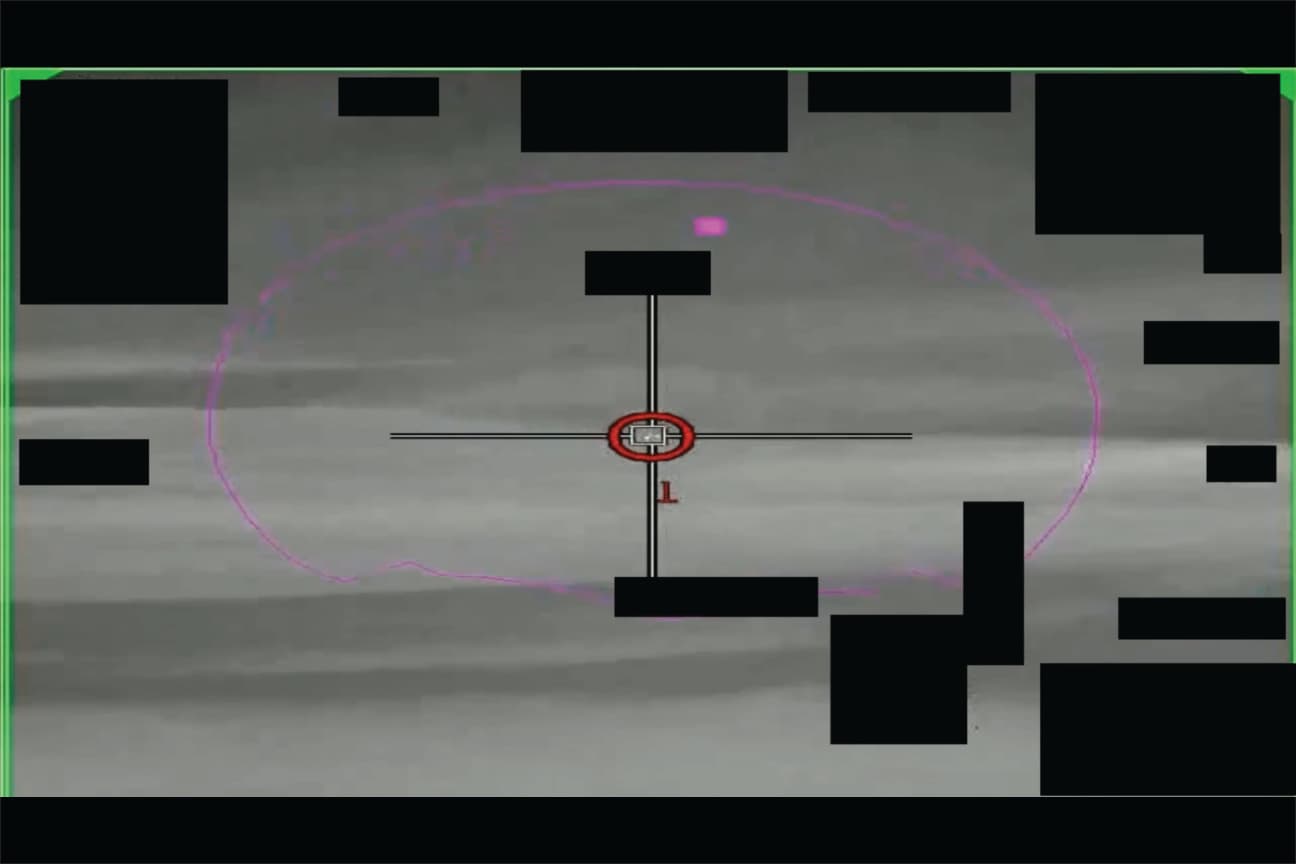
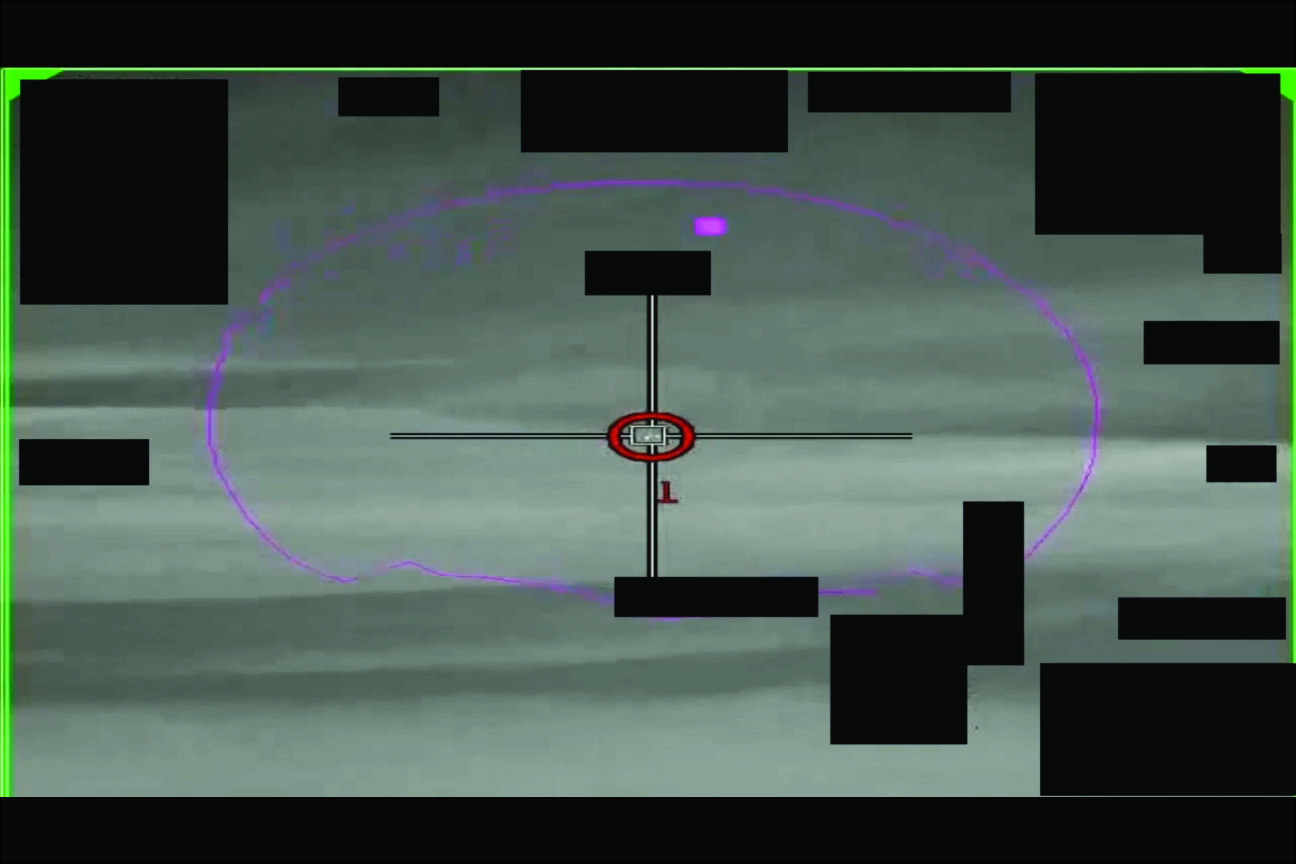
At 0726Z on August 8, 2020, while the air vehicle was holding at grid 39RWK95, a single unidentified object (1X UAP) was detected in the vicinity of grid 39RWL08 via FMV (Full Motion Video) sensor. The observed activity was described as "TRANSITING" — meaning the object was crossing through the area. Weather was not a contributing factor at the moment of observation, though dense cloud cover intermittently degraded FMV collection elsewhere during the sortie. The report explicitly records: "NO IMPACT TO MISSION" — the UAP did not disrupt the crew's ability to execute their tasking.
Iranian air defense Guard call
On August 8, 2020, at 1250Z, while the aircraft was heading 200 degrees, at flight level FL170 and 110 knots indicated airspeed, the Iranian Air Defense Guard initiated voice contact with the air vehicle on the Guard frequency. The tone was described as "PROFESSIONAL." The orders given were classified as a "STANDARD CALL," and the aircraft responded with a standard response. As with the UAP contact, this event was recorded with no impact to the mission.
Equipment and intelligence
The aircraft was fitted with a primary ANDAS4 sensor and a secondary AH\GMESH sensor. Data was submitted for analysis to DGS1 (Distributed Ground Station 1). Asked whether intelligence gaps were filled, the report recorded "Intel Gap Filled: No" — meaning pre-identified intelligence requirements were not satisfied by the mission. This outcome may be attributable in part to the dense cloud coverage that intermittently impaired collection throughout the sortie.
Significance
This document joins a cluster of ISR mission reports from USCENTCOM Arabian Gulf operations in 2020, several of which contain UAP observations. The particular significance of this report rests on a few points.
First, the UAP was formally recorded in a classified military report using standard technical language and a concrete grid reference, reflecting an institutionalized reporting practice rather than an informal note.
Second, the observation location — in the vicinity of the Strait of Hormuz — is one of the most operationally sensitive maritime chokepoints in the world, making any unidentified object of potential intelligence significance.
Third, the aircraft's altitude of FL170 and airspeed of 110 knots IAS at the time of the Iranian Guard call — occurring roughly ninety minutes after the UAP observation — provides useful context for the operational environment in which the encounter took place, even though the report draws no explicit link between the two events.
The FMV sensor used for the UAP observation is a visual system rather than radar, which limits the physical data available on the object's characteristics. The absence of additional information — speed, altitude, maneuverability of the UAP itself — reflects the nature of single-sensor FMV detection in a complex operational environment.
Key People
- SrA [name redacted] — primary point of contact (POC), 482 ATKS, 432 AEW, 603 AOC
- Ctr [name redacted] — QC officer, PAROC IDAT
- 1st Lt [name redacted] — approver, 609th AOC, 609 CAOC
- MG Richard A. Harrison — USCENTCOM Chief of Staff; signed document release on March 20, 2026
Locations
- OKAS — takeoff and landing base (ICAO code; precise location classified)
- Arabian Gulf — primary ISR area of operations
- Strait of Hormuz — secondary area of operations
- Gulf of Oman — secondary area of operations
- 39RWK95 — aircraft position at time of UAP observation (partially redacted)
- 39RWL08 / 39RVL90 — UAP observed location (partially redacted)
- 39RVN34 — tasking start point (partially redacted)
Incidents
| Incident | Date | Time (Zulu) | Location | Pages |
|---|---|---|---|---|
| Takeoff from OKAS | August 8, 2020 | 0337Z | OKAS | 1, 5 |
| Arrival on ISR station | August 8, 2020 | 0513Z | Arabian Gulf | 5, 6 |
| UAP observation (1X) | August 8, 2020 | 0726Z | 39RWL08 | 4, 5 |
| Iranian Air Defense Guard call | August 8, 2020 | 1250Z | FL170, HDG 200 | 4 |
| Departure from station | August 9, 2020 | 0017Z | — | 5, 6 |
| Landing at OKAS | August 9, 2020 | 0045Z | OKAS | 1, 4 |
Notable Quotes
"AT 0726Z, [REDACTED] OBSERVED 1X UAP IVO 39RWL08[REDACTED] NO IMPACT TO MISSION." — page 5, GENTEXT/OBSERVATION
"[REDACTED] AT 1250Z, [REDACTED] WAS HAILED ON GUARD [REDACTED] BY IRANIAN AIR DEFENSE. ORDERS GIVEN: STANDARD CALL. [REDACTED] RESPONDED STANDARD RESPONSE. NO IMPACT TO THE MISSION." — page 4, GENTEXT/GUARDCALL
"AT 0513Z, [REDACTED] ARRIVED ON STATION ISO NAVCENT TO OPERATION [REDACTED] TO CONDUCT SCANS FOR IDENTIFIED IRINURGCN VESSELS TO ESTABLISH PATTERN OF LIFE, UAS ACTIVITY AND CHARACTERIZE ACTIVITY OUTSIDE OF PORTS." — page 6, GENTEXT/ISR
"DENSE CLOUD COVERAGE INTERMITTANTLY IMPACTED FMV COLLECTION" — page 6, WEATHER/ISR
Images
1 image - click any image to enlarge
Related Articles
- DoW/DoD · 2020-07-16
Mission Report DOW-UAP-D65: Three UAP Observations in the Persian Gulf, July 16, 2020
USCENTCOM Mission Report Misrep 4472514 documents three separate observations of an unidentified aerial phenomenon during a single ISR sortie over the Persian Gulf, the Strait…
- DoW/DoD · 2020
Mission Report: Formation of Unknown Flying Objects over the Persian Gulf, August 2020
MISREP number 4685903, filed by the 482 ATKS unit of the 432 AEW under USCENTCOM, documents a 21-hour ISR/SIGINT sortie over the Arabian Gulf, Strait…
- DoW/DoD · 2020-09-15
Mission Report DOW-UAP-D62: UAP Observation, Link-Loss Events, and Iranian Air-Defense Intercepts over the Strait of Hormuz, September 2020
Mission Report MISREP 4782130 from the U.S. Air Force 482 ATKS / 432 AEW documents an intense 21-hour ISR sortie over the Strait of Hormuz…
- DoW/DoD · 2020
Range Fouler Debrief Form — Middle East Theater, May 2020
This document is a Range Fouler Debrief Form re-reviewed for release by Brigadier General Richard A. Harrison, USCENTCOM Chief of Staff. It records a UAP…