Email Correspondence on a Pacific-Area UAP Observation — March 2023
Source file: dow-uap-d51-email-correspondence-pacific-time-zone-march-2023.pdf Originating agency: Department of Defense / DoD Modern UAP — Office of the Undersecretary of Defense for Intelligence and Security (OUSD I&S) and Air Force Office of Special Investigations (AFOSI) Date range: March 2023 (incident); date of correspondence not explicitly stated Page count: 6 (all read) High-significance pages: 4, 5 (incident description and classified report details)
Official Blurb (from war.gov)
This document is email correspondence describing the content of a mission report and requesting clarification on its content. All descriptive and estimative language contained in this report reflects the reporter's subjective interpretation at the time of the event. Such characterizations should not be interpreted as a conclusive indication of the presence or absence of any intrinsic object features or performance characteristics.
Summary
The document contains an email chain between an information disclosure analyst from the Office of the Undersecretary of Defense for Intelligence and Security (OUSD I&S) and an official from the Air Force Office of Special Investigations (AFOSI) concerning the approval of an information release to the unclassified tier. The underlying event is a civilian's observation of a large blue triangular object hovering near a national security facility in the Pacific time zone in March 2023. The correspondence reveals the internal mechanism through which the U.S. military processes and releases UAP information to the unclassified level.
Research Article
Introduction
The document under review, originally marked SECRET//NOFORN, is a chain of three emails recording a distinctive administrative process: a request to declassify an Intelligence Information Report (IIR) concerning a UAP sighting to the unclassified tier. The emails reveal not only details about the incident itself but also the bureaucratic architecture of UAP information governance inside the Pentagon.
Structure of the Correspondence and the Release Process
The email chain involves three main stages.
Stage one — the request: An information disclosure analyst from OUSD I&S (name redacted under FOIA exemption (b)(6)) sent a request to AFOSI to release a UAP-related IIR, together with an unclassified summary the analyst had drafted. The request was classified SECRET//NOFORN. The analyst characterized the request as "routine" and asked for a receipt confirmation.
Stage two — internal review at AFOSI: The AFOSI official — whose role is Program Manager (PM) for counterintelligence (CI) collection and operations, as well as PM for intelligence oversight — replied that the IIR declassification process is lengthy and requires the AFOSI Commander's signature. He therefore explored an alternative: conducting a "derivative classification review" of the unclassified summary the analyst had provided, rather than a full declassification. The official explicitly noted this was a "first for me" — an encounter with a request of this type.
Stage three — approval: After consulting internally at AFOSI headquarters, the official confirmed that his office had the authority to process the request as a derivative classification review. He notified the analyst that the request was approved and that the unclassified summary could be used in the final product.
Description of the Incident — Observation Details
Page 4 contains the core of the document: the unclassified summary submitted for approval. The details of the incident are as follows.
Object appearance: A large, blue, featureless triangular object with a solid, unwavering silhouette, emitting powerful "whitish-blue" light from multiple points along its perimeter.
Behavior: The object hovered stationary above or near a national security facility for approximately three minutes, then moved higher in the observer's field of view. Its motion was described as "backing up" in a "jerking" or "jumping" manner inconsistent with smooth jet propulsion. Total observation time was approximately eight minutes.
What the observer could not determine: The observer could not determine how the object was controlled, what powered it, or whether it had a defined front or rear. The observer stated a belief that the object was not a drone.
What the object did not display: The object did not follow a defined flight path, did not exhibit camera or data-collection capabilities, did not emit a vapor trail, and did not display any camouflage capability.
Incident summary:
- Location: Pacific time zone
- Date: March 2023
- Time: Nighttime
- Duration: Approximately eight minutes
- Observer type: Civilian
- Recording device: Personal mobile device
- Altitude: Not reported
- Speed: Not reported
- Size: Large
- Shape: Triangular
- Color: Blue
- Material: Not reported
- Markings: None
- Behavior: Light emission, irregular movement
Significance
This document is important for several reasons. First, it reveals that the original IIR was classified SECRET//NOFORN, indicating that the intelligence investigation of the event reached conclusions requiring sensitive protection. Second, it demonstrates that AFOSI functions as a gatekeeper for UAP information, to the point where even releasing an unclassified summary required a novel mechanism. Third, the incident itself — a large triangular object hovering near a national security facility — carries obvious operational significance, raising questions about the vulnerability of sensitive installations.
Key People
- Information Disclosure Analyst (name redacted): From OUSD I&S; initiated the release request.
- AFOSI Program Manager (name redacted): PM for CI collection and operations, and PM for intelligence oversight; conducted the internal review and approved the request.
- AFOSI Commander (not named): The figure whose signature would be required for a full IIR declassification.
Locations
| Location | Details |
|---|---|
| Pacific time zone | General location of the observation |
| National security facility (unidentified) | The facility above which the object hovered; precise location redacted or not stated |
| AFOSI headquarters | Site of the internal consultation that confirmed authority for a derivative classification review |
Incidents
| Incident | Date | Location | Pages |
|---|---|---|---|
| Observation of a large blue triangular object near a national security facility | March 2023, nighttime | Pacific time zone | 4–5 |
| Request to AFOSI for classified IIR release | Not stated (2023) | OUSD I&S / AFOSI HQ | 1–2, 5 |
| Approval of derivative classification review | Not stated (2023) | AFOSI HQ | 1 |
Notable Quotes
"An individual reported observing a large blue featureless triangular object with a solid, unwavering silhouette emitting powerful 'whitish blue' light from multiple points along its perimeter." — page 4
"The reporter described the object as 'hovering' stationary above or near a national security facility for approximately three minutes." — page 4
"The reporter characterized the object's motion as 'backing up' in a 'jerking' or 'jumping' manner inconsistent with 'smooth' jet propulsion." — page 4
"Our process for declassifying IIRs is lengthy and requires AFOSI Commander signature so I'm exploring options akin to a security review of the UNCLASS summary you have provided below. This is a first for me." — page 2
"Upon consulting internally here at HQ, our folks confirmed we do have the authority to process this as a derivative classification review, instead of a declassification request... Consider your request approved." — page 1
Images
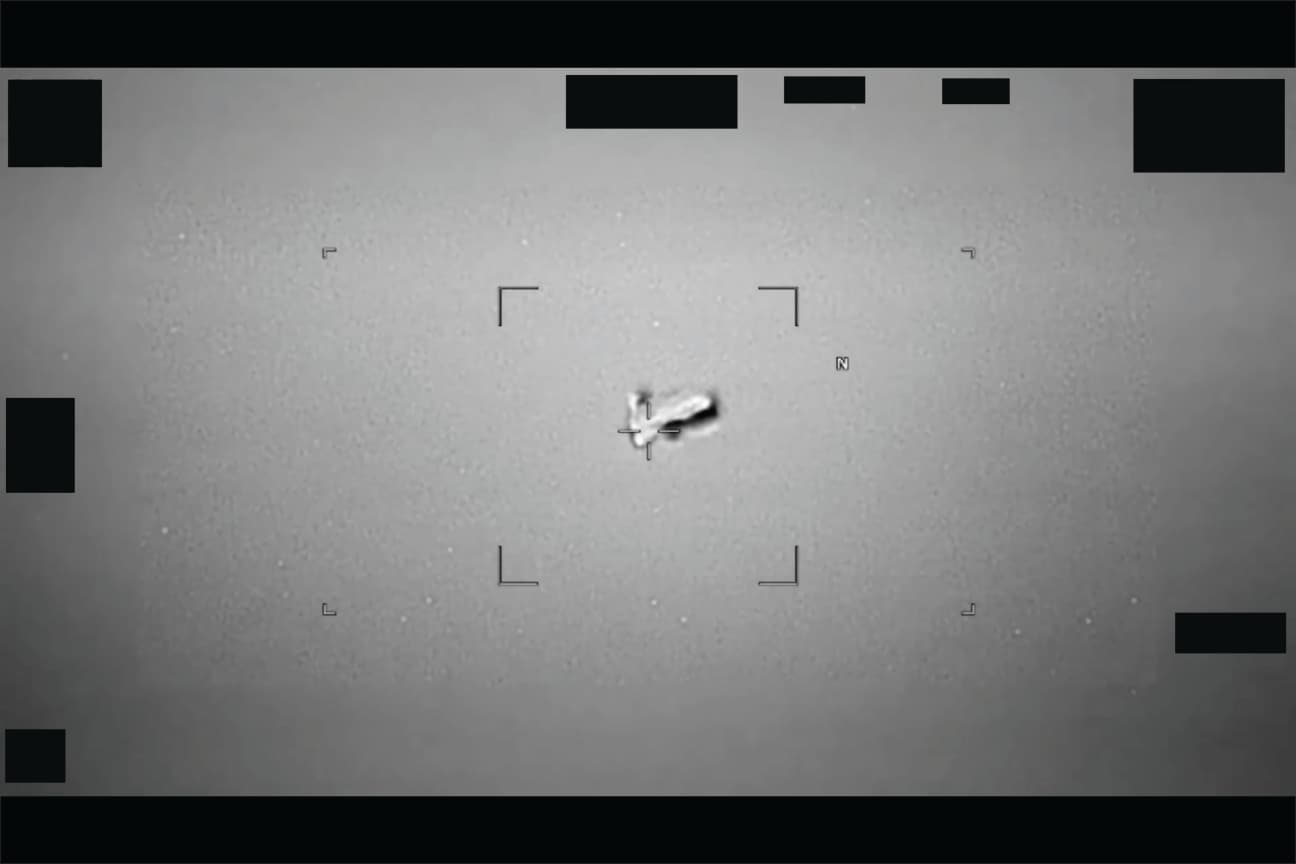
1 image - click any image to enlarge
Related Articles
- DoW/DoD · 2023
AARO Unresolved Case Analysis Update: The Western U.S. "Orbs Launching Orbs" Event, 2023
A signed All-domain Anomaly Resolution Office (AARO) Memorandum for Record, dated 05 June 2026 and signed by Director Jon T. Kosloski, summarizing the agency's ongoing…
- DoW/DoD · 2022
Unresolved UAP Report DOW-UAP-PR20: Digitally Annotated Still Image, Kuwait, May 2022
An Unresolved UAP Report (PR series) submitted by USCENTCOM to AARO, consisting of a single still image captured by a U.S. military sensor system in…
- DoW/DoD · 2023
Witness 1 Narrative: The Western U.S. Event, October 2023
The first-hand, free-form narrative of Witness 1 — one of several U.S. federal law enforcement special agents who reported unidentified anomalous phenomena over two days…
- DoW/DoD · 2023
Witness 2 Narrative: The Western U.S. Event, October 2023
The longest and most detailed first-hand narrative in the Western U.S. Event, from Witness 2 — a U.S. federal law enforcement special agent who, with…