Mission Report: UAP Observation over the Gulf of Aden, September 2020
Source file: dow-uap-d57-mission-report-gulf-of-aden-september-2020.pdf Originating agency: Department of Defense / DoD Modern UAP (USCENTCOM 26.0028) Date range: September 4, 2020 Page count: 1 (read in full) High-significance pages: page 1 (the complete report)
Official Blurb (from war.gov)
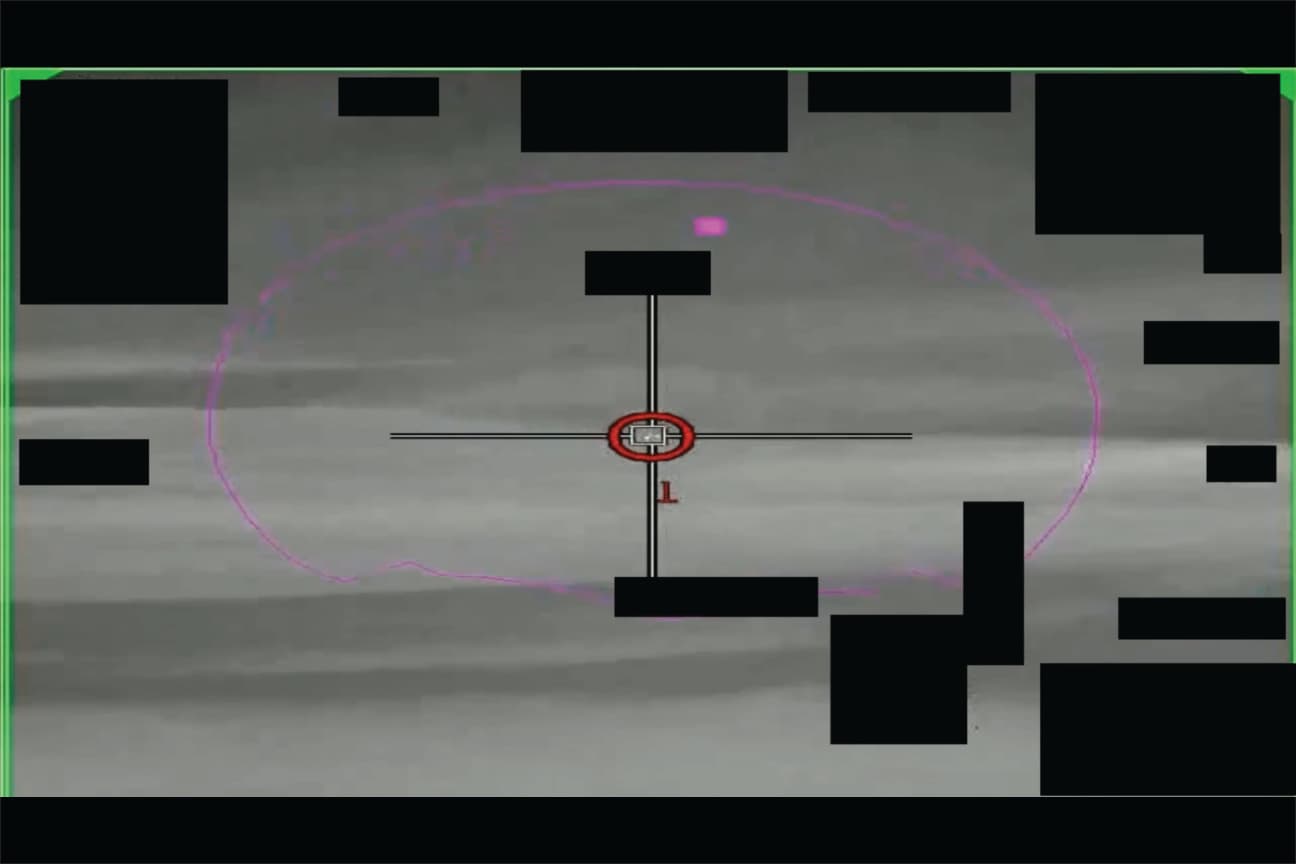
This document is a Range Fouler Reporting Form, a standardized reporting form the U.S. Navy uses to record the circumstances surrounding an unauthorized intrusion into controlled airspace during active military operations or training. These reports contain a narrative description of the observer's experiences. A U.S. military operator reported tracking a "round, cold object" over the Gulf of Aden for eight minutes via "black hot" IR sensor, making the UAP appear "bright white." The report states that the UAP was "traveling 168 degrees at 277 mph" and "made a few abrupt directional changes" during the encounter. All descriptive and estimative language contained in this report reflects the reporter's subjective interpretation at the time of the event. Such characterizations should not be interpreted as a conclusive indication of the presence or absence of any intrinsic object features or performance characteristics.
Summary
This Range Fouler reporting form, declassified and released publicly by USCENTCOM in March 2026, describes an eight-minute observation of a round, infrared-cold object over the Gulf of Aden on the night of September 4, 2020. A flight crew from the 172 ATKS, at the O-3 grade level, reported an object traveling at 168 degrees at 277 mph that made several abrupt directional changes and resisted all conventional identification. The document was released under FOUO designation with Privacy Act protections applied and was submitted through the SPEAR system.
Research Article
Introduction
On September 4, 2020, at 2109Z, a U.S. Air Force flight crew recorded an anomalous observation over one of the world's most strategically sensitive waterways: the Gulf of Aden. This body of water serves as a critical maritime transit corridor between the Indian Ocean and the Red Sea and is continuously monitored by U.S. and allied naval and air forces. The report was filed through the SPEAR system — designed to collect reports of unidentified objects encountered in operational airspace while maintaining complete crew and squadron anonymity.
Encounter details and sensor data
The flight was designated as an ISR (Intelligence, Surveillance, Reconnaissance) mission conducted during nighttime hours. The aircraft's bureau number (Buno) was 23819. The unidentified object was first acquired at 2109Z and tracked continuously until 2117Z, for a total contact duration of eight minutes.
The position data recorded in the form was partially redacted due to classification, but an MGRS location of 38P LT was preserved. The aircraft was operating at 23,819 feet HAT (Height Above Terrain) over the Gulf of Aden. The infrared sensor — ATFLIR or equivalent — was pointed approximately 39 degrees below the aircraft's flight horizon, with a slant range of 6.17 nautical miles and a ground range of 8.81 kilometers.
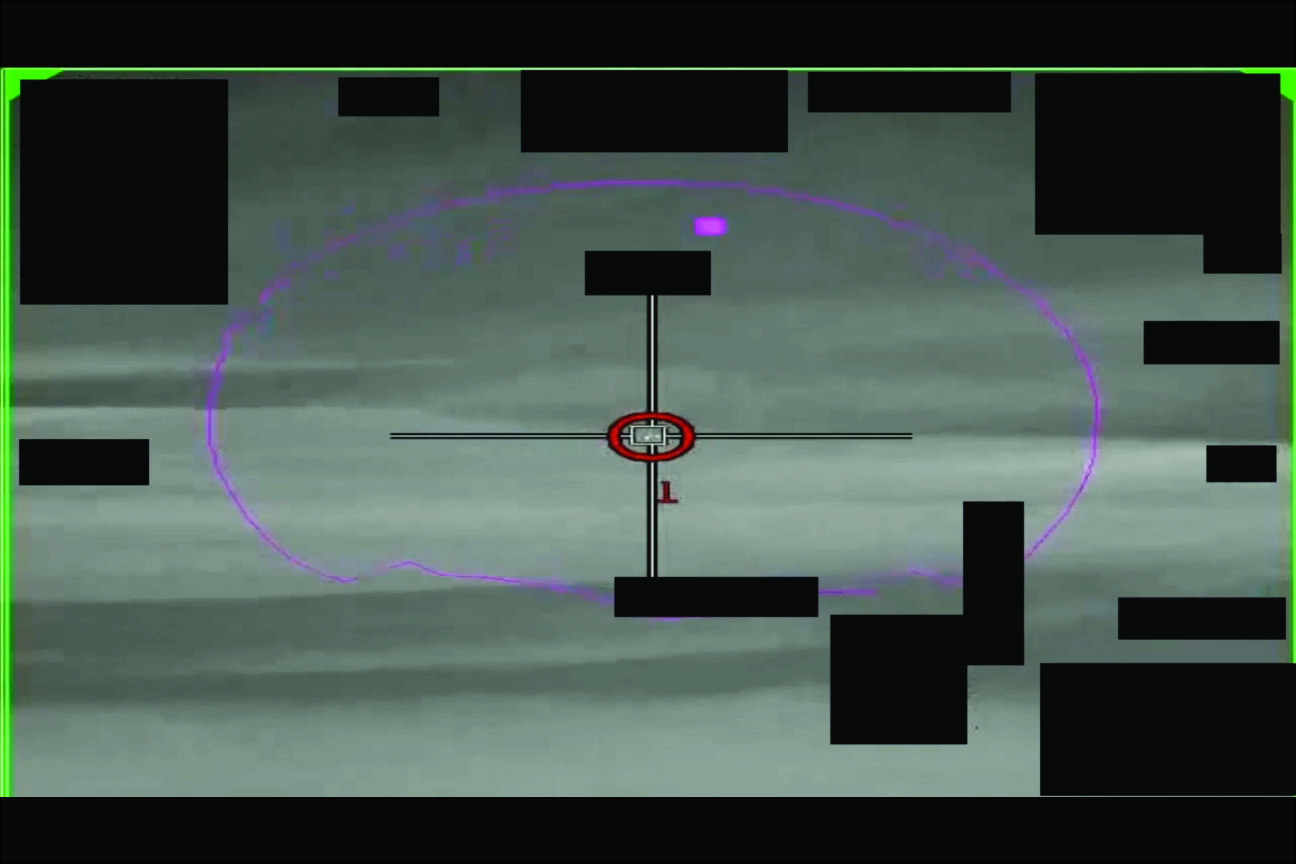
The IR sensor was set to "Black Hot" mode, and the detected object appeared as bright white. This means the object was thermally cooler relative to its surroundings: in Black Hot imaging, warm surfaces appear dark while cool surfaces appear bright. This thermal signature characteristic has appeared in multiple documented UAP encounters and presents researchers with significant questions about the nature of such objects.
Physical and kinematic characteristics
According to the report, the object was described as follows:
Shape: Round — the only shape field checked on the form.
Thermal energy: Cold relative to the environment on the IR scale.
Speed and direction: Traveling 168 degrees (nearly due south) at 277 mph.
Directional changes: The object made several abrupt directional changes during the eight-minute contact.
Radar track file: "Stable Trackfile" is noted but not confirmed; ATFLIR Autotrack was not selected, indicating automatic IR lock-on was not achieved.
Visual identification: No tally (visual eye contact) was achieved.
External features: No wings, airframe structure, markings, moving parts, balloon envelope, transparency, metallic sheen, reflectivity, or visible means of propulsion were observed.
Electronic warfare indicators: No ECM arc, Letter Identifier, False Trackfiles, or Ambiguous signals were detected.
Abrupt directional changes as the key data point
The most operationally notable detail in this report is the execution of several abrupt directional changes by an object traveling at 277 mph. A conventional aircraft at that speed cannot execute sharp course reversals without generating significant g-forces — forces that would be lethal to any biological pilot without specialized protection systems. Abrupt directional changes at speed have been observed in other well-documented UAP encounters, including the 2004 Nimitz incident and the 2015 Roosevelt encounters off the Atlantic coast, where objects displaying similar behavior were recorded on sensor.
Regional context: the Gulf of Aden
The Gulf of Aden lies between the Arabian Peninsula (Yemen to the northeast) and the Horn of Africa (Djibouti and Somalia). It forms the southern approach to the Red Sea and the Suez Canal, making it a chokepoint for global maritime commerce and U.S. military force projection. In September 2020, the region was under heightened USCENTCOM surveillance, in part because of the ongoing Yemeni conflict and Houthi naval activity in the surrounding waters. ISR flight operations at 23,000 feet during nighttime hours indicate a sustained, operationally significant surveillance posture.
Reporting framework: the SPEAR system
The form was submitted through the SPEAR system — likely standing for System for Processing Evidence of Anomalous and Reportable Phenomena, or a similarly named program — designed to collect, normalize, and analyze anomalous encounter reports from multiple services and units. The system emphasizes complete crew anonymity: names, squadron designators, and electronic identifiers are all censored, allowing analysts to work with clean data free from attribution bias. This reflects a more institutionalized policy toward UAP compared with the ad hoc approaches of the 1990s and early 2000s.
Significance
This report is part of a sustained USCENTCOM and AARO (All-domain Anomaly Resolution Office) document release effort that began in 2021 and accelerated through 2026. It illustrates that the U.S. government is systematically accumulating detailed UAP reports from operationally sensitive domains. The object's characteristics — round, thermally cold, no visible propulsion, abrupt directional changes — are inconsistent with any known aircraft from 2020, whether autonomous or remotely piloted. The complete absence of any hostile electromagnetic signature rules out an immediate reading as an electronic countermeasures platform.
Key People
| Name | Role | Details |
|---|---|---|
| Reporter (redacted) | O-3 grade, Crew Position: Other | 172 ATKS; name redacted per SPEAR policy |
| MG Richard A. Harrison | Release authority | Signed release on behalf of USCENTCOM, March 2026 |
Locations
| Location | Details |
|---|---|
| Gulf of Aden | Discovery area; MGRS 38P LT (precise coordinates redacted) |
| USCENTCOM | Command authority responsible for document release |
Incidents
| Incident | Date | Location | Pages |
|---|---|---|---|
| IR observation of round, cold object; abrupt directional changes; 8-minute contact | September 4, 2020, 2109Z–2117Z | Gulf of Aden, 23,819 ft HAT | 1 |
Notable Quotes
"While at 23,819 HAT over the Gulf of Aden we tracked a round, cold object in IR traveling 168 degrees at 277 mph. It made a few abrupt directional changes during the 8 minute contact."
"The IR sensor was set to black hot and the object in question was a bright white."
"Absolutely no identifying information for aircrew or squadron will be recorded for analysis."
Images
1 image - click any image to enlarge
Related Articles
- DoW/DoD · 2024-07-14
Mission Report DOW-UAP-D75: Fast-Moving UAP over the Gulf of Aden, July 2024
Mission Report DOW-UAP-D75 (Misrep 10194673) documents a single UAP observation by a U.S. military operator on July 14, 2024 at 0517Z over the Gulf of…
- DoW/DoD · 2023
AARO Unresolved Case Analysis Update: The Western U.S. "Orbs Launching Orbs" Event, 2023
A signed All-domain Anomaly Resolution Office (AARO) Memorandum for Record, dated 05 June 2026 and signed by Director Jon T. Kosloski, summarizing the agency's ongoing…
- DoW/DoD · 2022
Unresolved UAP Report DOW-UAP-PR20: Digitally Annotated Still Image, Kuwait, May 2022
An Unresolved UAP Report (PR series) submitted by USCENTCOM to AARO, consisting of a single still image captured by a U.S. military sensor system in…
- DoW/DoD · 2023
Witness 1 Narrative: The Western U.S. Event, October 2023
The first-hand, free-form narrative of Witness 1 — one of several U.S. federal law enforcement special agents who reported unidentified anomalous phenomena over two days…