Mission Report DOW-UAP-D75: Fast-Moving UAP over the Gulf of Aden, July 2024
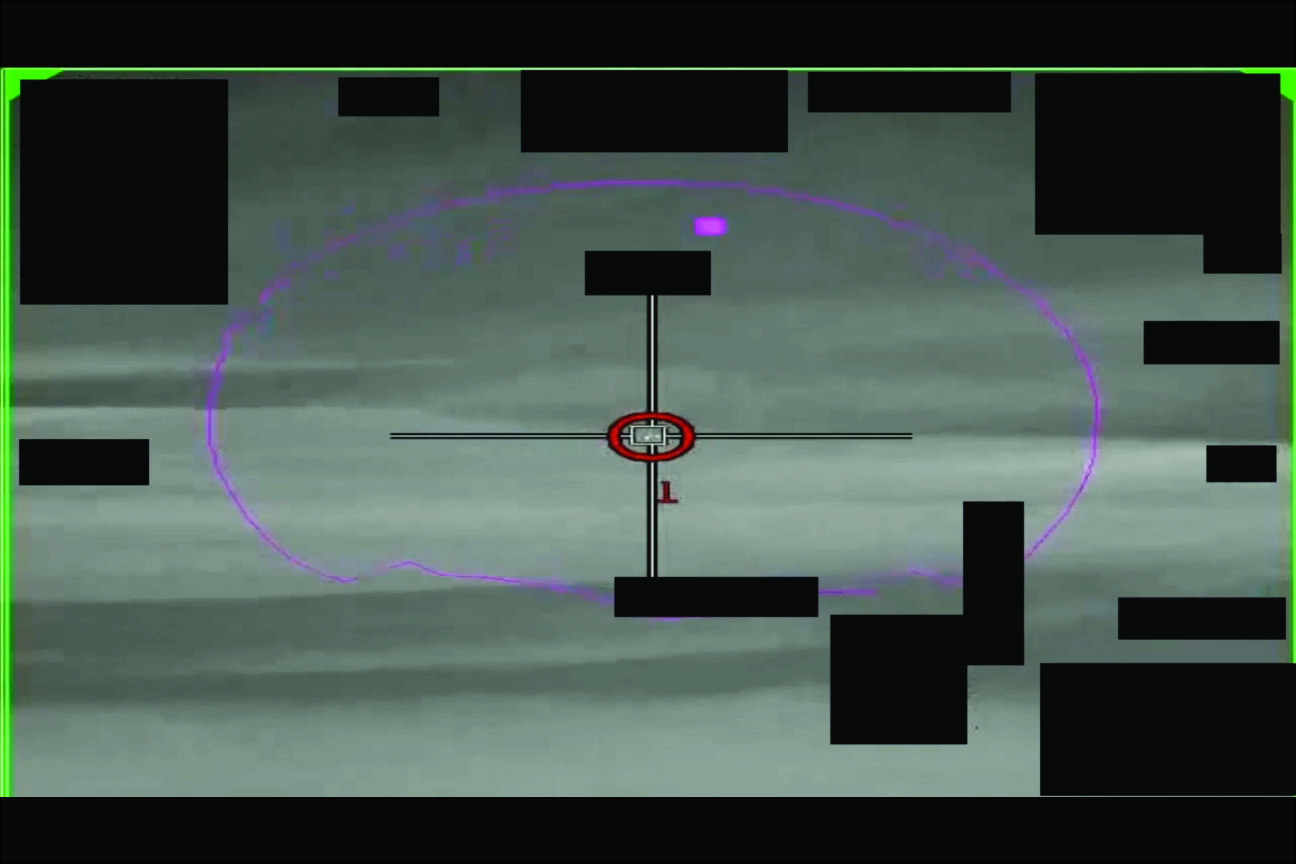
Source file: dow-uap-d75-mission-report-gulf-of-aden-july-2024.pdf Originating agency: Department of War / Department of Defense (USCENTCOM) Report number: Misrep 10194673 Incident date: July 14, 2024, 0517Z Page count: 8 (all read) High-significance pages: pages 7–8 (UAP section and GENTEXT/UAP) Operation: OPERATION [name redacted], in support of NAVCENT and AFCENT Originating unit: 124 ATKS (124th Attack Squadron), 132nd Wing Command authority: USCENTCOM, 609th CAOC
Official Blurb (from war.gov)
This document is a Mission Report (MISREP). A U.S. military operator reported observing one UAP on July 14, 2024. The observer reported that the UAP maintained a "straight flight path at same altitude." The report notes that the UAP's "speed was faster than flying speed," and the operator assessed the object as "benign." The operator reported following the UAP "till the distance became too far."
Summary
Mission Report DOW-UAP-D75 (Misrep 10194673) is an operational record of a UAP observation over the Gulf of Aden on July 14, 2024. The mission was conducted by the 124th Attack Squadron (124 ATKS) of the U.S. Air Force under USCENTCOM, as part of a multi-phase ISR sortie in support of U.S. Naval Forces Central Command (NAVCENT) and Air Forces Central (AFCENT). At 0517Z, during target development activity in the vicinity of MGRS grid 38P MT 53, the crew identified a single unidentified aerial object. The UAP maintained a straight flight path at a constant altitude while traveling at a speed assessed as faster than the observing platform's own airspeed. The crew attempted to follow the object until the range grew too great to maintain tracking. Despite these anomalous characteristics, the operator assessed the object as "benign."
Research Article
Introduction
DOW-UAP-D75 is part of the PURSUE Initiative Release 1 series published by the Department of War in 2026. The document was approved for release on June 2, 2025, by MG Brandon R. Tegtmeier, USCENTCOM Chief of Staff, and published under USCENTCOM MDR 25-0072. It was released to the All-domain Anomaly Resolution Office (AARO) as part of Congress's UAP transparency mandate.
Geographically, the incident occurred at a strategically critical flashpoint. MGRS coordinate 38P MT places the observation in the Gulf of Aden or Arabian Sea, near the Yemeni coastline — the operational area of Operation Prosperity Guardian, the U.S.-led multinational maritime coalition established in December 2023 in response to Houthi attacks on commercial shipping in the Red Sea and Gulf of Aden.
Observation Details
The mission window was broad. The platform — a 124 ATKS FMV-based ISR aircraft, with all type details redacted — took off at 140222ZJUL24 (July 14, 2024, 02:22 UTC) and arrived on station at 0300Z. Target development in support of NAVCENT began at 0334Z in the vicinity of 38P MT 51 (inside the Gulf of Aden). After approximately one hour and forty-three minutes of continuous surveillance, at 0517Z, the incident occurred.
The crew identified a single UAP in the vicinity of 38P MT 53. The object's first recorded coordinate was 38P MT 53; its last recorded coordinate before tracking was lost was 38P MT 22 (retrieval 49). The object therefore traveled in a northwest direction — explicitly noted in the report as "Kinetic Trajectory: NW" — while increasing its distance from the observing platform.
The parameters recorded in the UAP section of the report are as follows:
- Initial Contact DTG: 140517:00ZJUL24
- UAP Event Type: UAP Incident
- Maneuverability Observations: "STRAIGHT FLIGHT PATH AT SAME ALTI" (straight flight path at constant altitude)
- UAP Response to Observer Actions: UNKNOWN
- Kinetic Altitude: LOW (estimated)
- Kinetic Trajectory: NW (estimated)
- Kinetic Velocity: 1.4a (redacted; estimated)
- Observer Assessment: Benign
- Observation Interrogation: NO (no dedicated sensor interrogation performed)
- Engagement: NO (no contact attempted)
- RF signature: not documented
- Materials recovered: NO
- Effects on personnel or equipment: NONE
The observer was a TSgt/E-5 (Technical Sergeant), a member of the 124 ATKS intelligence collection crew who was analyzing the aircraft's full-motion video (FMV) feed.
"Speed Was Faster Than Flying Speed"
The most significant section of the document appears under "UAP Anomalous Characteristics/Behaviors":
"UAP'S SPEED WAS FASTER THAN THE [1.4a, 1.4g] FLYING SPEED"
The combined redactions under FOIA exemptions 1.4a (intelligence source or method) and 1.4g (military capabilities) conceal the name of the observing platform. Based on the unit attribution (132nd Wing, 124 ATKS) and mission characteristics (FMV, long-duration ISR, USCENTCOM operations in 2024), the platform is most likely an MQ-9 Reaper or a comparable unmanned system. A typical cruise speed for such a platform is approximately 194 knots, with a maximum of roughly 260 knots.
The practical implication is that the UAP was moving faster than the military aircraft's own airspeed — almost certainly above 200–260 knots — while simultaneously maintaining:
- A completely straight flight path (no maneuvering, no direction change)
- A constant altitude (no altitude variation)
- A coherent, stable northwest track
The combination of high speed, straight path, and constant altitude is not characteristic of an atmospheric phenomenon, a bird, or a balloon. It is more consistent with a purposefully guided aerial platform — including modern unmanned aircraft, cruise missiles, or conventional fixed-wing aircraft. However, if the object were a recognized military or commercial aircraft, a standard identification interrogation (IFF or radar check) would have resolved it. The report's "Observation Interrogation" field explicitly reads "NO."
Failed Tracking Attempt
Under "UAP Reaction to Observation, Interrogation, Engagement" the report states:
"[1.4a] FOLLOWED THE UAP TILL THE DISTANCE BECAME TOO FAR TO FOLLOW"
This is a consequential statement. It directly records an active pursuit attempt by a U.S. ISR platform — and its failure to maintain contact. In operational terms, a military FMV platform designed for long-range surveillance of high-speed targets could not keep the object within range. This indicates one of two things: either the UAP's speed significantly exceeded the platform's maximum velocity, or the platform was constrained by its operating boundaries — fuel state, airspace restrictions, or tasking limits — and could not give chase beyond its assigned area.
The coordinates support the first interpretation. The object moved a substantial distance in a northwest direction between its first recorded position (38P MT 53) and its last (38P MT 22) during what appears to be a relatively brief observation window, consistent with the observer's characterization of speed exceeding the platform's own capability.
The Context of the Gulf of Aden, July 2024
July 2024 was the tenth month of Operation Prosperity Guardian (which began December 18, 2023). The operational environment in the area included:
- USS Dwight D. Eisenhower Carrier Strike Group (CSG-2) — the carrier had been continuously deployed in the Red Sea and Gulf of Aden from November 2023 through July 2024 (its return home was on July 14, 2024 itself, the very day of this observation).
- U.S. Navy destroyers (USS Laboon, USS Mason, USS Gravely, USS Carney, and others) — conducting daily intercepts of Houthi cruise missiles and drones.
- U.S. Air Force assets based in Qatar (Al Udeid), Bahrain, and the UAE — executing continuous ISR missions.
- Navy F/A-18 and EA-18G aircraft — striking Houthi positions ashore.
- Combined Task Force 153 (CTF 153) — maritime shipping defense operations.
The months immediately preceding the incident — May, June, and July 2024 — saw an escalating tempo of Houthi attacks. The group was employing anti-ship cruise missiles (ASCMs), anti-ship ballistic missiles (ASBMs), and loitering munitions of types including the Samad-3, Waid-1, and Waid-2. As a result, Gulf of Aden airspace was among the most actively threat-saturated in the world.
This context makes the operator's "benign" assessment especially meaningful. In an environment where every unidentified airborne object was treated as a potential cruise missile or hostile UAS, the crew distinguished an object with anomalous characteristics — anomalous speed — but did not assess it as a threat. This implies that the observer found features inconsistent with a Houthi weapons profile. The northwest trajectory, running from northern Yemen toward the upper Gulf of Aden, did not match typical Houthi strike patterns, and the object's visual signature apparently differed from known Houthi munitions.
Significance
D75 stands out on several grounds.
First, it records an observation during an active combat operation in a hot-conflict zone. Unlike many UAP reports from relatively peaceful environments, this incident occurred while the U.S. Air Force was at high alert and its threat-identification tools were operating at full capability. The statement "faster than flying speed" is not a layperson's judgment.
Second, the "benign" assessment in these circumstances is analytically interesting. This is not a routine report of an opportunistic target. It is a professional's account of watching an object in a high-quality FMV feed, operating in an active threat environment, yet not considering it hostile — while simultaneously acknowledging its anomalous velocity.
Third, the failure to maintain tracking, combined with the "faster than flying speed" observation, is consistent with documented UAP encounters near U.S. military operating areas over the past decade. High speed and the ability to evade military surveillance are recurring features in AARO reporting and across the PURSUE series.
Fourth, the geographic clustering with other documents in the D series is notable. DOW-UAP-D8 (Djibouti, 2025) and additional records from the Bab el-Mandeb and Gulf of Aden region form an expanding cluster of UAP reports from the waterway most critical to global maritime commerce — an area where forces from some fifteen nations operate simultaneously. Whether that clustering reflects heightened military exposure to UAP or some property intrinsic to the region itself remains an open question.
Key People
- MG Brandon R. Tegtmeier — USCENTCOM Chief of Staff; approved release of the document on June 2, 2025.
- TSgt/E-5 (name redacted) — the UAP observer; 124 ATKS crew member analyzing the FMV feed.
- POC (name redacted) — primary point of contact, 124 ATKS, 132nd Wing.
- QC (name redacted) — quality-control reviewer, 432 AEW.
- Approver (name redacted) — report approver, 379 AEW, 609 CAOC.
Locations
- Gulf of Aden — maritime arm of the Arabian Sea between Yemen and Somalia; primary incident location.
- Bab el-Mandeb — strategic strait between Yemen and Djibouti.
- Yemen — country in whose airspace the Houthi threat was generated.
- Arabian Sea — broader operational area for U.S. naval forces.
- Military coordinates: 38P MT 51 (mission start), 38P MT 53 (initial UAP observation), 38P MT 22 (last UAP position before contact lost), 38P MV 24 (subsequent AFCENT tasking).
Incidents
| Incident | Date/Time | Location | Pages |
|---|---|---|---|
| Takeoff | July 14, 2024, 0222Z | Classified base (likely Al Udeid, Qatar) | p. 1 |
| Arrival on station | July 14, 2024, 0300Z | Gulf of Aden | p. 1 |
| NAVCENT ISR tasking begins | July 14, 2024, 0334Z | 38P MT 51 | pp. 1, 5 |
| Single UAP observed — "faster than flying speed," straight path, constant altitude | July 14, 2024, 0517Z | 38P MT 53 (Gulf of Aden) | p. 7 |
| Tracking lost at last recorded UAP coordinate | July 14, 2024, ~0517Z+ | 38P MT 22 | p. 8 |
| NAVCENT tasking ends; transition to AFCENT | July 14, 2024, 0925Z | 38P MV 24 | pp. 1, 6 |
| AFCENT mission phase | July 14, 2024, 1041Z–2130Z | 38P MV 24 | p. 6 |
| Landing | July 14, 2024, 2259Z | Classified base | p. 1 |
Notable Quotes
"STRAIGHT FLIGHT PATH AT SAME ALTI" — page 7, maneuverability observations
"Observer Assessment of UAP: Benign" — page 7
"FOLLOWED THE UAP TILL THE DISTANCE BECAME TOO FAR TO FOLLOW" — page 8, UAP reaction to observation
"UAP'S SPEED WAS FASTER THAN THE [1.4a, 1.4g] FLYING SPEED" — page 8, anomalous characteristics
"UAP HAD..." — page 8, description begins but continuation is redacted under 1.4a
Images
1 image - click any image to enlarge
Related Articles
- DoW/DoD · 2020
Range Fouler Reporting Form — Gulf of Aden, October 2020
On 15 October 2020, at 14:18:39 Zulu, an O-2 pilot of the 172 ATKS squadron detected and tracked a round, cold infrared object over the…
- DoW/DoD · 2020
Range Fouler Debrief Form: Unidentified Air Contacts over the Arabian Sea, August 2020
On August 24, 2020, at 0004:30Z, an O-3 grade aviator from HSM-73 documented three small unidentified air contacts over the North Arabian Sea. All three…
- DoW/DoD · 2020
Mission Report: UAP Observation over the Gulf of Aden, September 2020
A Range Fouler reporting form declassified and released by USCENTCOM in March 2026 describes an eight-minute infrared contact over the Gulf of Aden on the…
- DoW/DoD · 2023
AARO Unresolved Case Analysis Update: The Western U.S. "Orbs Launching Orbs" Event, 2023
A signed All-domain Anomaly Resolution Office (AARO) Memorandum for Record, dated 05 June 2026 and signed by Director Jon T. Kosloski, summarizing the agency's ongoing…