Investigation Report: Range Fouler Debrief Form — October 2020
Source file: dow-uap-d58-range-fouler-debrief-na-october-2020.pdf Originating agency: Department of Defense / DoD Modern UAP Date range: October 27, 2020 Page count: 1 (read in full) High-significance pages: Page 1 (entire document)
Official Blurb (from war.gov)
This document is a Range Fouler Debrief, a standardized reporting form the U.S. Navy uses to record the circumstances surrounding an unauthorized intrusion into controlled airspace during active military operations or training. These reports contain a narrative description of the observer's experiences. A U.S. military operator reported an encounter with a group of two UAP. The operator described the UAP as "balloon-shaped," metallic, and reflective, characterizing them as "2x red blinking strobes." The report states that "one range fouler was circling around the other." All descriptive and estimative language contained in this report reflects the reporter's subjective interpretation at the time of the event. Such characterizations should not be interpreted as a conclusive indication of the presence or absence of any intrinsic object features or performance characteristics.
Summary
This is a Range Fouler Debrief Form completed by an O-3 pilot from the 77th Expeditionary Fighter Squadron (77 EFS), documenting a nighttime encounter with two unidentified aerial objects on October 27, 2020. The encounter included radar lock, targeting-pod video, and active noise jamming. The document was released by Major General Richard A. Harrison under USCENTCOM MDR 26-0038 through MDR 26-0046 and approved for transfer to AARO on March 27, 2026.
Research Article
Introduction
On October 27, 2020, at 01:12:21 Zulu, a U.S. Air Force pilot holding the rank of O-3 from the 77th Expeditionary Fighter Squadron (77 EFS) filed an official debrief form with the SPEAR program following an encounter with unidentified aerial objects during a nighttime DCA (Defensive Combat Air Patrol) mission. The form, originally classified SECRET//NOFORN at the time of writing, reveals an unusual incident combining anomalous physical behavior, active electronic jamming, and motion that is inconsistent with any known physics of flight.
Circumstances of the Encounter
The encounter occurred in a nighttime environment at an engagement altitude of 26,000 feet. Two objects were initially identified at the navigation point B/E ZIM 248/17 — a nav reference recorded on the form as the initial detection point, with additional detail redacted. The pilot, acting on the direction of mission commander "KINGPIN" to identify an unknown contact, locked his radar onto the targets and acquired a video lock using the aircraft's targeting pod.
Sensor Data and Identification
The radar and sensor data reveal the following:
- Radar: Setting listed as "Other," with a stable trackfile (Stable Trackfile: Yes). Radar lock was achieved, though the pilot could not close within 16.9 nautical miles of the targets for a cleaner visual identification.
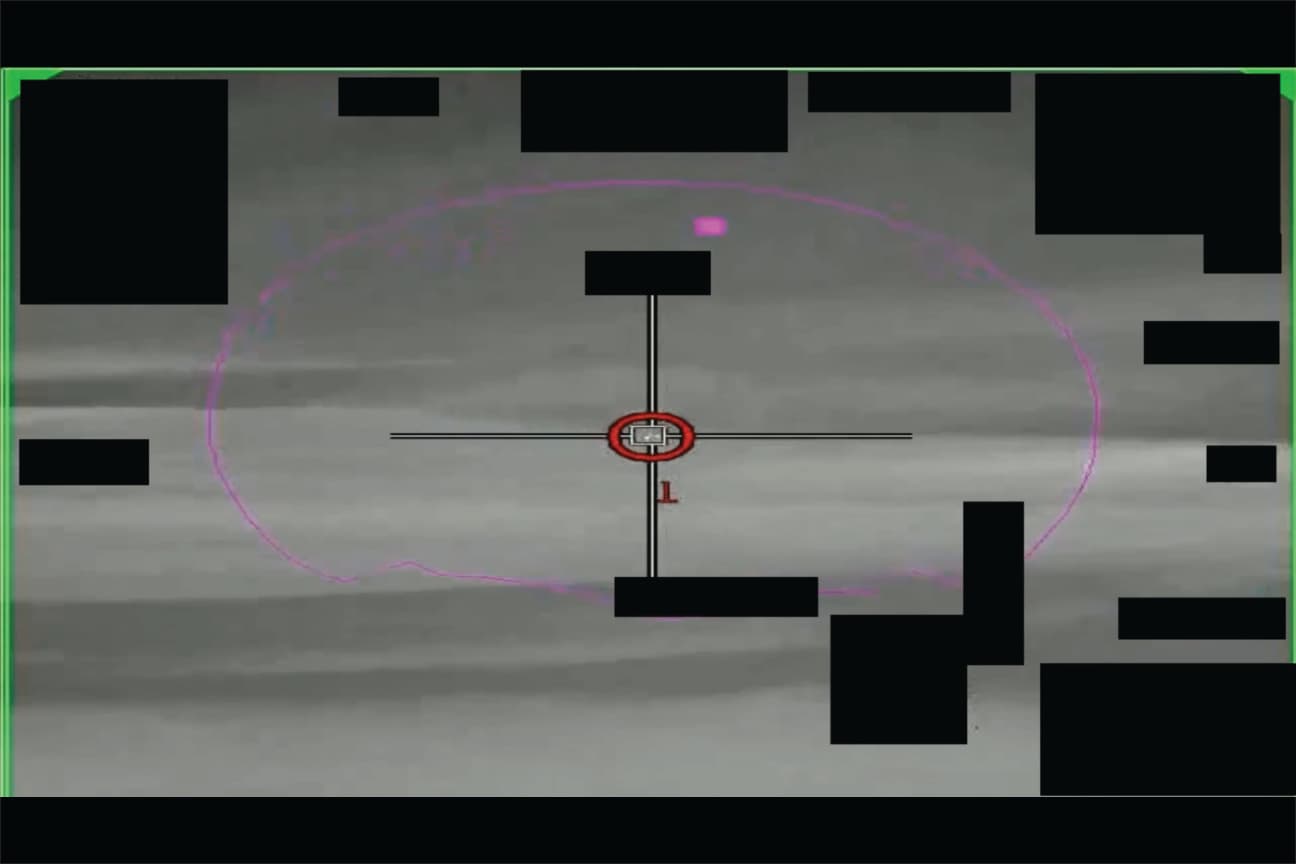
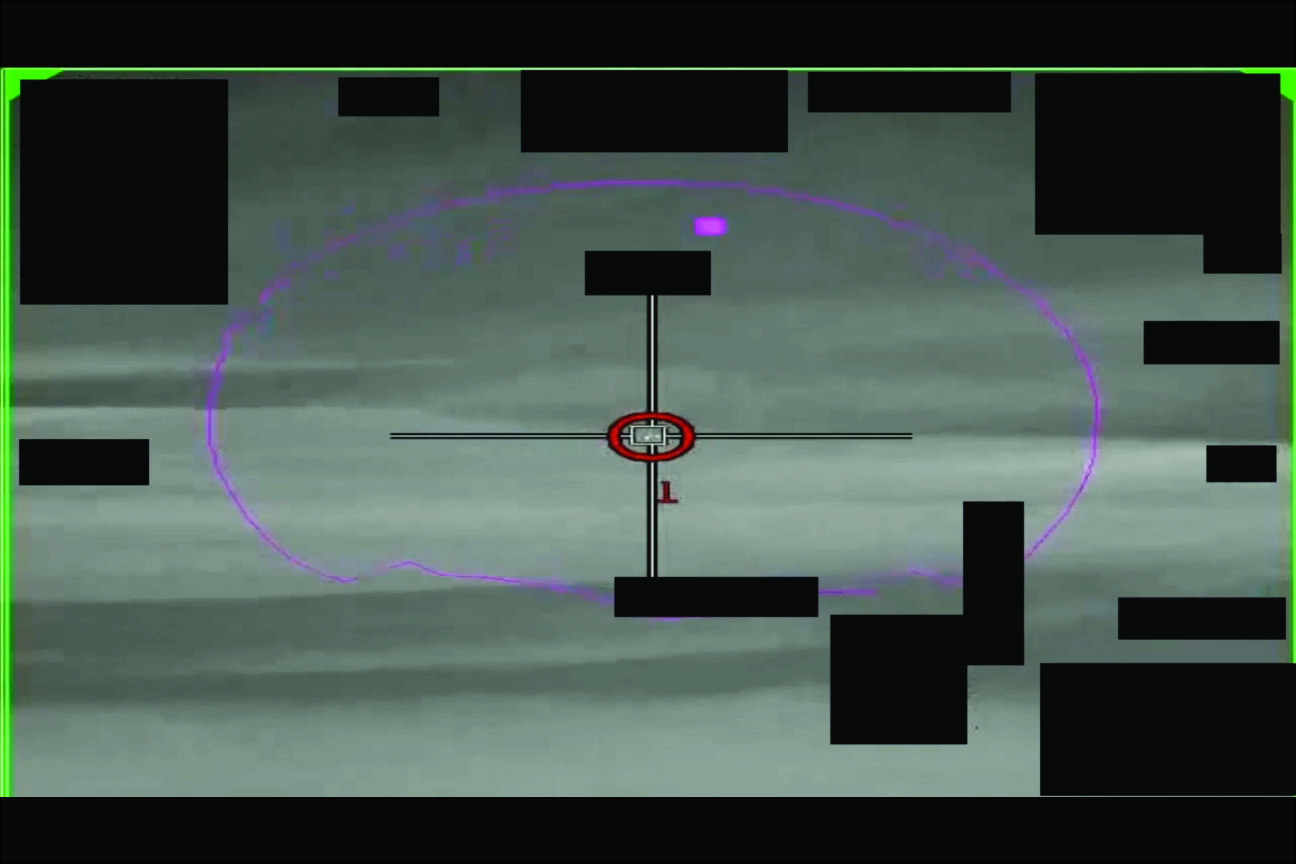
- Targeting pod: Two significant IR (infrared) contacts were detected (2 IR Significant Contacts).
- Contact count: 2 objects in the group.
- Visual acquisition: The tally obtained consisted of two red blinking strobes (2X Red Blinking Strobes).
- Movement: The objects moved on a heading of 060 at 20 knots (060/20).
- AIM-9X Self-Track: Not employed.
- ATFLIR Autotrack: Not employed.
Anomalous Behavior — The Core of the Incident
The most dramatic detail in the document appears in the pilot's free-text narrative description:
"One range fouler was circling around the other. In 1/30th of a second, they were gone."
This description points to a maneuver impossible for any known aircraft. Circular flight followed by instantaneous disappearance in 1/30th of a second — roughly 33 milliseconds — falls far outside the performance envelope of any known aviation system, manned or unmanned. In context, the minimum velocity needed to physically vacate a volume of airspace in so brief a window would imply acceleration forces incompatible with any known technology.
Electronic Jamming
In addition to the anomalous physical behavior, two electronic phenomena were reported:
- Noise jamming: Active electronic jamming was received. This phenomenon indicates that the objects (or a nearby source) were emitting deliberate electromagnetic interference.
- Indication: The jamming was confirmed by two chevrons displayed on the aircraft's systems.
- EA Indications box: The entry "Other/Ambiguous" is checked, indicating the jamming signature did not match a known pattern.
Noise jamming is a recognized electronic-warfare technique typically employed by military aircraft or ground-based systems. Its presence raises the question of attribution: can it be assigned to a known platform, or does it originate from an unidentified threat?
Visual Characteristics
From the visual-descriptor checkboxes in the form, the objects were characterized as:
- Metallic: Yes
- Balloon-shaped: Yes
- Other shape: Yes
- Opaque: Yes
- Reflective: Yes
- Wings / frame: No
- Moving parts: No
- Apparent propulsion: No
- Round: No
- Square: No
- Identifying markings: No
This combination — metallic, reflective, balloon-shaped, no visible propulsion, no wings — alongside active jamming and physically inexplicable movement, produces a strikingly anomalous profile.
The SPEAR Program and Reporting Procedures
The form references the SPEAR program, a range-fouler reporting system that consolidates data across DCA forces. SPEAR synthesizes identifying information from pilots and squadrons and preserves the data for analysis. The requirement to retain display tapes and upload WMV files to a data repository reveals that a genuine institutional infrastructure exists for collecting evidence from UAP encounters in real time.
Significance
Document D58 represents raw military testimony recorded close in time to the encounter itself, and it contains three anomalous elements simultaneously: unexplained physical behavior (disappearance in 1/30th of a second), active electronic warfare (noise jamming), and anomalous visual characteristics (metallic, balloon-shaped, no visible propulsion). The document's release in 2026 under USCENTCOM and its approval for transfer to AARO reinforce its standing as part of a serious, centrally managed body of evidence for the study of the phenomenon.
Key People
- Reporting pilot: O-3, 77 EFS (name redacted)
- KINGPIN: Mission commander who directed identification of the unknown contact
- MG Richard A. Harrison: General officer who authorized release of the document
Locations
- Contact location: Not provided (contact field blank, likely redacted)
- Navigation reference: B/E ZIM 248/17 (bullseye point for initial detection)
- Altitude: 26,000 feet
- Squadron: 77 EFS (base location not stated)
Incidents
| Incident | Date | Location | Pages |
|---|---|---|---|
| Nighttime encounter with 2 UAP; radar lock and targeting-pod video; noise jamming; disappearance in 1/30th of a second | Oct 27, 2020, 01:12:21Z | Unknown (B/E ZIM 248/17), altitude 26,000 ft | 1 |
Notable Quotes
"ONE RANGE FOULER WAS CIRCLING AROUND THE OTHER. IN 1/30TH OF A SECOND, THEY WERE GONE."
"TALLY ACHIEVED WAS 2X RED BLINKING STROBES AND NOISE JAMMING WAS RECIEVED. NOISE JAMMING WAS INDICATED BY TWO CHEVRONS."
"KINGPIN DIRECTED ID OF UNKNOWN CONTACT. OBTAINED RADAR LOCK AND TARGET POD VIDEO BUT UNABLE TO GET CLOSER THAN 16.9NM TO GET A BETTER ID."
Images
1 image - click any image to enlarge
Related Articles
- DoW/DoD · 2023
AARO Unresolved Case Analysis Update: The Western U.S. "Orbs Launching Orbs" Event, 2023
A signed All-domain Anomaly Resolution Office (AARO) Memorandum for Record, dated 05 June 2026 and signed by Director Jon T. Kosloski, summarizing the agency's ongoing…
- DoW/DoD · 2022
Unresolved UAP Report DOW-UAP-PR20: Digitally Annotated Still Image, Kuwait, May 2022
An Unresolved UAP Report (PR series) submitted by USCENTCOM to AARO, consisting of a single still image captured by a U.S. military sensor system in…
- DoW/DoD · 2023
Witness 1 Narrative: The Western U.S. Event, October 2023
The first-hand, free-form narrative of Witness 1 — one of several U.S. federal law enforcement special agents who reported unidentified anomalous phenomena over two days…
- DoW/DoD · 2023
Witness 2 Narrative: The Western U.S. Event, October 2023
The longest and most detailed first-hand narrative in the Western U.S. Event, from Witness 2 — a U.S. federal law enforcement special agent who, with…