Mission Report DOW-UAP-D7: UAP Observation in the Arabian Gulf, 2020
Source file: dow-uap-d7-mission-report-arabian-gulf-2020.pdf Originating agency: Department of War / Department of Defense Date range: 2020 (precise date withheld by redaction) Page count: 6 (all read) High-significance pages: Page 6 (the only page with readable text)
Official Blurb (from war.gov)
This document is a Mission Report (MISREP), a standardized reporting form the U.S. Military uses to record the circumstances surrounding its operations. U.S. military services often use MISREPs to report Unidentified Anomalous Phenomena (UAP) to AARO. The GENTEXT section of these reports often contains important qualitative, contextual information.
Summary
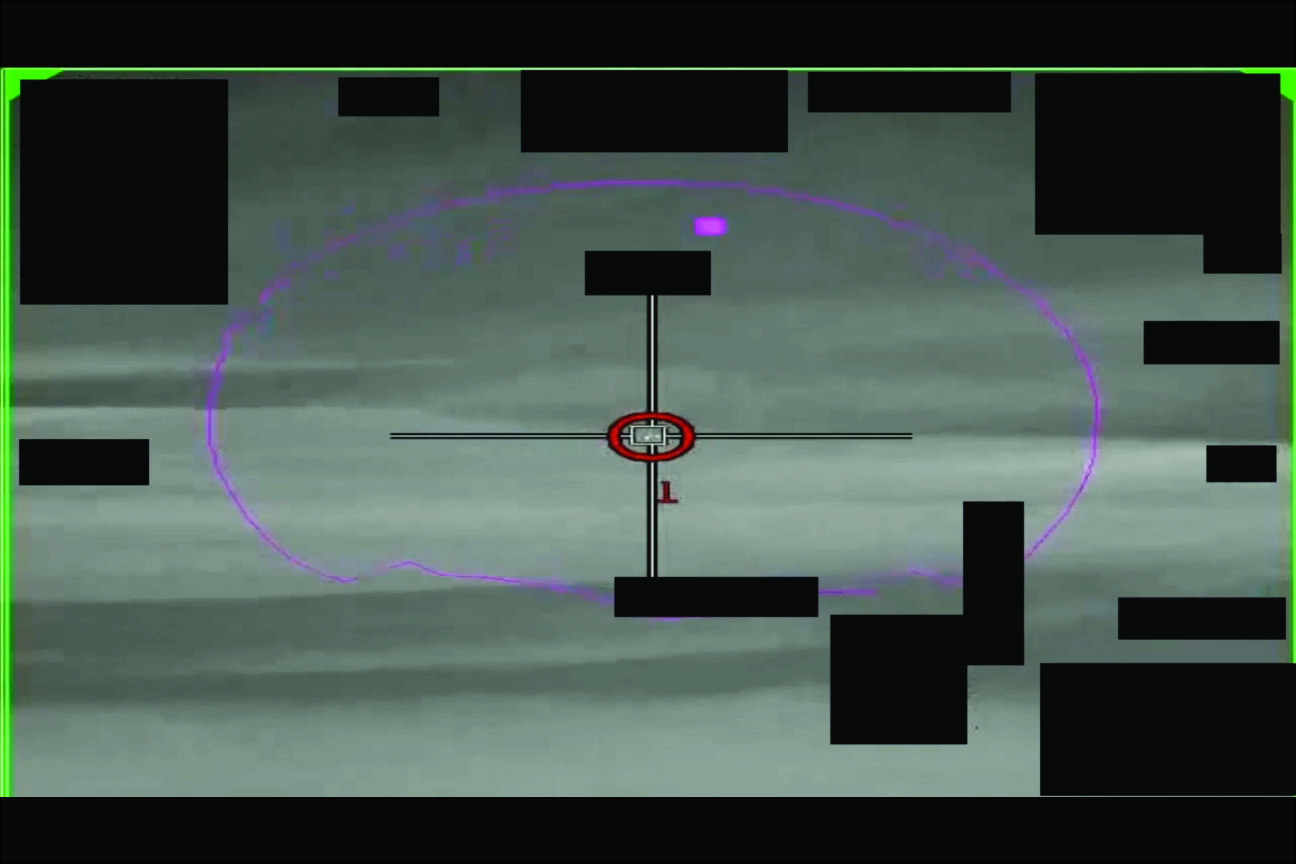
Mission Report DOW-UAP-D7 documents a single observation of an unidentified aerial object in the Arabian Gulf in 2020. The first five pages of the document are withheld in full under FOIA exemption 1.4(a), which protects classified information whose disclosure could damage national security. Page 6 contains the only readable operational report: a description of a balloon-like object at approximately 31,000 feet MSL traveling with the winds. The crew obtained a weapons-quality radar track and a visual identification via the TFLIR targeting pod.
Research Article
Introduction
File DOW-UAP-D7 is part of the hundreds of documents published by the U.S. Department of War under the PURSUE Initiative Release 1 on May 8, 2026. The document series, D1 through D75, records U.S. military UAP observations over recent decades. Report D7 is a brief, functional document — part of a broader cluster of Arabian Gulf reports from 2020 (D3 through D8) — reflecting an intensive observation period by Air Force aircraft in that region.
The document is classified SECRET/NOFORN and was released under FOIA exemptions, with most content withheld pursuant to section 1.4(a) of Executive Order 13526. That section protects "intelligence activities, sources, methods, and cryptology" whose disclosure is expected to cause damage to national security.
The UAP Incident
Page 6 of the report — the only readable portion — contains the GENTEXT (general text) section of the UAP event. The key points are:
Object description: "LOOKS LIKE A BALLOON, SIMILAR TO PREVIOUSLY REPORTED UAP FROM 48FW" — the object appeared balloon-like and resembled a prior report from the 48th Fighter Wing. The 48 FW (48th Fighter Wing, "Liberty Wing") is a U.S. Air Force combat unit based at RAF Lakenheath in England, operating F-15E Strike Eagle aircraft. The reference to a prior 48 FW report indicates that UAP reports cross unit boundaries and serve as comparative baselines within the Air Force.
Incident description: "OBSERVED A WEAPONS QUALITY 1 TRACK OF A UAP TRAVELING WITH THE WINDS AT 31,000 FT MSL IVO 323'S" — a weapons-quality radar track (Weapons Quality 1 Track) was obtained of a UAP traveling with the winds at 31,000 feet MSL in the vicinity of position 323'S. The term "Weapons Quality Track" denotes a radar track of sufficient clarity and stability to support weapon system engagement — meaning the object was detected on radar in a clear and stable manner.
Visual identification: "WAS ABLE TO MAKE A NEXT TO SHOOT ON THE TRACK AND VISUALLY ID THE UAP IN THE TFLIR" — the crew performed a "Next to Shoot" (targeting solution preparation) on the track and visually identified the UAP through the TFLIR (Targeting Forward-Looking Infrared) pod. A visual infrared identification confirms the physical presence of the object and is consistent with the "balloon-like" characterization.
The Logic of "Traveling with the Winds"
The phrase "TRAVELING WITH THE WINDS" is key to understanding this classification. A balloon-like or passively buoyant object moves with the prevailing wind at its altitude. That behavior does not indicate controlled propulsion. In contrast to other UAP reports in the series — such as D62 and D63 from the Strait of Hormuz, where rapid maneuvers, unexplained accelerations, and sudden course changes were observed — the D7 UAP displays none of those anomalous characteristics. Even so, it warranted a MISREP filing, reflecting military reporting methodology: report every object that is not positively identified, regardless of how mundane it may appear.
Altitude and Operational Context
An altitude of 31,000 feet MSL falls within the normal operating envelope of modern jet fighters but also within the range used by atmospheric research balloons, meteorological balloons, and occasionally surveillance balloons. The fact that the crew could obtain a weapons-quality track and a TFLIR identification indicates an object of measurable size and infrared signature, though not anomalous in terms of its flight altitude.
Significance
D7 presents a borderline case on several dimensions. First, it illustrates the military reporting philosophy of "anything unidentified is a UAP" — even an object that appears to be a balloon. Second, it confirms that UAP reports cross unit and geographic lines: a prior 48 FW sighting (UK-based) serves as a comparison point for an Arabian Gulf observation. Third, it demonstrates the limitations of the FOIA process: five of six pages are withheld, severely constraining public understanding of the full operational context. Fourth, it offers the public a narrow window into the functioning of modern sensor systems — TFLIR and weapons-quality radar — and the reporting protocols applied to such data.
Comparison with the Arabian Gulf Series
Taken together, reports D3 through D8 — all from the Arabian Gulf, 2020 — paint a picture of intensive UAP activity in that region over a period of several months. The Arabian Gulf is a strategic flashpoint: American, British, and French naval assets operate there continuously, Iranian provocation is a recurring factor, and commercial air traffic is dense. The frequency of UAP reports in this environment may reflect the density of radar and sensor coverage as much as any genuine anomaly in the phenomenon itself.
Key People
No names were identified in the document. All personal identifiers were withheld by redaction.
Locations
- Arabian Gulf — area of operations; the Persian Gulf zone of sustained U.S. military presence
- RAF Lakenheath, England — home of the 48 FW, the unit referenced in the prior comparison sighting
Incidents
| Incident | Date | Location | Pages |
|---|---|---|---|
| Balloon-like UAP observed at 31,000 ft, weapons-quality radar track, TFLIR visual ID | 2020 (precise date withheld) | Arabian Gulf | Page 6 |
Notable Quotes
"LOOKS LIKE A BALLOON, SIMILAR TO PREVIOUSLY REPORTED UAP FROM 48FW" — page 6
"OBSERVED A WEAPONS QUALITY 1 TRACK OF A UAP TRAVELING WITH THE WINDS AT 31,000 FT MSL IVO 323'S" — page 6
"WAS ABLE TO MAKE A NEXT TO SHOOT ON THE TRACK AND VISUALLY ID THE UAP IN THE TFLIR" — page 6
Images
1 image - click any image to enlarge
Related Articles
- DoW/DoD · 2020-07-16
Mission Report DOW-UAP-D65: Three UAP Observations in the Persian Gulf, July 16, 2020
USCENTCOM Mission Report Misrep 4472514 documents three separate observations of an unidentified aerial phenomenon during a single ISR sortie over the Persian Gulf, the Strait…
- DoW/DoD · 2020-09-15
Mission Report DOW-UAP-D62: UAP Observation, Link-Loss Events, and Iranian Air-Defense Intercepts over the Strait of Hormuz, September 2020
Mission Report MISREP 4782130 from the U.S. Air Force 482 ATKS / 432 AEW documents an intense 21-hour ISR sortie over the Strait of Hormuz…
- DoW/DoD · 2020
Range Fouler Debrief Form — Middle East Theater, May 2020
This document is a Range Fouler Debrief Form re-reviewed for release by Brigadier General Richard A. Harrison, USCENTCOM Chief of Staff. It records a UAP…
- DoW/DoD · 2020
Mission Report: Formation of Unknown Flying Objects over the Persian Gulf, August 2020
MISREP number 4685903, filed by the 482 ATKS unit of the 432 AEW under USCENTCOM, documents a 21-hour ISR/SIGINT sortie over the Arabian Gulf, Strait…