Mission Report DOW-UAP-D8: Two Round White-Hot UAP over Djibouti, 2025
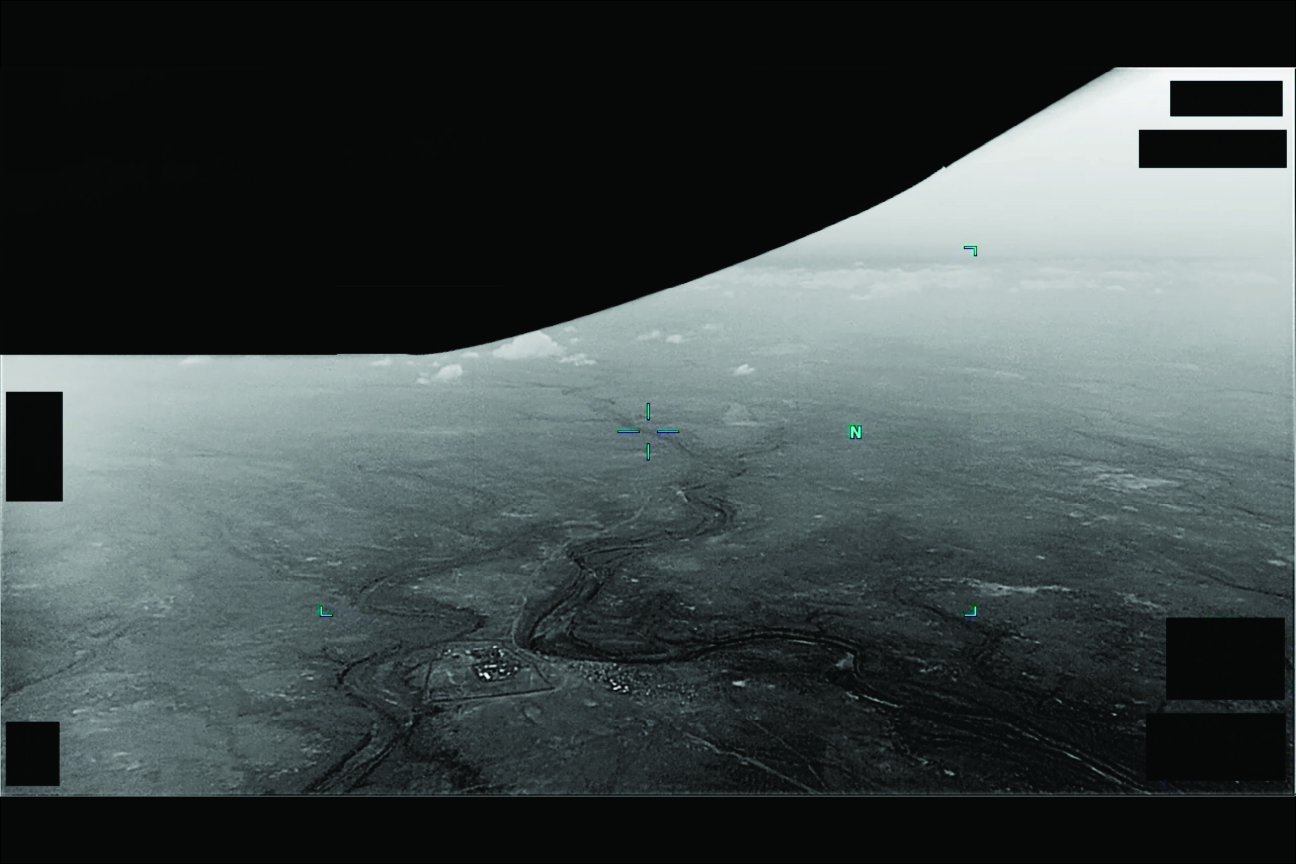
Source file: dow-uap-d8-mission-report-djibouti-2025.pdf Originating agency: Department of War / Department of Defense Date range: 2025 (precise date withheld by redaction) Page count: 7 (all read) High-significance pages: page 7 (GENTEXT/UAP — the only readable page)
Official Blurb (from war.gov)
This document is a Mission Report (MISREP), a standardized reporting form the U.S. Military uses to record the circumstances surrounding its operations. U.S. military services often use MISREPs to report Unidentified Anomalous Phenomena (UAP) to AARO. The GENTEXT section of these reports often contains important qualitative, contextual information.
Summary
The DOW-UAP-D8 mission report documents an observation of two unidentified anomalous phenomena (UAP) over Djibouti, in the Horn of Africa, during 2025. The first six pages of the document are withheld in their entirety under FOIA exemption 1.4(a). Page 7 contains the only readable operational entry: at 1653Z, two round, white-hot objects were observed moving dynamically southward at approximately 240 knots. The event location is partially redacted, but the military grid coordinate MGRS 35SQT34236 92957 was preserved.
Research Article
Introduction
File DOW-UAP-D8 is part of the PURSUE Initiative Release 1 series, published by the Department of War on May 8, 2026. The series runs from D1 through D75 and contains U.S. military reports on UAP phenomena spanning recent decades. Report D8 specifically documents an event from 2025 — the precise date withheld — in the airspace over Djibouti, a strategically vital republic situated at the Bab el-Mandeb strait in the Horn of Africa.
Djibouti holds exceptional military significance for the United States. It is home to Camp Lemonnier, the only permanent U.S. military base in sub-Saharan Africa, which hosts the Combined Joint Task Force — Horn of Africa (CJTF-HOA). The base serves as an operational hub for counterterrorism missions and as a critical force-projection node. A UAP observation over such an active operational environment carries considerable weight.
The UAP incident
Page 7 of the report, the only readable section, contains the brief GENTEXT entry. The key data points are as follows.
Time of the event: 1653Z (Zulu, i.e., UTC). Djibouti is UTC+3, placing this observation at approximately 1953 local time — at or shortly after sunset.
Object description: "OBS 2X ROUND WHITE HOT UAPS DYNAMIC SOUTH AT APPROX 240NM/HOUR" — an observation of two round, white-hot UAP moving dynamically southward at approximately 240 nautical miles per hour. The designation "WHITE HOT" is standard infrared imaging terminology (FLIR/TFLIR), where surfaces warmer than their surroundings appear white. The sensor was detecting these objects through their thermal signature rather than, or in addition to, their visible-light appearance.
Speed: 240 knots equates to approximately 444 km/h (276 mph). This is within the range of large civilian airliners in cruise, slower military aircraft, or modern large uncrewed systems — not an inherently exceptional speed in isolation.
Geometry and motion: "DYNAMIC SOUTH" indicates motion that is purposeful or maneuvering rather than passive drift. The term suggests directional activity beyond simple linear transit, potentially implying course changes or non-uniform flight behavior. Two objects moving together in coordinated fashion is independently noteworthy.
Location: The MGRS coordinate 35SQT34236 92957 is partially redacted. The "35S" designator corresponds to UTM zone 35S, which covers portions of East Africa, the Arabian Peninsula, and adjacent areas. Combined with the Djibouti heading, this points to a position near the Bab el-Mandeb straits or the southern Red Sea.
The thermal signature as evidence
The "WHITE HOT" designation carries analytical weight. Objects appearing white in infrared imaging are warmer than their environment. The maritime and desert environment around Djibouti undergoes significant cooling after sunset. An airborne object still emitting notable infrared radiation at that hour could indicate:
- Active propulsion — an engine generating heat
- Aerodynamic heating — speed-induced friction
- Internal heat source — electronics, batteries, or another onboard system
- A dark surface that absorbed solar energy during the day and is still radiating it
None of these explanations is mutually exclusive, but together they rule out interpretations based on cool or passive objects such as balloons or simple reflectors.
Comparison with other Horn of Africa observations
D8 is the second report in the D-series with a Horn of Africa focus. Report D75 documents an observation over the Gulf of Aden in July 2024, and report D57 covers an encounter there in September 2020. Together, the three paint a picture of recurring UAP activity in a narrow band of strategically critical waterway between Africa and the Arabian Peninsula, centered on the Bab el-Mandeb chokepoint.
Significance
D8 is notable for several reasons. First, it is a recent 2025 report — one of the latest events in the series prior to Release 1 in May 2026 — which means it reflects current-era observation and documentation standards. Second, the number of objects (two) is significant in its own right; reports of multiple objects moving in coordination are less common than single-object sightings and raise distinct questions about the nature of the phenomenon — whether the objects are coordinated platforms, components of a larger system, or a single phenomenon that presents as multiple contacts. Third, the geographic area — Djibouti and the Horn of Africa — is a multinational friction point where the United States, France, China, Japan, and Italy all maintain military facilities. Recurring UAP observations in such an environment warrant sustained analytical attention.
Key People
No names were identified in the document. All personal identifiers are withheld by redaction.
Locations
- Djibouti — Republic in the Horn of Africa, adjacent to the Bab el-Mandeb strait
- Camp Lemonnier — sole U.S. permanent military base in sub-Saharan Africa
- Horn of Africa — strategic zone along the southern Red Sea
Incidents
| Incident | Date | Location | Pages |
|---|---|---|---|
| Observation of 2 round white-hot UAP moving south at 240 knots | 1653Z; precise date withheld, 2025 | Djibouti, MGRS 35SQT34236 92957 | page 7 |
Notable Quotes
"OBS 2X ROUND WHITE HOT UAPS DYNAMIC SOUTH AT APPROX 240NM/HOUR IVO 35SQT3423692957" — page 7
Images
1 image - click any image to enlarge
Related Articles
- DoW/DoD · 2023
AARO Unresolved Case Analysis Update: The Western U.S. "Orbs Launching Orbs" Event, 2023
A signed All-domain Anomaly Resolution Office (AARO) Memorandum for Record, dated 05 June 2026 and signed by Director Jon T. Kosloski, summarizing the agency's ongoing…
- DoW/DoD · 2022
Unresolved UAP Report DOW-UAP-PR20: Digitally Annotated Still Image, Kuwait, May 2022
An Unresolved UAP Report (PR series) submitted by USCENTCOM to AARO, consisting of a single still image captured by a U.S. military sensor system in…
- DoW/DoD · 2023
Witness 1 Narrative: The Western U.S. Event, October 2023
The first-hand, free-form narrative of Witness 1 — one of several U.S. federal law enforcement special agents who reported unidentified anomalous phenomena over two days…
- DoW/DoD · 2023
Witness 2 Narrative: The Western U.S. Event, October 2023
The longest and most detailed first-hand narrative in the Western U.S. Event, from Witness 2 — a U.S. federal law enforcement special agent who, with…